Facebook Instagram Youtube Twitter

Mercury – Properties – Price – Applications – Production

Mercury-properties-price-application-production

About Mercury

Mercury is commonly known as quicksilver and was formerly named hydrargyrum. Mercury is a heavy, silvery d-block element, mercury is the only metallic element that is liquid at standard conditions for temperature and pressure

Summary

Element Mercury
Atomic number 80
Element category Transition Metal
Phase at STP Liquid
Density 13.534 g/cm3
Ultimate Tensile Strength N/A
Yield Strength N/A
Young’s Modulus of Elasticity N/A
Mohs Scale N/A
Brinell Hardness N/A
Vickers Hardness N/A
Melting Point -38.9 °C
Boiling Point 357 °C
Thermal Conductivity 8.3 W/mK
Thermal Expansion Coefficient 60.4 µm/mK
Specific Heat 0.139 J/g K
Heat of Fusion 2.295 kJ/mol
Heat of Vaporization 59.229 kJ/mol
Electrical resistivity [nanoOhm meter] 961
Magnetic Susceptibility −33.4e-6 cm^3/mol

Applications of Mercury

Mercury is used primarily for the manufacture of industrial chemicals or for electrical and electronic applications. However, because of its toxicity, many uses of mercury are being phased out or are under review. It is used in some thermometers, especially ones which are used to measure high temperatures. Mercury easily forms alloys, called amalgams, with other metals such as gold, silver and tin. The ease with which it amalgamates with gold made it useful in recovering gold from its ores. Mercury amalgams were also used in dental fillings. Gaseous mercury is used in mercury-vapor lamps and some “neon sign” type advertising signs and fluorescent lamps.

Mercury-applications

Production and Price of Mercury

Raw materials prices change daily. They are primarily driven by supply, demand and energy prices. In 2019, prices of pure Mercury were at around 50 $/kg.

The price of mercury has been highly volatile over the years and in 2006 was $650 per 76-pound (34.46 kg) flask. Mercury is extracted by heating cinnabar in a current of air and condensing the vapor. The equation for this extraction is: HgS + O2 → Hg + SO2 In 2005, China was the top producer of mercury with almost two-thirds global share followed by Kyrgyzstan. Several other countries are believed to have unrecorded production of mercury from copper electrowinning processes and by recovery from effluents.
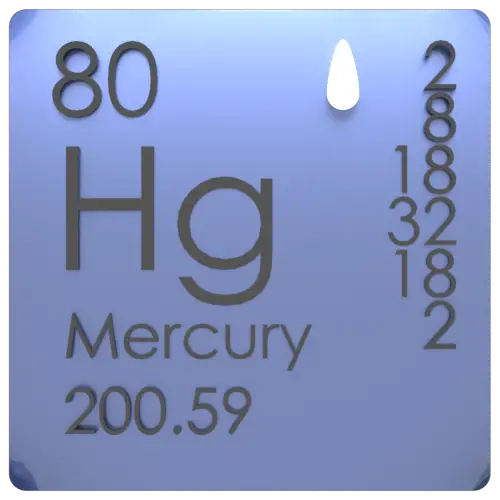
Mercury-periodic-table

Source: www.luciteria.com

Mechanical Properties of Mercury

Mercury-mechanical-properties-strength-hardness-crystal-structure

Strength of Mercury

In mechanics of materials, the strength of a material is its ability to withstand an applied load without failure or plastic deformation. Strength of materials basically considers the relationship between the external loads applied to a material and the resulting deformation or change in material dimensions. In designing structures and machines, it is important to consider these factors, in order that the material selected will have adequate strength to resist applied loads or forces and retain its original shape. Strength of a material is its ability to withstand this applied load without failure or plastic deformation.

For tensile stress, the capacity of a material or structure to withstand loads tending to elongate is known as ultimate tensile strength (UTS). Yield strength or yield stress is the material property defined as the stress at which a material begins to deform plastically whereas yield point is the point where nonlinear (elastic + plastic) deformation begins.

See also: Strength of Materials

Ultimate Tensile Strength of Mercury

Ultimate tensile strength of Mercury is N/A.

Yield Strength of Mercury

Yield strength of Mercury is N/A.

Modulus of Elasticity of Mercury

The Young’s modulus of elasticity of Mercury is N/A.

Hardness of Mercury

In materials science, hardness is the ability to withstand surface indentation (localized plastic deformation) and scratching. Brinell hardness test is one of indentation hardness tests, that has been developed for hardness testing. In Brinell tests, a hard, spherical indenter is forced under a specific load into the surface of the metal to be tested.

Brinell hardness of Mercury is approximately N/A.

The Vickers hardness test method was developed by Robert L. Smith and George E. Sandland at Vickers Ltd as an alternative to the Brinell method to measure the hardness of materials. The Vickers hardness test method can be also used as a microhardness test method, which is mostly used for small parts, thin sections, or case depth work.

Vickers hardness of Mercury is approximately N/A.

Scratch hardness is the measure of how resistant a sample is to permanent plastic deformation due to friction from a sharp object. The most common scale for this qualitative test is Mohs scale, which is used in mineralogy. The Mohs scale of mineral hardness is based on the ability of one natural sample of mineral to scratch another mineral visibly.

Mercury is has a hardness of approximately N/A.

See also: Hardness of Materials

Mercury – Crystal Structure

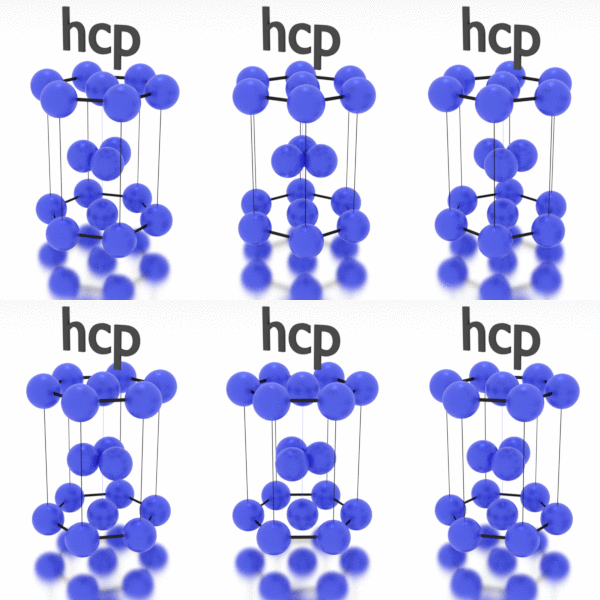
A possible crystal structure of Mercury is rhombohedral structure.
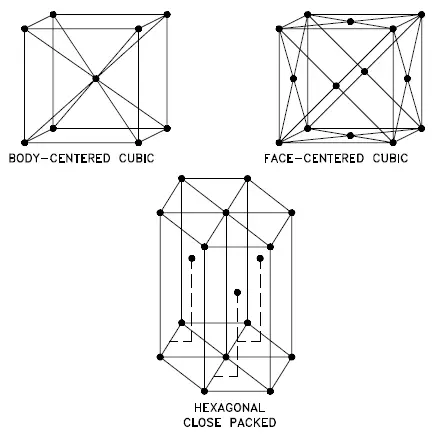
crystal structures - FCC, BCC, HCP

In metals, and in many other solids, the atoms are arranged in regular arrays called crystals. A crystal lattice is a repeating pattern of mathematical points that extends throughout space. The forces of chemical bonding causes this repetition. It is this repeated pattern which control properties like strength, ductility, density, conductivity (property of conducting or transmitting heat, electricity, etc.), and shape. There are 14 general types of such patterns known as Bravais lattices.

See also: Crystal Structure of Materials

Crystal Structure of Mercury
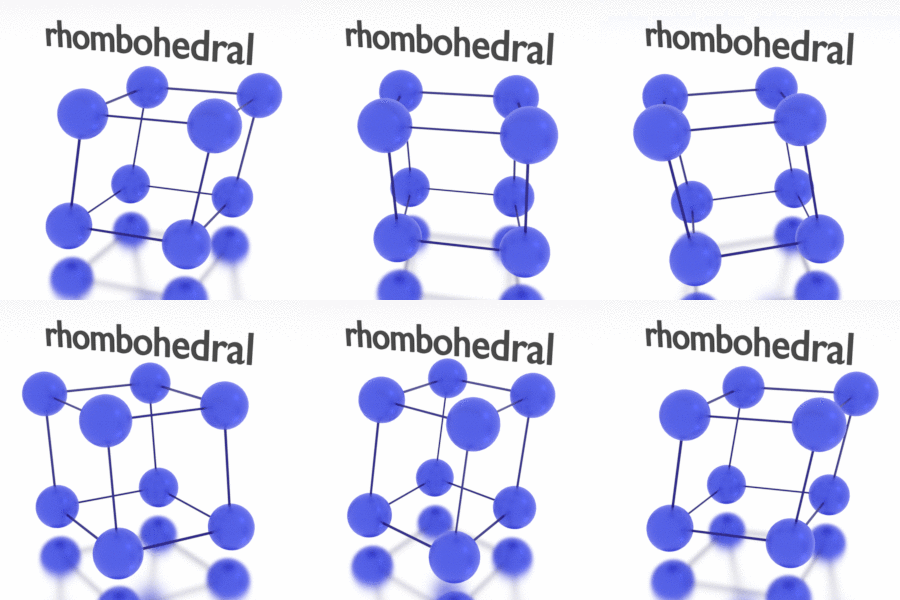
Crystal Structure of Mercury is: rhombohedral

Strength of Elements

Elasticity of Elements
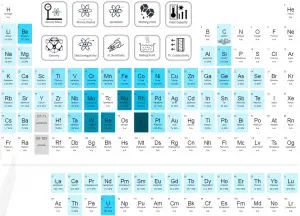
Hardness of Elements
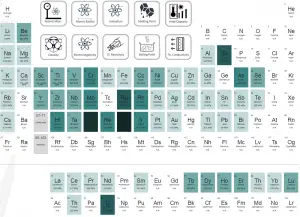
 

Thermal Properties of Mercury

Mercury-melting-point-conductivity-thermal-properties

Mercury – Melting Point and Boiling Point

Melting point of Mercury is -38.9°C.

Boiling point of Mercury is 357°C.

Note that, these points are associated with the standard atmospheric pressure.

Mercury – Thermal Conductivity

Thermal conductivity of Mercury is 8.3 W/(m·K).

The heat transfer characteristics of a solid material are measured by a property called the thermal conductivity, k (or λ), measured in W/m.K. It is a measure of a substance’s ability to transfer heat through a material by conduction. Note that Fourier’s law applies for all matter, regardless of its state (solid, liquid, or gas), therefore, it is also defined for liquids and gases.

Coefficient of Thermal Expansion of Mercury

Linear thermal expansion coefficient of Mercury is 60.4 µm/(m·K)

Thermal expansion is generally the tendency of matter to change its dimensions in response to a change in temperature. It is usually expressed as a fractional change in length or volume per unit temperature change.

Mercury – Specific Heat, Latent Heat of Fusion, Latent Heat of Vaporization

Specific heat of Mercury is 0.139 J/g K.

Heat capacity is an extensive property of matter, meaning it is proportional to the size of the system. Heat capacity C has the unit of energy per degree or energy per kelvin. When expressing the same phenomenon as an intensive property, the heat capacity is divided by the amount of substance, mass, or volume, thus the quantity is independent of the size or extent of the sample.

Latent Heat of Fusion of Mercury is 2.295 kJ/mol.

Latent Heat of Vaporization of Mercury is 59.229 kJ/mol.

Latent heat is the amount of heat added to or removed from a substance to produce a change in phase. This energy breaks down the intermolecular attractive forces, and also must provide the energy necessary to expand the gas (the pΔV work). When latent heat is added, no temperature change occurs. The enthalpy of vaporization is a function of the pressure at which that transformation takes place.

Melting Point of Elements
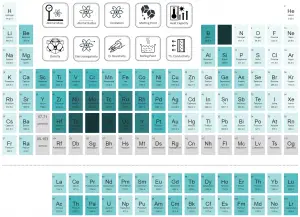
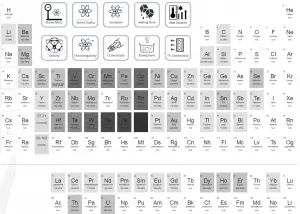
Periodic Table of Elements - melting point

Thermal Conductivity of Elements

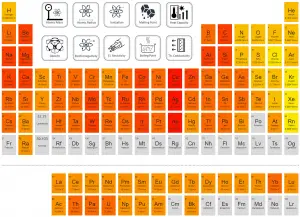
Periodic Table of Elements - thermal conductivity

Thermal Expansion of Elements

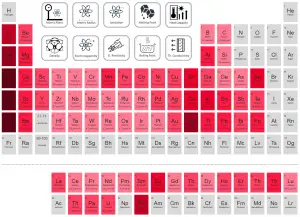
Periodic Table of Elements - thermal expansion

Heat Capacity of Elements

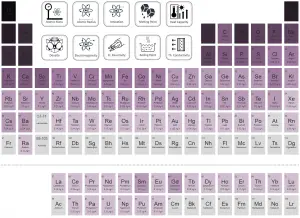
Periodic Table of Elements - heat capacity

Heat of Fusion of Elements

Periodic Table of Elements - latent heat fusion

Heat of Vaporization of Elements

Periodic Table of Elements - latent heat vaporization

Mercury – Electrical Resistivity – Magnetic Susceptibility

Mercury-electrical-resistivity-magnetic-susceptibility

Electrical property refers to the response of a material to an applied electric field. One of the principal characteristics of materials is their ability (or lack of ability) to conduct electrical current. Indeed, materials are classified by this property, that is, they are divided into conductors, semiconductors, and nonconductors.

See also: Electrical Properties

Magnetic property refers to the response of a material to an applied magnetic field. The macroscopic magnetic properties of a material are a consequence of interactions between an external magnetic field and the magnetic dipole moments of the constituent atoms. Different materials react to the application of magnetic field differently.

See also: Magnetic Properties

Electrical Resistivity of Mercury

Electrical resistivity of Mercury is 961 nΩ⋅m.

Electrical conductivity and its converse, electrical resistivity, is a fundamental property of a material that quantifies how Mercury conducts the flow of electric current. Electrical conductivity or specific conductance is the reciprocal of electrical resistivity.

Magnetic Susceptibility of Mercury

Magnetic susceptibility of Mercury is −33.4e-6 cm^3/mol.

In electromagnetism, magnetic susceptibility is the measure of the magnetization of a substance. Magnetic susceptibility is a dimensionless proportionality factor that indicates the degree of magnetization of Mercury in response to an applied magnetic field.

Electrical Resistivity of Elements
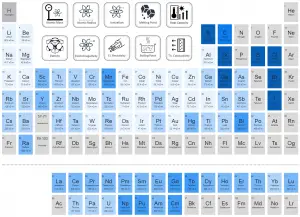
Periodic Table of Elements - electrical resistivity

Magnetic Susceptibility of Elements

Application and prices of other elements

Mercury - Comparison of Properties and Prices

Periodic Table in 8K resolution

Other properties of Mercury


Gold – Properties – Price – Applications – Production

Gold-properties-price-application-production

About Gold

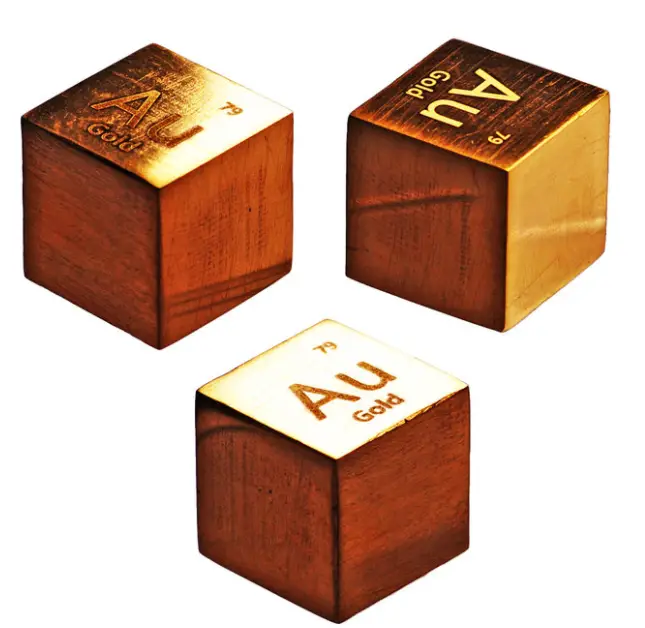
Gold is a bright, slightly reddish yellow, dense, soft, malleable, and ductile metal. Gold is a transition metal and a group 11 element. It is one of the least reactive chemical elements and is solid under standard conditions. Gold is thought to have been produced in supernova nucleosynthesis, from the collision of neutron stars.

Summary

Element Gold
Atomic number 79
Element category Transition Metal
Phase at STP Solid
Density 19.3 g/cm3
Ultimate Tensile Strength 220 MPa
Yield Strength 205 MPa
Young’s Modulus of Elasticity 79 GPa
Mohs Scale 2.75
Brinell Hardness 190 MPa
Vickers Hardness 215 MPa
Melting Point 1064 °C
Boiling Point 2970 °C
Thermal Conductivity 320 W/mK
Thermal Expansion Coefficient 14.2 µm/mK
Specific Heat 0.128 J/g K
Heat of Fusion 12.55 kJ/mol
Heat of Vaporization 334.4 kJ/mol
Electrical resistivity [nanoOhm meter] 22.14
Magnetic Susceptibility −28e-6 cm^3/mol

Applications of Gold

Gold is used extensively in jewellery, either in its pure form or as an alloy. About 75% of all gold produced is used in the jewelry industry. Pure gold is too soft to stand up to the stresses applied to many jewelry items. Craftsmen learned that alloying gold with other metals such as copper, silver, and platinum would increase its durability. The term ‘carat’ indicates the amount of gold present in an alloy. 24-carat is pure gold, but it is very soft. 18- and 9-carat gold alloys are commonly used because they are more durable. Gold’s high malleability, ductility, resistance to corrosion and most other chemical reactions, and conductivity of electricity have led to its continued use in corrosion resistant electrical connectors in all types of computerized devices (its chief industrial use). Gold is also used in infrared shielding, colored-glass production, gold leafing, and tooth restoration. Only 10% of the world consumption of new gold produced goes to industry, but by far the most important industrial use for new gold is in fabrication of corrosion-free electrical connectors in computers and other electrical devices.

Gold-applications

Production and Price of Gold

Raw materials prices change daily. They are primarily driven by supply, demand and energy prices. In 2019, prices of pure Gold were at around 49900 $/kg.

Hard rock gold mining extracts gold encased in rock, rather than fragments in loose sediment, and produces most of the world’s gold. In 2017, the world’s largest gold producer by far was China with 440 tonnes. The second-largest producer, Australia, mined 300 tonnes in the same year, followed by Russia with 255 tonnes.

Gold-periodic-table

Source: www.luciteria.com

Mechanical Properties of Gold

Gold-mechanical-properties-strength-hardness-crystal-structure

Strength of Gold

In mechanics of materials, the strength of a material is its ability to withstand an applied load without failure or plastic deformation. Strength of materials basically considers the relationship between the external loads applied to a material and the resulting deformation or change in material dimensions. In designing structures and machines, it is important to consider these factors, in order that the material selected will have adequate strength to resist applied loads or forces and retain its original shape. Strength of a material is its ability to withstand this applied load without failure or plastic deformation.

For tensile stress, the capacity of a material or structure to withstand loads tending to elongate is known as ultimate tensile strength (UTS). Yield strength or yield stress is the material property defined as the stress at which a material begins to deform plastically whereas yield point is the point where nonlinear (elastic + plastic) deformation begins.

See also: Strength of Materials

Ultimate Tensile Strength of Gold

Ultimate tensile strength of Gold is 220 MPa.

Yield Strength of Gold

Yield strength of Gold is 205 MPa.

Modulus of Elasticity of Gold

The Young’s modulus of elasticity of Gold is 205 MPa.

Hardness of Gold

In materials science, hardness is the ability to withstand surface indentation (localized plastic deformation) and scratching. Brinell hardness test is one of indentation hardness tests, that has been developed for hardness testing. In Brinell tests, a hard, spherical indenter is forced under a specific load into the surface of the metal to be tested.

Brinell hardness of Gold is approximately 190 MPa.

The Vickers hardness test method was developed by Robert L. Smith and George E. Sandland at Vickers Ltd as an alternative to the Brinell method to measure the hardness of materials. The Vickers hardness test method can be also used as a microhardness test method, which is mostly used for small parts, thin sections, or case depth work.

Vickers hardness of Gold is approximately 215 MPa.

Scratch hardness is the measure of how resistant a sample is to permanent plastic deformation due to friction from a sharp object. The most common scale for this qualitative test is Mohs scale, which is used in mineralogy. The Mohs scale of mineral hardness is based on the ability of one natural sample of mineral to scratch another mineral visibly.

Gold is has a hardness of approximately 2.75.

See also: Hardness of Materials

Gold – Crystal Structure

A possible crystal structure of Gold is face-centered cubic structure.

crystal structures - FCC, BCC, HCP

In metals, and in many other solids, the atoms are arranged in regular arrays called crystals. A crystal lattice is a repeating pattern of mathematical points that extends throughout space. The forces of chemical bonding causes this repetition. It is this repeated pattern which control properties like strength, ductility, density, conductivity (property of conducting or transmitting heat, electricity, etc.), and shape. There are 14 general types of such patterns known as Bravais lattices.

See also: Crystal Structure of Materials

Crystal Structure of Gold
Crystal Structure of Gold is: face-centered cubic

Strength of Elements

Elasticity of Elements

Hardness of Elements


Thermal Properties of Gold

Gold-melting-point-conductivity-thermal-properties

Gold – Melting Point and Boiling Point

Melting point of Gold is 1064°C.

Boiling point of Gold is 2970°C.

Note that, these points are associated with the standard atmospheric pressure.

Gold – Thermal Conductivity

Thermal conductivity of Gold is 320 W/(m·K).

The heat transfer characteristics of a solid material are measured by a property called the thermal conductivity, k (or λ), measured in W/m.K. It is a measure of a substance’s ability to transfer heat through a material by conduction. Note that Fourier’s law applies for all matter, regardless of its state (solid, liquid, or gas), therefore, it is also defined for liquids and gases.

Coefficient of Thermal Expansion of Gold

Linear thermal expansion coefficient of Gold is 14.2 µm/(m·K)

Thermal expansion is generally the tendency of matter to change its dimensions in response to a change in temperature. It is usually expressed as a fractional change in length or volume per unit temperature change.

Gold – Specific Heat, Latent Heat of Fusion, Latent Heat of Vaporization

Specific heat of Gold is 0.128 J/g K.

Heat capacity is an extensive property of matter, meaning it is proportional to the size of the system. Heat capacity C has the unit of energy per degree or energy per kelvin. When expressing the same phenomenon as an intensive property, the heat capacity is divided by the amount of substance, mass, or volume, thus the quantity is independent of the size or extent of the sample.

Latent Heat of Fusion of Gold is 12.55 kJ/mol.

Latent Heat of Vaporization of Gold is 334.4 kJ/mol.

Latent heat is the amount of heat added to or removed from a substance to produce a change in phase. This energy breaks down the intermolecular attractive forces, and also must provide the energy necessary to expand the gas (the pΔV work). When latent heat is added, no temperature change occurs. The enthalpy of vaporization is a function of the pressure at which that transformation takes place.

Melting Point of Elements

Periodic Table of Elements - melting point

Thermal Conductivity of Elements

Periodic Table of Elements - thermal conductivity

Thermal Expansion of Elements

Periodic Table of Elements - thermal expansion

Heat Capacity of Elements

Periodic Table of Elements - heat capacity

Heat of Fusion of Elements

Periodic Table of Elements - latent heat fusion

Heat of Vaporization of Elements

Periodic Table of Elements - latent heat vaporization

Gold – Electrical Resistivity – Magnetic Susceptibility

Gold-electrical-resistivity-magnetic-susceptibility

Electrical property refers to the response of a material to an applied electric field. One of the principal characteristics of materials is their ability (or lack of ability) to conduct electrical current. Indeed, materials are classified by this property, that is, they are divided into conductors, semiconductors, and nonconductors.

See also: Electrical Properties

Magnetic property refers to the response of a material to an applied magnetic field. The macroscopic magnetic properties of a material are a consequence of interactions between an external magnetic field and the magnetic dipole moments of the constituent atoms. Different materials react to the application of magnetic field differently.

See also: Magnetic Properties

Electrical Resistivity of Gold

Electrical resistivity of Gold is 22.14 nΩ⋅m.

Electrical conductivity and its converse, electrical resistivity, is a fundamental property of a material that quantifies how Gold conducts the flow of electric current. Electrical conductivity or specific conductance is the reciprocal of electrical resistivity.

Magnetic Susceptibility of Gold

Magnetic susceptibility of Gold is −28e-6 cm^3/mol.

In electromagnetism, magnetic susceptibility is the measure of the magnetization of a substance. Magnetic susceptibility is a dimensionless proportionality factor that indicates the degree of magnetization of Gold in response to an applied magnetic field.

Electrical Resistivity of Elements

Periodic Table of Elements - electrical resistivity

Magnetic Susceptibility of Elements

Application and prices of other elements

Gold - Comparison of Properties and Prices

Periodic Table in 8K resolution

Other properties of Gold


Platinum – Properties – Price – Applications – Production

Platinum-properties-price-application-production

About Platinum

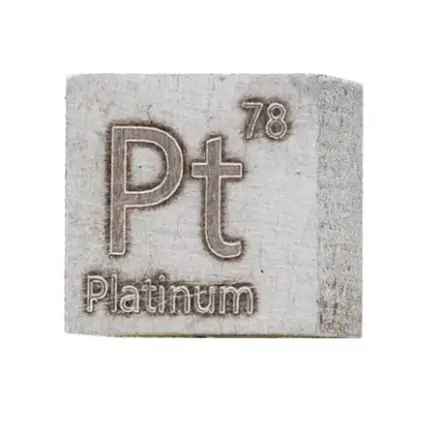
Platinum is a dense, malleable, ductile, highly unreactive, precious, silverish-white transition metal. Platinum is one of the least reactive metals. It has remarkable resistance to corrosion, even at high temperatures, and is therefore considered a noble metal. Platinum is used in catalytic converters, laboratory equipment, electrical contacts and electrodes, platinum resistance thermometers, dentistry equipment, and jewelry.

Summary

Element Platinum
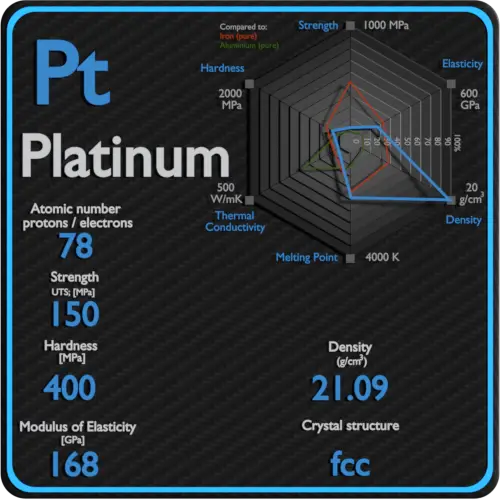
Atomic number 78
Element category Transition Metal
Phase at STP Solid
Density 21.09 g/cm3
Ultimate Tensile Strength 150 MPa
Yield Strength 70 MPa
Young’s Modulus of Elasticity 168 GPa
Mohs Scale 3.5
Brinell Hardness 400 MPa
Vickers Hardness 550 MPa
Melting Point 1772 °C
Boiling Point 3827 °C
Thermal Conductivity 72 W/mK
Thermal Expansion Coefficient 8.8 µm/mK
Specific Heat 0.13 J/g K
Heat of Fusion 19.6 kJ/mol
Heat of Vaporization 510 kJ/mol
Electrical resistivity [nanoOhm meter] 105
Magnetic Susceptibility +201e-6 cm^3/mol

Applications of Platinum

Platinum is primarily an industrial metal. It is a critical material for many industries and is considered a strategic metal. Platinum is used as a catalyst, platinum is mostly found in vehicle catalytic converters that reduce toxic exhaust chemicals, and also in fuel cells to increase efficiency. The most common use of platinum is as a catalyst in chemical reactions, often as platinum black. In catalytic converters, platinum allows the complete combustion of low concentrations of unburned hydrocarbons from the exhaust into carbon dioxide and water vapor. Platinum has been used in thermocouple devices that measure temperature with high accuracy. Platinum is a component in magnetic coatings for high-density hard disk drives and some of the newer optical storage systems.

Platinum-applications

Production and Price of Platinum

Raw materials prices change daily. They are primarily driven by supply, demand and energy prices. In 2019, prices of pure Platinum were at around 31500 $/kg.

Platinum, along with the rest of the platinum-group metals, is obtained commercially as a by-product from nickel and copper mining and processing. During electrorefining of copper, noble metals such as silver, gold and the platinum-group metals as well as selenium and tellurium settle to the bottom of the cell as “anode mud”, which forms the starting point for the extraction of the platinum-group metals. Of the 218 tonnes of platinum sold in 2014, 98 tonnes were used for vehicle emissions control devices (45%), 74.7 tonnes for jewelry (34%), 20.0 tonnes for chemical production and petroleum refining (9.2%), and 5.85 tonnes for electrical applications such as hard disk drives (2.7%). As of 2020, the value of platinum is around $32.00 per gram ($1,000 per troy ounce).

Platinum-periodic-table

Source: www.luciteria.com

Mechanical Properties of Platinum

Platinum-mechanical-properties-strength-hardness-crystal-structure

Strength of Platinum

In mechanics of materials, the strength of a material is its ability to withstand an applied load without failure or plastic deformation. Strength of materials basically considers the relationship between the external loads applied to a material and the resulting deformation or change in material dimensions. In designing structures and machines, it is important to consider these factors, in order that the material selected will have adequate strength to resist applied loads or forces and retain its original shape. Strength of a material is its ability to withstand this applied load without failure or plastic deformation.

For tensile stress, the capacity of a material or structure to withstand loads tending to elongate is known as ultimate tensile strength (UTS). Yield strength or yield stress is the material property defined as the stress at which a material begins to deform plastically whereas yield point is the point where nonlinear (elastic + plastic) deformation begins.

See also: Strength of Materials

Ultimate Tensile Strength of Platinum

Ultimate tensile strength of Platinum is 150 MPa.

Yield Strength of Platinum

Yield strength of Platinum is 70 MPa.

Modulus of Elasticity of Platinum

The Young’s modulus of elasticity of Platinum is 70 MPa.

Hardness of Platinum

In materials science, hardness is the ability to withstand surface indentation (localized plastic deformation) and scratching. Brinell hardness test is one of indentation hardness tests, that has been developed for hardness testing. In Brinell tests, a hard, spherical indenter is forced under a specific load into the surface of the metal to be tested.

Brinell hardness of Platinum is approximately 400 MPa.

The Vickers hardness test method was developed by Robert L. Smith and George E. Sandland at Vickers Ltd as an alternative to the Brinell method to measure the hardness of materials. The Vickers hardness test method can be also used as a microhardness test method, which is mostly used for small parts, thin sections, or case depth work.

Vickers hardness of Platinum is approximately 550 MPa.

Scratch hardness is the measure of how resistant a sample is to permanent plastic deformation due to friction from a sharp object. The most common scale for this qualitative test is Mohs scale, which is used in mineralogy. The Mohs scale of mineral hardness is based on the ability of one natural sample of mineral to scratch another mineral visibly.

Platinum is has a hardness of approximately 3.5.

See also: Hardness of Materials

Platinum – Crystal Structure

A possible crystal structure of Platinum is face-centered cubic structure.

crystal structures - FCC, BCC, HCP

In metals, and in many other solids, the atoms are arranged in regular arrays called crystals. A crystal lattice is a repeating pattern of mathematical points that extends throughout space. The forces of chemical bonding causes this repetition. It is this repeated pattern which control properties like strength, ductility, density, conductivity (property of conducting or transmitting heat, electricity, etc.), and shape. There are 14 general types of such patterns known as Bravais lattices.

See also: Crystal Structure of Materials

Crystal Structure of Platinum
Crystal Structure of Platinum is: face-centered cubic

Strength of Elements

Elasticity of Elements

Hardness of Elements


Thermal Properties of Platinum

Platinum-melting-point-conductivity-thermal-properties

Platinum – Melting Point and Boiling Point

Melting point of Platinum is 1772°C.

Boiling point of Platinum is 3827°C.

Note that, these points are associated with the standard atmospheric pressure.

Platinum – Thermal Conductivity

Thermal conductivity of Platinum is 72 W/(m·K).

The heat transfer characteristics of a solid material are measured by a property called the thermal conductivity, k (or λ), measured in W/m.K. It is a measure of a substance’s ability to transfer heat through a material by conduction. Note that Fourier’s law applies for all matter, regardless of its state (solid, liquid, or gas), therefore, it is also defined for liquids and gases.

Coefficient of Thermal Expansion of Platinum

Linear thermal expansion coefficient of Platinum is 8.8 µm/(m·K)

Thermal expansion is generally the tendency of matter to change its dimensions in response to a change in temperature. It is usually expressed as a fractional change in length or volume per unit temperature change.

Platinum – Specific Heat, Latent Heat of Fusion, Latent Heat of Vaporization

Specific heat of Platinum is 0.13 J/g K.

Heat capacity is an extensive property of matter, meaning it is proportional to the size of the system. Heat capacity C has the unit of energy per degree or energy per kelvin. When expressing the same phenomenon as an intensive property, the heat capacity is divided by the amount of substance, mass, or volume, thus the quantity is independent of the size or extent of the sample.

Latent Heat of Fusion of Platinum is 19.6 kJ/mol.

Latent Heat of Vaporization of Platinum is 510 kJ/mol.

Latent heat is the amount of heat added to or removed from a substance to produce a change in phase. This energy breaks down the intermolecular attractive forces, and also must provide the energy necessary to expand the gas (the pΔV work). When latent heat is added, no temperature change occurs. The enthalpy of vaporization is a function of the pressure at which that transformation takes place.

Melting Point of Elements

Periodic Table of Elements - melting point

Thermal Conductivity of Elements

Periodic Table of Elements - thermal conductivity

Thermal Expansion of Elements

Periodic Table of Elements - thermal expansion

Heat Capacity of Elements

Periodic Table of Elements - heat capacity

Heat of Fusion of Elements

Periodic Table of Elements - latent heat fusion

Heat of Vaporization of Elements

Periodic Table of Elements - latent heat vaporization

Platinum – Electrical Resistivity – Magnetic Susceptibility

Platinum-electrical-resistivity-magnetic-susceptibility

Electrical property refers to the response of a material to an applied electric field. One of the principal characteristics of materials is their ability (or lack of ability) to conduct electrical current. Indeed, materials are classified by this property, that is, they are divided into conductors, semiconductors, and nonconductors.

See also: Electrical Properties

Magnetic property refers to the response of a material to an applied magnetic field. The macroscopic magnetic properties of a material are a consequence of interactions between an external magnetic field and the magnetic dipole moments of the constituent atoms. Different materials react to the application of magnetic field differently.

See also: Magnetic Properties

Electrical Resistivity of Platinum

Electrical resistivity of Platinum is 105 nΩ⋅m.

Electrical conductivity and its converse, electrical resistivity, is a fundamental property of a material that quantifies how Platinum conducts the flow of electric current. Electrical conductivity or specific conductance is the reciprocal of electrical resistivity.

Magnetic Susceptibility of Platinum

Magnetic susceptibility of Platinum is +201e-6 cm^3/mol.

In electromagnetism, magnetic susceptibility is the measure of the magnetization of a substance. Magnetic susceptibility is a dimensionless proportionality factor that indicates the degree of magnetization of Platinum in response to an applied magnetic field.

Electrical Resistivity of Elements

Periodic Table of Elements - electrical resistivity

Magnetic Susceptibility of Elements

Application and prices of other elements

Platinum - Comparison of Properties and Prices

Periodic Table in 8K resolution

Other properties of Platinum


Iridium – Properties – Price – Applications – Production

Iridium-properties-price-application-production

About Iridium

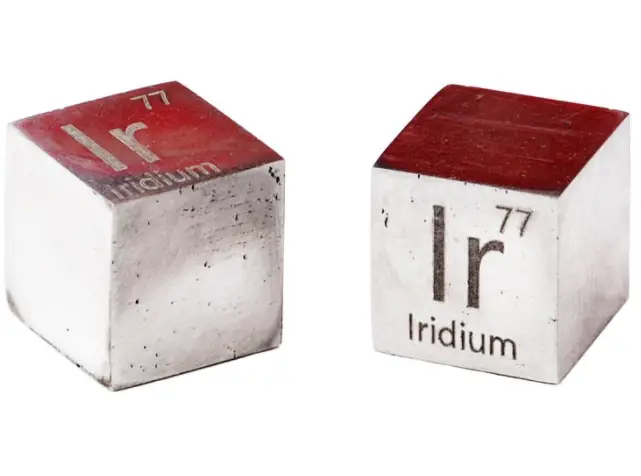
Iridium is a very hard, brittle, silvery-white transition metal of the platinum group, iridium is generally credited with being the second densest element (after osmium). It is also the most corrosion-resistant metal, even at temperatures as high as 2000 °C.

Summary

Element Iridium
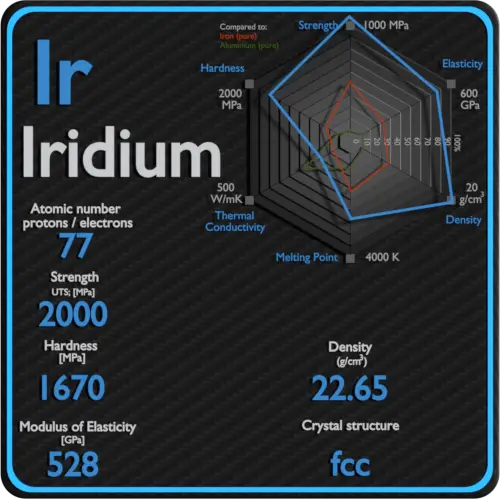
Atomic number 77
Element category Transition Metal
Phase at STP Solid
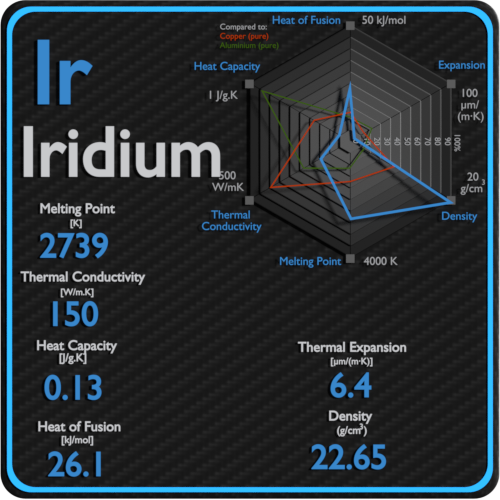
Density 22.65 g/cm3
Ultimate Tensile Strength 2000 MPa
Yield Strength N/A
Young’s Modulus of Elasticity 528 GPa
Mohs Scale 6.25
Brinell Hardness 1670 MPa
Vickers Hardness 1760 MPa
Melting Point 2410 °C
Boiling Point 4130 °C
Thermal Conductivity 150 W/mK
Thermal Expansion Coefficient 6.4 µm/mK
Specific Heat 0.13 J/g K
Heat of Fusion 26.1 kJ/mol
Heat of Vaporization 604 kJ/mol
Electrical resistivity [nanoOhm meter] 47
Magnetic Susceptibility +26e-6 cm^3/mol

Applications of Iridium

Iridium is mainly consumed by the automotive, electronic, and chemical industries. Iridium metal is employed when high corrosion resistance at high temperatures is needed, as in high-performance spark plugs, crucibles for recrystallization of semiconductors at high temperatures, and electrodes for the production of chlorine in the chloralkali process. The demand for iridium surged from 2.5 tonnes in 2009 to 10.4 tonnes in 2010, mostly because of electronics-related applications that saw a rise from 0.2 to 6 tonnes – iridium crucibles are commonly used for growing large high-quality single crystals, demand for which has increased sharply.

Iridium-applications

Production and Price of Iridium

Raw materials prices change daily. They are primarily driven by supply, demand and energy prices. In 2019, prices of pure Iridium were at around 44900 $/kg.

In 2019, worldwide production of iridium totaled 242,000 ounces (6860 kg). Similarly as osmium, iridium concentrates are produced as a by-product of nickel and copper mining or alternatively while isolating the platinum metal from its ores. During electrorefining of copper and nickel, noble metals such as silver, gold and the platinum group metals, together with non-metallic elements such as selenium and tellurium settle to the bottom of the cell as anode mud, which forms the starting material for their extraction.

Iridium-periodic-table

Source: www.luciteria.com

Mechanical Properties of Iridium

Iridium-mechanical-properties-strength-hardness-crystal-structure

Strength of Iridium

In mechanics of materials, the strength of a material is its ability to withstand an applied load without failure or plastic deformation. Strength of materials basically considers the relationship between the external loads applied to a material and the resulting deformation or change in material dimensions. In designing structures and machines, it is important to consider these factors, in order that the material selected will have adequate strength to resist applied loads or forces and retain its original shape. Strength of a material is its ability to withstand this applied load without failure or plastic deformation.

For tensile stress, the capacity of a material or structure to withstand loads tending to elongate is known as ultimate tensile strength (UTS). Yield strength or yield stress is the material property defined as the stress at which a material begins to deform plastically whereas yield point is the point where nonlinear (elastic + plastic) deformation begins.

See also: Strength of Materials

Ultimate Tensile Strength of Iridium

Ultimate tensile strength of Iridium is 2000 MPa.

Yield Strength of Iridium

Yield strength of Iridium is N/A.

Modulus of Elasticity of Iridium

The Young’s modulus of elasticity of Iridium is N/A.

Hardness of Iridium

In materials science, hardness is the ability to withstand surface indentation (localized plastic deformation) and scratching. Brinell hardness test is one of indentation hardness tests, that has been developed for hardness testing. In Brinell tests, a hard, spherical indenter is forced under a specific load into the surface of the metal to be tested.

Brinell hardness of Iridium is approximately 1670 MPa.

The Vickers hardness test method was developed by Robert L. Smith and George E. Sandland at Vickers Ltd as an alternative to the Brinell method to measure the hardness of materials. The Vickers hardness test method can be also used as a microhardness test method, which is mostly used for small parts, thin sections, or case depth work.

Vickers hardness of Iridium is approximately 1760 MPa.

Scratch hardness is the measure of how resistant a sample is to permanent plastic deformation due to friction from a sharp object. The most common scale for this qualitative test is Mohs scale, which is used in mineralogy. The Mohs scale of mineral hardness is based on the ability of one natural sample of mineral to scratch another mineral visibly.

Iridium is has a hardness of approximately 6.25.

See also: Hardness of Materials

Iridium – Crystal Structure

A possible crystal structure of Iridium is face-centered cubic structure.

crystal structures - FCC, BCC, HCP

In metals, and in many other solids, the atoms are arranged in regular arrays called crystals. A crystal lattice is a repeating pattern of mathematical points that extends throughout space. The forces of chemical bonding causes this repetition. It is this repeated pattern which control properties like strength, ductility, density, conductivity (property of conducting or transmitting heat, electricity, etc.), and shape. There are 14 general types of such patterns known as Bravais lattices.

See also: Crystal Structure of Materials

Crystal Structure of Iridium
Crystal Structure of Iridium is: face-centered cubic

Strength of Elements

Elasticity of Elements

Hardness of Elements


Thermal Properties of Iridium

Iridium-melting-point-conductivity-thermal-properties

Iridium – Melting Point and Boiling Point

Melting point of Iridium is 2410°C.

Boiling point of Iridium is 4130°C.

Note that, these points are associated with the standard atmospheric pressure.

Iridium – Thermal Conductivity

Thermal conductivity of Iridium is 150 W/(m·K).

The heat transfer characteristics of a solid material are measured by a property called the thermal conductivity, k (or λ), measured in W/m.K. It is a measure of a substance’s ability to transfer heat through a material by conduction. Note that Fourier’s law applies for all matter, regardless of its state (solid, liquid, or gas), therefore, it is also defined for liquids and gases.

Coefficient of Thermal Expansion of Iridium

Linear thermal expansion coefficient of Iridium is 6.4 µm/(m·K)

Thermal expansion is generally the tendency of matter to change its dimensions in response to a change in temperature. It is usually expressed as a fractional change in length or volume per unit temperature change.

Iridium – Specific Heat, Latent Heat of Fusion, Latent Heat of Vaporization

Specific heat of Iridium is 0.13 J/g K.

Heat capacity is an extensive property of matter, meaning it is proportional to the size of the system. Heat capacity C has the unit of energy per degree or energy per kelvin. When expressing the same phenomenon as an intensive property, the heat capacity is divided by the amount of substance, mass, or volume, thus the quantity is independent of the size or extent of the sample.

Latent Heat of Fusion of Iridium is 26.1 kJ/mol.

Latent Heat of Vaporization of Iridium is 604 kJ/mol.

Latent heat is the amount of heat added to or removed from a substance to produce a change in phase. This energy breaks down the intermolecular attractive forces, and also must provide the energy necessary to expand the gas (the pΔV work). When latent heat is added, no temperature change occurs. The enthalpy of vaporization is a function of the pressure at which that transformation takes place.

Melting Point of Elements

Periodic Table of Elements - melting point

Thermal Conductivity of Elements

Periodic Table of Elements - thermal conductivity

Thermal Expansion of Elements

Periodic Table of Elements - thermal expansion

Heat Capacity of Elements

Periodic Table of Elements - heat capacity

Heat of Fusion of Elements

Periodic Table of Elements - latent heat fusion

Heat of Vaporization of Elements

Periodic Table of Elements - latent heat vaporization

Iridium – Electrical Resistivity – Magnetic Susceptibility

Iridium-electrical-resistivity-magnetic-susceptibility

Electrical property refers to the response of a material to an applied electric field. One of the principal characteristics of materials is their ability (or lack of ability) to conduct electrical current. Indeed, materials are classified by this property, that is, they are divided into conductors, semiconductors, and nonconductors.

See also: Electrical Properties

Magnetic property refers to the response of a material to an applied magnetic field. The macroscopic magnetic properties of a material are a consequence of interactions between an external magnetic field and the magnetic dipole moments of the constituent atoms. Different materials react to the application of magnetic field differently.

See also: Magnetic Properties

Electrical Resistivity of Iridium

Electrical resistivity of Iridium is 47 nΩ⋅m.

Electrical conductivity and its converse, electrical resistivity, is a fundamental property of a material that quantifies how Iridium conducts the flow of electric current. Electrical conductivity or specific conductance is the reciprocal of electrical resistivity.

Magnetic Susceptibility of Iridium

Magnetic susceptibility of Iridium is +26e-6 cm^3/mol.

In electromagnetism, magnetic susceptibility is the measure of the magnetization of a substance. Magnetic susceptibility is a dimensionless proportionality factor that indicates the degree of magnetization of Iridium in response to an applied magnetic field.

Electrical Resistivity of Elements

Periodic Table of Elements - electrical resistivity

Magnetic Susceptibility of Elements

Application and prices of other elements

Iridium - Comparison of Properties and Prices

Periodic Table in 8K resolution

Other properties of Iridium


Osmium – Properties – Price – Applications – Production

Osmium-properties-price-application-production

About Osmium

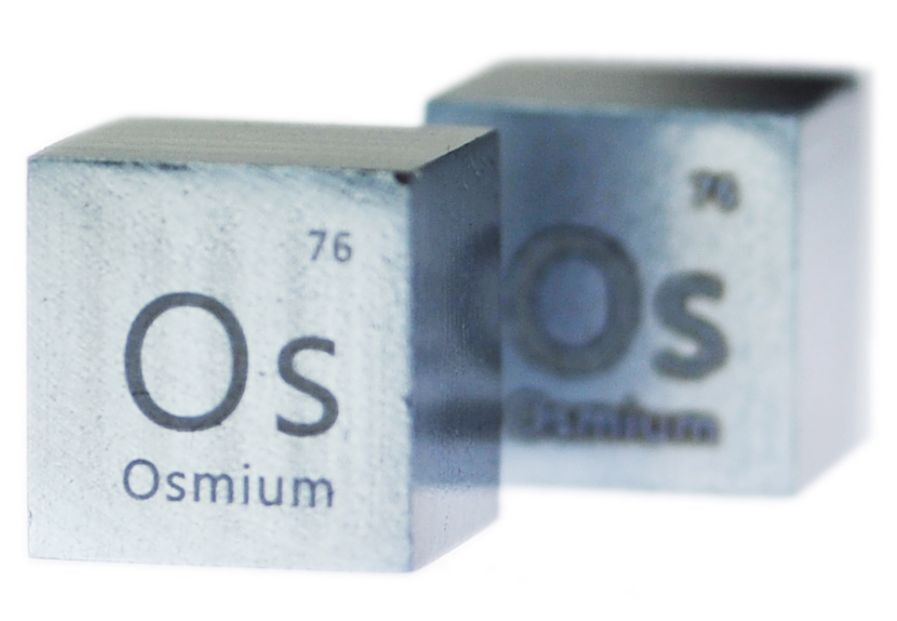
Osmium is a hard, brittle, bluish-white transition metal in the platinum group that is found as a trace element in alloys, mostly in platinum ores. Osmium is the densest naturally occurring element, with a density of 22.59 g/cm3. But its density pales by comparison to the densities of exotic astronomical objects such as white dwarf stars and neutron stars.

Summary

Element Osmium
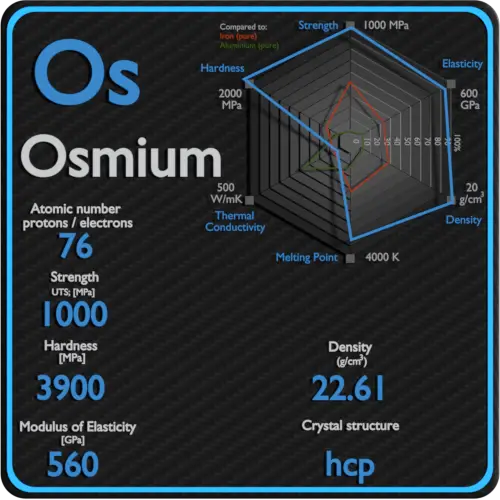
Atomic number 76
Element category Transition Metal
Phase at STP Solid
Density 22.61 g/cm3
Ultimate Tensile Strength 1000 MPa
Yield Strength N/A
Young’s Modulus of Elasticity N/A
Mohs Scale 7
Brinell Hardness 3900 MPa
Vickers Hardness 4140 MPa
Melting Point 3045 °C
Boiling Point 5030 °C
Thermal Conductivity 88 W/mK
Thermal Expansion Coefficient 5.1 µm/mK
Specific Heat 0.13 J/g K
Heat of Fusion 31.8 kJ/mol
Heat of Vaporization 746 kJ/mol
Electrical resistivity [nanoOhm meter] 81.2
Magnetic Susceptibility +11e-6 cm^3/mol

Applications of Osmium

Due to its rarity and hence expense, osmium has only a few industrial uses. It is used to produce very hard alloys for fountain pen tips, instrument pivots, needles and electrical contacts. It is also used in the chemical industry as a catalyst. Finely divided osmium metal can be used as a catalyst e.g. in the process of forming ammonia by combining hydrogen and nitrogen.

Osmium-applications

Production and Price of Osmium

Raw materials prices change daily. They are primarily driven by supply, demand and energy prices. In 2019, prices of pure Osmium were at around 20000 $/kg.

Osmium concentrates are produced as a by-product of nickel and copper mining or alternatively while isolating the platinum metal from its ores. During electrorefining of copper and nickel, noble metals such as silver, gold and the platinum group metals, together with non-metallic elements such as selenium and tellurium settle to the bottom of the cell as anode mud, which forms the starting material for their extraction.

Osmium-periodic-table

Source: www.luciteria.com

Mechanical Properties of Osmium

Osmium-mechanical-properties-strength-hardness-crystal-structure

Strength of Osmium

In mechanics of materials, the strength of a material is its ability to withstand an applied load without failure or plastic deformation. Strength of materials basically considers the relationship between the external loads applied to a material and the resulting deformation or change in material dimensions. In designing structures and machines, it is important to consider these factors, in order that the material selected will have adequate strength to resist applied loads or forces and retain its original shape. Strength of a material is its ability to withstand this applied load without failure or plastic deformation.

For tensile stress, the capacity of a material or structure to withstand loads tending to elongate is known as ultimate tensile strength (UTS). Yield strength or yield stress is the material property defined as the stress at which a material begins to deform plastically whereas yield point is the point where nonlinear (elastic + plastic) deformation begins.

See also: Strength of Materials

Ultimate Tensile Strength of Osmium

Ultimate tensile strength of Osmium is 1000 MPa.

Yield Strength of Osmium

Yield strength of Osmium is N/A.

Modulus of Elasticity of Osmium

The Young’s modulus of elasticity of Osmium is N/A.

Hardness of Osmium

In materials science, hardness is the ability to withstand surface indentation (localized plastic deformation) and scratching. Brinell hardness test is one of indentation hardness tests, that has been developed for hardness testing. In Brinell tests, a hard, spherical indenter is forced under a specific load into the surface of the metal to be tested.

Brinell hardness of Osmium is approximately 3900 MPa.

The Vickers hardness test method was developed by Robert L. Smith and George E. Sandland at Vickers Ltd as an alternative to the Brinell method to measure the hardness of materials. The Vickers hardness test method can be also used as a microhardness test method, which is mostly used for small parts, thin sections, or case depth work.

Vickers hardness of Osmium is approximately 4140 MPa.

Scratch hardness is the measure of how resistant a sample is to permanent plastic deformation due to friction from a sharp object. The most common scale for this qualitative test is Mohs scale, which is used in mineralogy. The Mohs scale of mineral hardness is based on the ability of one natural sample of mineral to scratch another mineral visibly.

Osmium is has a hardness of approximately 7.

See also: Hardness of Materials

Osmium – Crystal Structure

A possible crystal structure of Osmium is hexagonal close-packed structure.

crystal structures - FCC, BCC, HCP

In metals, and in many other solids, the atoms are arranged in regular arrays called crystals. A crystal lattice is a repeating pattern of mathematical points that extends throughout space. The forces of chemical bonding causes this repetition. It is this repeated pattern which control properties like strength, ductility, density, conductivity (property of conducting or transmitting heat, electricity, etc.), and shape. There are 14 general types of such patterns known as Bravais lattices.

See also: Crystal Structure of Materials

Crystal Structure of Osmium
Crystal Structure of Osmium is: hexagonal close-packed

Strength of Elements

Elasticity of Elements

Hardness of Elements


Thermal Properties of Osmium

Osmium-melting-point-conductivity-thermal-properties

Osmium – Melting Point and Boiling Point

Melting point of Osmium is 3045°C.

Boiling point of Osmium is 5030°C.

Note that, these points are associated with the standard atmospheric pressure.

Osmium – Thermal Conductivity

Thermal conductivity of Osmium is 88 W/(m·K).

The heat transfer characteristics of a solid material are measured by a property called the thermal conductivity, k (or λ), measured in W/m.K. It is a measure of a substance’s ability to transfer heat through a material by conduction. Note that Fourier’s law applies for all matter, regardless of its state (solid, liquid, or gas), therefore, it is also defined for liquids and gases.

Coefficient of Thermal Expansion of Osmium

Linear thermal expansion coefficient of Osmium is 5.1 µm/(m·K)

Thermal expansion is generally the tendency of matter to change its dimensions in response to a change in temperature. It is usually expressed as a fractional change in length or volume per unit temperature change.

Osmium – Specific Heat, Latent Heat of Fusion, Latent Heat of Vaporization

Specific heat of Osmium is 0.13 J/g K.

Heat capacity is an extensive property of matter, meaning it is proportional to the size of the system. Heat capacity C has the unit of energy per degree or energy per kelvin. When expressing the same phenomenon as an intensive property, the heat capacity is divided by the amount of substance, mass, or volume, thus the quantity is independent of the size or extent of the sample.

Latent Heat of Fusion of Osmium is 31.8 kJ/mol.

Latent Heat of Vaporization of Osmium is 746 kJ/mol.

Latent heat is the amount of heat added to or removed from a substance to produce a change in phase. This energy breaks down the intermolecular attractive forces, and also must provide the energy necessary to expand the gas (the pΔV work). When latent heat is added, no temperature change occurs. The enthalpy of vaporization is a function of the pressure at which that transformation takes place.

Melting Point of Elements

Periodic Table of Elements - melting point

Thermal Conductivity of Elements

Periodic Table of Elements - thermal conductivity

Thermal Expansion of Elements

Periodic Table of Elements - thermal expansion

Heat Capacity of Elements

Periodic Table of Elements - heat capacity

Heat of Fusion of Elements

Periodic Table of Elements - latent heat fusion

Heat of Vaporization of Elements

Periodic Table of Elements - latent heat vaporization

Osmium – Electrical Resistivity – Magnetic Susceptibility

Osmium-electrical-resistivity-magnetic-susceptibility

Electrical property refers to the response of a material to an applied electric field. One of the principal characteristics of materials is their ability (or lack of ability) to conduct electrical current. Indeed, materials are classified by this property, that is, they are divided into conductors, semiconductors, and nonconductors.

See also: Electrical Properties

Magnetic property refers to the response of a material to an applied magnetic field. The macroscopic magnetic properties of a material are a consequence of interactions between an external magnetic field and the magnetic dipole moments of the constituent atoms. Different materials react to the application of magnetic field differently.

See also: Magnetic Properties

Electrical Resistivity of Osmium

Electrical resistivity of Osmium is 81.2 nΩ⋅m.

Electrical conductivity and its converse, electrical resistivity, is a fundamental property of a material that quantifies how Osmium conducts the flow of electric current. Electrical conductivity or specific conductance is the reciprocal of electrical resistivity.

Magnetic Susceptibility of Osmium

Magnetic susceptibility of Osmium is +11e-6 cm^3/mol.

In electromagnetism, magnetic susceptibility is the measure of the magnetization of a substance. Magnetic susceptibility is a dimensionless proportionality factor that indicates the degree of magnetization of Osmium in response to an applied magnetic field.

Electrical Resistivity of Elements

Periodic Table of Elements - electrical resistivity

Magnetic Susceptibility of Elements

Application and prices of other elements

Osmium - Comparison of Properties and Prices

Periodic Table in 8K resolution

Other properties of Osmium


Rhenium – Properties – Price – Applications – Production

Rhenium-properties-price-application-production

About Rhenium

Rhenium is a silvery-white, heavy, third-row transition metal in group 7 of the periodic table.

Summary

Element Rhenium
Atomic number 75
Element category Transition Metal
Phase at STP Solid
Density 21.02 g/cm3
Ultimate Tensile Strength 1070 MPa
Yield Strength 290 MPa
Young’s Modulus of Elasticity 463 GPa
Mohs Scale 7
Brinell Hardness 1400 MPa
Vickers Hardness 2500 MPa
Melting Point 3180 °C
Boiling Point 5600 °C
Thermal Conductivity 48 W/mK
Thermal Expansion Coefficient 6.2 µm/mK
Specific Heat 0.13 J/g K
Heat of Fusion 33.2 kJ/mol
Heat of Vaporization 715 kJ/mol
Electrical resistivity [nanoOhm meter] 193
Magnetic Susceptibility +67e-6 cm^3/mol

Applications of Rhenium

More than 80% of the global rhenium usage is in high-temperature superalloys for aircraft applications like turbine blades and engine parts. These alloys contain up to 6% rhenium, making jet engine construction the largest single use for the element. Rhenium is added to nickel-based super alloys to improve creep strength of the alloys. The remaining demand is mostly from petrochemical refining industries. Platinum-rhenium catalysts that are chiefly used in lead-free, high-octane gasoline are another major application of rhenium.

Rhenium-applications

Production and Price of Rhenium

Raw materials prices change daily. They are primarily driven by supply, demand and energy prices. In 2019, prices of pure Rhenium were at around 5400 $/kg.

Because of the low availability relative to demand, rhenium is expensive, with price reaching an all-time high in 2008/2009 of US$10,600 per kilogram (US$4,800 per pound). Due to increases in rhenium recycling and a drop in demand for rhenium in catalysts, the price of rhenium has dropped to US$2,844 per kilogram (US$1,290 per pound) as of July 2018. Approximately all principal rhenium production (rhenium produced by mining rather than through recycling) is as a by-product of copper mining. Total world production is between 40 and 50 tons/year; the main producers are in Chile, the United States, Peru, and Poland.

Rhenium-periodic-table

Source: www.luciteria.com

Mechanical Properties of Rhenium

Rhenium-mechanical-properties-strength-hardness-crystal-structure

Strength of Rhenium

In mechanics of materials, the strength of a material is its ability to withstand an applied load without failure or plastic deformation. Strength of materials basically considers the relationship between the external loads applied to a material and the resulting deformation or change in material dimensions. In designing structures and machines, it is important to consider these factors, in order that the material selected will have adequate strength to resist applied loads or forces and retain its original shape. Strength of a material is its ability to withstand this applied load without failure or plastic deformation.

For tensile stress, the capacity of a material or structure to withstand loads tending to elongate is known as ultimate tensile strength (UTS). Yield strength or yield stress is the material property defined as the stress at which a material begins to deform plastically whereas yield point is the point where nonlinear (elastic + plastic) deformation begins.

See also: Strength of Materials

Ultimate Tensile Strength of Rhenium

Ultimate tensile strength of Rhenium is 1070 MPa.

Yield Strength of Rhenium

Yield strength of Rhenium is 290 MPa.

Modulus of Elasticity of Rhenium

The Young’s modulus of elasticity of Rhenium is 290 MPa.

Hardness of Rhenium

In materials science, hardness is the ability to withstand surface indentation (localized plastic deformation) and scratching. Brinell hardness test is one of indentation hardness tests, that has been developed for hardness testing. In Brinell tests, a hard, spherical indenter is forced under a specific load into the surface of the metal to be tested.

Brinell hardness of Rhenium is approximately 1400 MPa.

The Vickers hardness test method was developed by Robert L. Smith and George E. Sandland at Vickers Ltd as an alternative to the Brinell method to measure the hardness of materials. The Vickers hardness test method can be also used as a microhardness test method, which is mostly used for small parts, thin sections, or case depth work.

Vickers hardness of Rhenium is approximately 2500 MPa.

Scratch hardness is the measure of how resistant a sample is to permanent plastic deformation due to friction from a sharp object. The most common scale for this qualitative test is Mohs scale, which is used in mineralogy. The Mohs scale of mineral hardness is based on the ability of one natural sample of mineral to scratch another mineral visibly.

Rhenium is has a hardness of approximately 7.

See also: Hardness of Materials

Rhenium – Crystal Structure

A possible crystal structure of Rhenium is hexagonal close-packed structure.

crystal structures - FCC, BCC, HCP

In metals, and in many other solids, the atoms are arranged in regular arrays called crystals. A crystal lattice is a repeating pattern of mathematical points that extends throughout space. The forces of chemical bonding causes this repetition. It is this repeated pattern which control properties like strength, ductility, density, conductivity (property of conducting or transmitting heat, electricity, etc.), and shape. There are 14 general types of such patterns known as Bravais lattices.

See also: Crystal Structure of Materials

Crystal Structure of Rhenium
Crystal Structure of Rhenium is: hexagonal close-packed

Strength of Elements

Elasticity of Elements

Hardness of Elements


Thermal Properties of Rhenium

Rhenium-melting-point-conductivity-thermal-properties

Rhenium – Melting Point and Boiling Point

Melting point of Rhenium is 3180°C.

Boiling point of Rhenium is 5600°C.

Note that, these points are associated with the standard atmospheric pressure.

Rhenium – Thermal Conductivity

Thermal conductivity of Rhenium is 48 W/(m·K).

The heat transfer characteristics of a solid material are measured by a property called the thermal conductivity, k (or λ), measured in W/m.K. It is a measure of a substance’s ability to transfer heat through a material by conduction. Note that Fourier’s law applies for all matter, regardless of its state (solid, liquid, or gas), therefore, it is also defined for liquids and gases.

Coefficient of Thermal Expansion of Rhenium

Linear thermal expansion coefficient of Rhenium is 6.2 µm/(m·K)

Thermal expansion is generally the tendency of matter to change its dimensions in response to a change in temperature. It is usually expressed as a fractional change in length or volume per unit temperature change.

Rhenium – Specific Heat, Latent Heat of Fusion, Latent Heat of Vaporization

Specific heat of Rhenium is 0.13 J/g K.

Heat capacity is an extensive property of matter, meaning it is proportional to the size of the system. Heat capacity C has the unit of energy per degree or energy per kelvin. When expressing the same phenomenon as an intensive property, the heat capacity is divided by the amount of substance, mass, or volume, thus the quantity is independent of the size or extent of the sample.

Latent Heat of Fusion of Rhenium is 33.2 kJ/mol.

Latent Heat of Vaporization of Rhenium is 715 kJ/mol.

Latent heat is the amount of heat added to or removed from a substance to produce a change in phase. This energy breaks down the intermolecular attractive forces, and also must provide the energy necessary to expand the gas (the pΔV work). When latent heat is added, no temperature change occurs. The enthalpy of vaporization is a function of the pressure at which that transformation takes place.

Melting Point of Elements

Periodic Table of Elements - melting point

Thermal Conductivity of Elements

Periodic Table of Elements - thermal conductivity

Thermal Expansion of Elements

Periodic Table of Elements - thermal expansion

Heat Capacity of Elements

Periodic Table of Elements - heat capacity

Heat of Fusion of Elements

Periodic Table of Elements - latent heat fusion

Heat of Vaporization of Elements

Periodic Table of Elements - latent heat vaporization

Rhenium – Electrical Resistivity – Magnetic Susceptibility

Rhenium-electrical-resistivity-magnetic-susceptibility

Electrical property refers to the response of a material to an applied electric field. One of the principal characteristics of materials is their ability (or lack of ability) to conduct electrical current. Indeed, materials are classified by this property, that is, they are divided into conductors, semiconductors, and nonconductors.

See also: Electrical Properties

Magnetic property refers to the response of a material to an applied magnetic field. The macroscopic magnetic properties of a material are a consequence of interactions between an external magnetic field and the magnetic dipole moments of the constituent atoms. Different materials react to the application of magnetic field differently.

See also: Magnetic Properties

Electrical Resistivity of Rhenium

Electrical resistivity of Rhenium is 193 nΩ⋅m.

Electrical conductivity and its converse, electrical resistivity, is a fundamental property of a material that quantifies how Rhenium conducts the flow of electric current. Electrical conductivity or specific conductance is the reciprocal of electrical resistivity.

Magnetic Susceptibility of Rhenium

Magnetic susceptibility of Rhenium is +67e-6 cm^3/mol.

In electromagnetism, magnetic susceptibility is the measure of the magnetization of a substance. Magnetic susceptibility is a dimensionless proportionality factor that indicates the degree of magnetization of Rhenium in response to an applied magnetic field.

Electrical Resistivity of Elements

Periodic Table of Elements - electrical resistivity

Magnetic Susceptibility of Elements

Application and prices of other elements

Rhenium - Comparison of Properties and Prices

Periodic Table in 8K resolution

Other properties of Rhenium


Tungsten – Properties – Price – Applications – Production

Tungsten-properties-price-application-production

About Tungsten

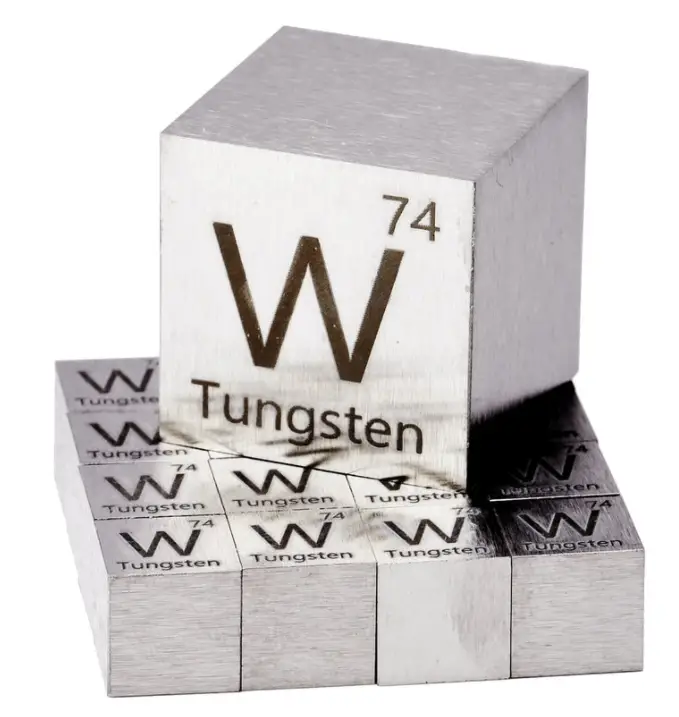
Tungsten is a rare metal found naturally on Earth almost exclusively in chemical compounds. Tungsten is an intrinsically brittle and hard material, making it difficult to work.

Summary

Element Tungsten
Atomic number 74
Element category Transition Metal
Phase at STP Solid
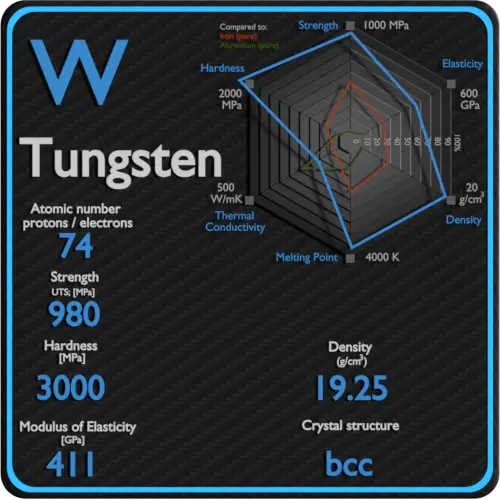
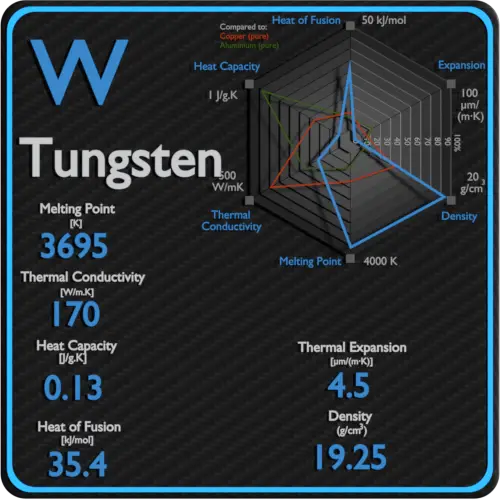
Density 19.25 g/cm3
Ultimate Tensile Strength 980 MPa
Yield Strength 750 MPa
Young’s Modulus of Elasticity 411 GPa
Mohs Scale 7.5
Brinell Hardness 3000 MPa
Vickers Hardness 3500 MPa
Melting Point 3410 °C
Boiling Point 59300 °C
Thermal Conductivity 170 W/mK
Thermal Expansion Coefficient 4.5 µm/mK
Specific Heat 0.13 J/g K
Heat of Fusion 35.4 kJ/mol
Heat of Vaporization 824 kJ/mol
Electrical resistivity [nanoOhm meter] 52.8
Magnetic Susceptibility +59e-6 cm^3/mol

Applications of Tungsten

Tungsten is widely used metal. Approximately half of the tungsten is consumed for the production of hard materials – namely tungsten carbide – with the remaining major use being in alloys and steels. Mining and mineral processing demand wear-resistant machines and components, because the energies and masses of interacting bodies are significant. For this purposes, materials with the highest wear-resistance must be used. For example, tungsten carbide is used extensively in mining in top hammer rock drill bits, downhole hammers, roller-cutters, long wall plough chisels, long wall shearer picks, raiseboring reamers, and tunnel boring machines. The remaining 40% is generally used to make various alloys and specialty steels, electrodes, filaments, wires, as well as diverse components for electric, electronic, heating, lighting, and welding applications. High-speed steels are complex iron-base alloys of carbon, chromium, vanadium, molybdenum, or tungsten (as much as 18%), or combinations there of.

Tungsten-applications

Production and Price of Tungsten

Raw materials prices change daily. They are primarily driven by supply, demand and energy prices. In 2019, prices of pure Tungsten were at around 110 $/kg.

The two major minerals of tungsten are wolframite and scheelite. Wolframite is strong, very dense, and has a high melting point. The tungsten ores are crushed, cleaned, and treated with alkali, resulting in the production of tungsten trioxide (WO3). The world’s reserves of tungsten are 3,200,000 tonnes; they are mostly located in China (1,800,000 t), Canada (290,000 t),[49] Russia (160,000 t), Vietnam (95,000 t) and Bolivia. As of 2017, China, Vietnam and Russia are the leading suppliers with 79,000, 7,200 and 3,100 tonnes, respectively.

Tungsten-periodic-table

Source: www.luciteria.com

Mechanical Properties of Tungsten

Tungsten-mechanical-properties-strength-hardness-crystal-structure

Strength of Tungsten

In mechanics of materials, the strength of a material is its ability to withstand an applied load without failure or plastic deformation. Strength of materials basically considers the relationship between the external loads applied to a material and the resulting deformation or change in material dimensions. In designing structures and machines, it is important to consider these factors, in order that the material selected will have adequate strength to resist applied loads or forces and retain its original shape. Strength of a material is its ability to withstand this applied load without failure or plastic deformation.

For tensile stress, the capacity of a material or structure to withstand loads tending to elongate is known as ultimate tensile strength (UTS). Yield strength or yield stress is the material property defined as the stress at which a material begins to deform plastically whereas yield point is the point where nonlinear (elastic + plastic) deformation begins.

See also: Strength of Materials

Ultimate Tensile Strength of Tungsten

Ultimate tensile strength of Tungsten is 980 MPa.

Yield Strength of Tungsten

Yield strength of Tungsten is 750 MPa.

Modulus of Elasticity of Tungsten

The Young’s modulus of elasticity of Tungsten is 750 MPa.

Hardness of Tungsten

In materials science, hardness is the ability to withstand surface indentation (localized plastic deformation) and scratching. Brinell hardness test is one of indentation hardness tests, that has been developed for hardness testing. In Brinell tests, a hard, spherical indenter is forced under a specific load into the surface of the metal to be tested.

Brinell hardness of Tungsten is approximately 3000 MPa.

The Vickers hardness test method was developed by Robert L. Smith and George E. Sandland at Vickers Ltd as an alternative to the Brinell method to measure the hardness of materials. The Vickers hardness test method can be also used as a microhardness test method, which is mostly used for small parts, thin sections, or case depth work.

Vickers hardness of Tungsten is approximately 3500 MPa.

Scratch hardness is the measure of how resistant a sample is to permanent plastic deformation due to friction from a sharp object. The most common scale for this qualitative test is Mohs scale, which is used in mineralogy. The Mohs scale of mineral hardness is based on the ability of one natural sample of mineral to scratch another mineral visibly.

Tungsten is has a hardness of approximately 7.5.

See also: Hardness of Materials

Tungsten – Crystal Structure

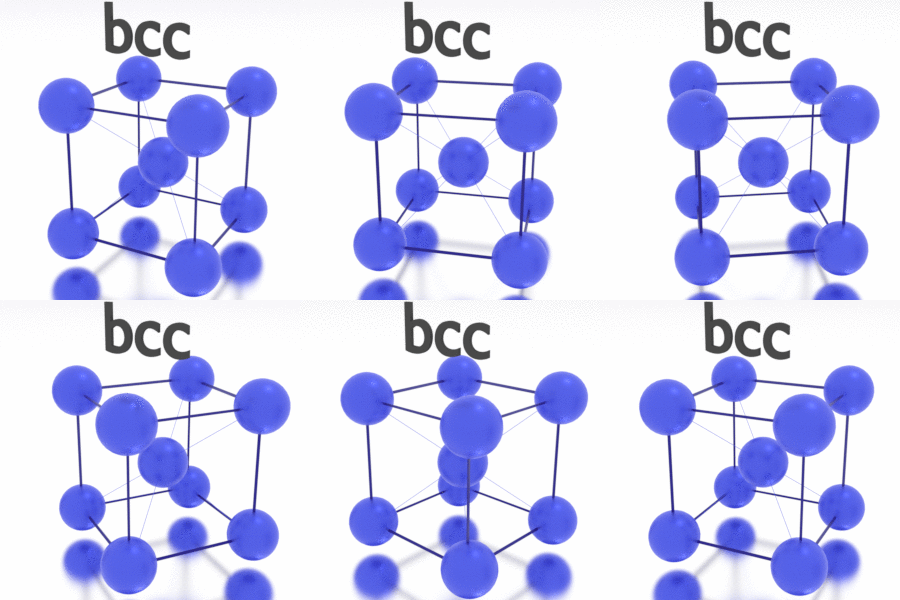
A possible crystal structure of Tungsten is body-centered cubic structure.

crystal structures - FCC, BCC, HCP

In metals, and in many other solids, the atoms are arranged in regular arrays called crystals. A crystal lattice is a repeating pattern of mathematical points that extends throughout space. The forces of chemical bonding causes this repetition. It is this repeated pattern which control properties like strength, ductility, density, conductivity (property of conducting or transmitting heat, electricity, etc.), and shape. There are 14 general types of such patterns known as Bravais lattices.

See also: Crystal Structure of Materials

Crystal Structure of Tungsten
Crystal Structure of Tungsten is: body-centered cubic

Strength of Elements

Elasticity of Elements

Hardness of Elements


Thermal Properties of Tungsten

Tungsten-melting-point-conductivity-thermal-properties

Tungsten – Melting Point and Boiling Point

Melting point of Tungsten is 3410°C.

Boiling point of Tungsten is 59300°C.

Note that, these points are associated with the standard atmospheric pressure.

Tungsten – Thermal Conductivity

Thermal conductivity of Tungsten is 170 W/(m·K).

The heat transfer characteristics of a solid material are measured by a property called the thermal conductivity, k (or λ), measured in W/m.K. It is a measure of a substance’s ability to transfer heat through a material by conduction. Note that Fourier’s law applies for all matter, regardless of its state (solid, liquid, or gas), therefore, it is also defined for liquids and gases.

Coefficient of Thermal Expansion of Tungsten

Linear thermal expansion coefficient of Tungsten is 4.5 µm/(m·K)

Thermal expansion is generally the tendency of matter to change its dimensions in response to a change in temperature. It is usually expressed as a fractional change in length or volume per unit temperature change.

Tungsten – Specific Heat, Latent Heat of Fusion, Latent Heat of Vaporization

Specific heat of Tungsten is 0.13 J/g K.

Heat capacity is an extensive property of matter, meaning it is proportional to the size of the system. Heat capacity C has the unit of energy per degree or energy per kelvin. When expressing the same phenomenon as an intensive property, the heat capacity is divided by the amount of substance, mass, or volume, thus the quantity is independent of the size or extent of the sample.

Latent Heat of Fusion of Tungsten is 35.4 kJ/mol.

Latent Heat of Vaporization of Tungsten is 824 kJ/mol.

Latent heat is the amount of heat added to or removed from a substance to produce a change in phase. This energy breaks down the intermolecular attractive forces, and also must provide the energy necessary to expand the gas (the pΔV work). When latent heat is added, no temperature change occurs. The enthalpy of vaporization is a function of the pressure at which that transformation takes place.

Melting Point of Elements

Periodic Table of Elements - melting point

Thermal Conductivity of Elements

Periodic Table of Elements - thermal conductivity

Thermal Expansion of Elements

Periodic Table of Elements - thermal expansion

Heat Capacity of Elements

Periodic Table of Elements - heat capacity

Heat of Fusion of Elements

Periodic Table of Elements - latent heat fusion

Heat of Vaporization of Elements

Periodic Table of Elements - latent heat vaporization

Tungsten – Electrical Resistivity – Magnetic Susceptibility

Tungsten-electrical-resistivity-magnetic-susceptibility

Electrical property refers to the response of a material to an applied electric field. One of the principal characteristics of materials is their ability (or lack of ability) to conduct electrical current. Indeed, materials are classified by this property, that is, they are divided into conductors, semiconductors, and nonconductors.

See also: Electrical Properties

Magnetic property refers to the response of a material to an applied magnetic field. The macroscopic magnetic properties of a material are a consequence of interactions between an external magnetic field and the magnetic dipole moments of the constituent atoms. Different materials react to the application of magnetic field differently.

See also: Magnetic Properties

Electrical Resistivity of Tungsten

Electrical resistivity of Tungsten is 52.8 nΩ⋅m.

Electrical conductivity and its converse, electrical resistivity, is a fundamental property of a material that quantifies how Tungsten conducts the flow of electric current. Electrical conductivity or specific conductance is the reciprocal of electrical resistivity.

Magnetic Susceptibility of Tungsten

Magnetic susceptibility of Tungsten is +59e-6 cm^3/mol.

In electromagnetism, magnetic susceptibility is the measure of the magnetization of a substance. Magnetic susceptibility is a dimensionless proportionality factor that indicates the degree of magnetization of Tungsten in response to an applied magnetic field.

Electrical Resistivity of Elements

Periodic Table of Elements - electrical resistivity

Magnetic Susceptibility of Elements

Application and prices of other elements

Tungsten - Comparison of Properties and Prices

Periodic Table in 8K resolution

Other properties of Tungsten


Tantalum – Properties – Price – Applications – Production

Tantalum-properties-price-application-production

About Tantalum

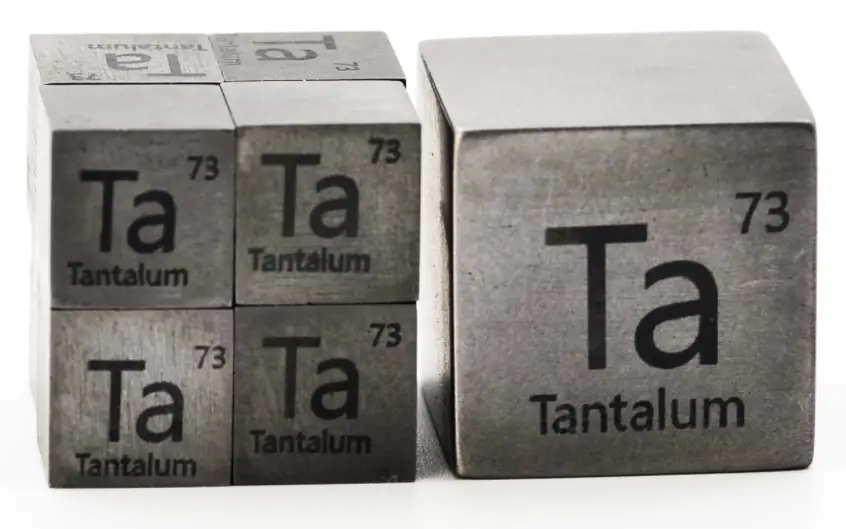
Tantalum is a rare, hard, blue-gray, lustrous transition metal that is highly corrosion-resistant.

Summary

Element Tantalum
Atomic number 73
Element category Transition Metal
Phase at STP Solid
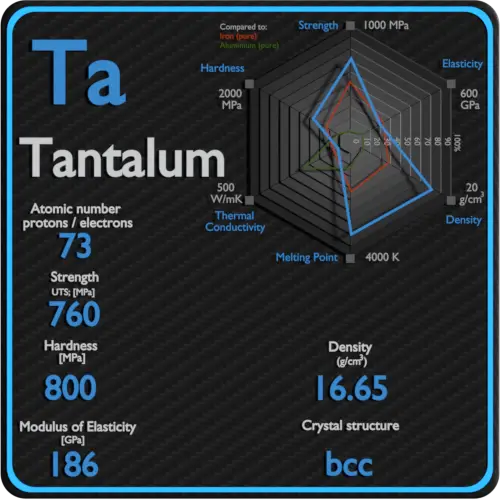
Density 16.65 g/cm3
Ultimate Tensile Strength 760 MPa
Yield Strength 705 MPa
Young’s Modulus of Elasticity 186 GPa
Mohs Scale 6.5
Brinell Hardness 800 MPa
Vickers Hardness 870 MPa
Melting Point 2996 °C
Boiling Point 5425 °C
Thermal Conductivity 57 W/mK
Thermal Expansion Coefficient 6.3 µm/mK
Specific Heat 0.14 J/g K
Heat of Fusion 31.6 kJ/mol
Heat of Vaporization 743 kJ/mol
Electrical resistivity [nanoOhm meter] 131
Magnetic Susceptibility +154e-6 cm^3/mol

Applications of Tantalum

Tantalum consumption is dominated by capacitors for electronic equipment. Capacitors are electrical components that store energy electrostatically in an electric field, and are used in a wide variety of electric and electronic products. Major end uses for tantalum capacitors include portable telephones, pagers, personal computers, and automotive electronics. Alloyed with other metals, tantalum is also used in making carbide tools for metalworking equipment and in the production of superalloys for jet engine components. Compounds of tantalum such as tantalum pentoxide is used to make capacitors and glass with a high index of refraction for use in camera lenses.

Tantalum-applications

Production and Price of Tantalum

Raw materials prices change daily. They are primarily driven by supply, demand and energy prices. In 2019, prices of pure Tantalum were at around 1200 $/kg.

Tantalum, always together with the chemically similar niobium, occurs in the mineral groups tantalite, columbite and coltan (a mix of columbite and tantalite, though not recognised as a separate mineral species). Several steps are involved in the extraction of tantalum from tantalite. First, the mineral is crushed and concentrated by gravity separation. Tantalum is considered a technology-critical element.

Tantalum-periodic-table

Source: www.luciteria.com

Mechanical Properties of Tantalum

Tantalum-mechanical-properties-strength-hardness-crystal-structure

Strength of Tantalum

In mechanics of materials, the strength of a material is its ability to withstand an applied load without failure or plastic deformation. Strength of materials basically considers the relationship between the external loads applied to a material and the resulting deformation or change in material dimensions. In designing structures and machines, it is important to consider these factors, in order that the material selected will have adequate strength to resist applied loads or forces and retain its original shape. Strength of a material is its ability to withstand this applied load without failure or plastic deformation.

For tensile stress, the capacity of a material or structure to withstand loads tending to elongate is known as ultimate tensile strength (UTS). Yield strength or yield stress is the material property defined as the stress at which a material begins to deform plastically whereas yield point is the point where nonlinear (elastic + plastic) deformation begins.

See also: Strength of Materials

Ultimate Tensile Strength of Tantalum

Ultimate tensile strength of Tantalum is 760 MPa.

Yield Strength of Tantalum

Yield strength of Tantalum is 705 MPa.

Modulus of Elasticity of Tantalum

The Young’s modulus of elasticity of Tantalum is 705 MPa.

Hardness of Tantalum

In materials science, hardness is the ability to withstand surface indentation (localized plastic deformation) and scratching. Brinell hardness test is one of indentation hardness tests, that has been developed for hardness testing. In Brinell tests, a hard, spherical indenter is forced under a specific load into the surface of the metal to be tested.

Brinell hardness of Tantalum is approximately 800 MPa.

The Vickers hardness test method was developed by Robert L. Smith and George E. Sandland at Vickers Ltd as an alternative to the Brinell method to measure the hardness of materials. The Vickers hardness test method can be also used as a microhardness test method, which is mostly used for small parts, thin sections, or case depth work.

Vickers hardness of Tantalum is approximately 870 MPa.

Scratch hardness is the measure of how resistant a sample is to permanent plastic deformation due to friction from a sharp object. The most common scale for this qualitative test is Mohs scale, which is used in mineralogy. The Mohs scale of mineral hardness is based on the ability of one natural sample of mineral to scratch another mineral visibly.

Tantalum is has a hardness of approximately 6.5.

See also: Hardness of Materials

Tantalum – Crystal Structure

A possible crystal structure of Tantalum is body-centered cubic structure.

crystal structures - FCC, BCC, HCP

In metals, and in many other solids, the atoms are arranged in regular arrays called crystals. A crystal lattice is a repeating pattern of mathematical points that extends throughout space. The forces of chemical bonding causes this repetition. It is this repeated pattern which control properties like strength, ductility, density, conductivity (property of conducting or transmitting heat, electricity, etc.), and shape. There are 14 general types of such patterns known as Bravais lattices.

See also: Crystal Structure of Materials

Crystal Structure of Tantalum
Crystal Structure of Tantalum is: body-centered cubic

Strength of Elements

Elasticity of Elements

Hardness of Elements


Thermal Properties of Tantalum

Tantalum-melting-point-conductivity-thermal-properties

Tantalum – Melting Point and Boiling Point

Melting point of Tantalum is 2996°C.

Boiling point of Tantalum is 5425°C.

Note that, these points are associated with the standard atmospheric pressure.

Tantalum – Thermal Conductivity

Thermal conductivity of Tantalum is 57 W/(m·K).

The heat transfer characteristics of a solid material are measured by a property called the thermal conductivity, k (or λ), measured in W/m.K. It is a measure of a substance’s ability to transfer heat through a material by conduction. Note that Fourier’s law applies for all matter, regardless of its state (solid, liquid, or gas), therefore, it is also defined for liquids and gases.

Coefficient of Thermal Expansion of Tantalum

Linear thermal expansion coefficient of Tantalum is 6.3 µm/(m·K)

Thermal expansion is generally the tendency of matter to change its dimensions in response to a change in temperature. It is usually expressed as a fractional change in length or volume per unit temperature change.

Tantalum – Specific Heat, Latent Heat of Fusion, Latent Heat of Vaporization

Specific heat of Tantalum is 0.14 J/g K.

Heat capacity is an extensive property of matter, meaning it is proportional to the size of the system. Heat capacity C has the unit of energy per degree or energy per kelvin. When expressing the same phenomenon as an intensive property, the heat capacity is divided by the amount of substance, mass, or volume, thus the quantity is independent of the size or extent of the sample.

Latent Heat of Fusion of Tantalum is 31.6 kJ/mol.

Latent Heat of Vaporization of Tantalum is 743 kJ/mol.

Latent heat is the amount of heat added to or removed from a substance to produce a change in phase. This energy breaks down the intermolecular attractive forces, and also must provide the energy necessary to expand the gas (the pΔV work). When latent heat is added, no temperature change occurs. The enthalpy of vaporization is a function of the pressure at which that transformation takes place.

Melting Point of Elements

Periodic Table of Elements - melting point

Thermal Conductivity of Elements

Periodic Table of Elements - thermal conductivity

Thermal Expansion of Elements

Periodic Table of Elements - thermal expansion

Heat Capacity of Elements

Periodic Table of Elements - heat capacity

Heat of Fusion of Elements

Periodic Table of Elements - latent heat fusion

Heat of Vaporization of Elements

Periodic Table of Elements - latent heat vaporization

Tantalum – Electrical Resistivity – Magnetic Susceptibility

Tantalum-electrical-resistivity-magnetic-susceptibility

Electrical property refers to the response of a material to an applied electric field. One of the principal characteristics of materials is their ability (or lack of ability) to conduct electrical current. Indeed, materials are classified by this property, that is, they are divided into conductors, semiconductors, and nonconductors.

See also: Electrical Properties

Magnetic property refers to the response of a material to an applied magnetic field. The macroscopic magnetic properties of a material are a consequence of interactions between an external magnetic field and the magnetic dipole moments of the constituent atoms. Different materials react to the application of magnetic field differently.

See also: Magnetic Properties

Electrical Resistivity of Tantalum

Electrical resistivity of Tantalum is 131 nΩ⋅m.

Electrical conductivity and its converse, electrical resistivity, is a fundamental property of a material that quantifies how Tantalum conducts the flow of electric current. Electrical conductivity or specific conductance is the reciprocal of electrical resistivity.

Magnetic Susceptibility of Tantalum

Magnetic susceptibility of Tantalum is +154e-6 cm^3/mol.

In electromagnetism, magnetic susceptibility is the measure of the magnetization of a substance. Magnetic susceptibility is a dimensionless proportionality factor that indicates the degree of magnetization of Tantalum in response to an applied magnetic field.

Electrical Resistivity of Elements

Periodic Table of Elements - electrical resistivity

Magnetic Susceptibility of Elements

Application and prices of other elements

Tantalum - Comparison of Properties and Prices

Periodic Table in 8K resolution

Other properties of Tantalum


Hafnium – Properties – Price – Applications – Production

Hafnium-properties-price-application-production

About Hafnium

Hafnium is a lustrous, silvery gray, tetravalent transition metal, hafnium chemically resembles zirconium and is found in many zirconium minerals. Hafnium’s large neutron capture cross-section makes it a good material for neutron absorption in control rods in nuclear power plants, but at the same time requires that it be removed from the neutron-transparent corrosion-resistant zirconium alloys used in nuclear reactors.

Summary

Element Hafnium
Atomic number 72
Element category Transition Metal
Phase at STP Solid
Density 13.31 g/cm3
Ultimate Tensile Strength 480 MPa
Yield Strength 125 MPa
Young’s Modulus of Elasticity 78 GPa
Mohs Scale 5.5
Brinell Hardness 1700 MPa
Vickers Hardness 1700 MPa
Melting Point 2227 °C
Boiling Point 4600 °C
Thermal Conductivity 23 W/mK
Thermal Expansion Coefficient 5.9 µm/mK
Specific Heat 0.14 J/g K
Heat of Fusion 24.06 kJ/mol
Heat of Vaporization 575 kJ/mol
Electrical resistivity [nanoOhm meter] 331
Magnetic Susceptibility +75e-6 cm^3/mol

Applications of Hafnium

Hafnium has good neutron-absorbing properties, and hence it is used in control rods in nuclear reactors, but at the same time requires that it be removed from the neutron-transparent corrosion-resistant zirconium alloys used in nuclear reactors. While hafnium nitride is the most refractory of all the metal nitrides, hafnium carbide is the most refractory of all the binary materials. With a melting point of about 3900 °C it is one of the most refractory binary compounds known. Hafnium has been successfully alloyed with several metals including iron, titanium and niobium.

Hafnium-applications

Production and Price of Hafnium

Raw materials prices change daily. They are primarily driven by supply, demand and energy prices. In 2019, prices of pure Hafnium were at around 1200 $/kg.

The heavy mineral sands ore deposits of the titanium ores ilmenite and rutile yield most of the mined zirconium, and therefore also most of the hafnium. Zirconium is a good nuclear fuel-rod cladding metal, with the desirable properties of a very low neutron capture cross-section and good chemical stability at high temperatures. However, because of hafnium’s neutron-absorbing properties, hafnium impurities in zirconium would cause it to be far less useful for nuclear-reactor applications. Thus, a nearly complete separation of zirconium and hafnium is necessary for their use in nuclear power. The production of hafnium-free zirconium is the main source for hafnium.

Hafnium-periodic-table

Source: www.luciteria.com

Mechanical Properties of Hafnium

Hafnium-mechanical-properties-strength-hardness-crystal-structure

Strength of Hafnium

In mechanics of materials, the strength of a material is its ability to withstand an applied load without failure or plastic deformation. Strength of materials basically considers the relationship between the external loads applied to a material and the resulting deformation or change in material dimensions. In designing structures and machines, it is important to consider these factors, in order that the material selected will have adequate strength to resist applied loads or forces and retain its original shape. Strength of a material is its ability to withstand this applied load without failure or plastic deformation.

For tensile stress, the capacity of a material or structure to withstand loads tending to elongate is known as ultimate tensile strength (UTS). Yield strength or yield stress is the material property defined as the stress at which a material begins to deform plastically whereas yield point is the point where nonlinear (elastic + plastic) deformation begins.

See also: Strength of Materials

Ultimate Tensile Strength of Hafnium

Ultimate tensile strength of Hafnium is 480 MPa.

Yield Strength of Hafnium

Yield strength of Hafnium is 125 MPa.

Modulus of Elasticity of Hafnium

The Young’s modulus of elasticity of Hafnium is 125 MPa.

Hardness of Hafnium

In materials science, hardness is the ability to withstand surface indentation (localized plastic deformation) and scratching. Brinell hardness test is one of indentation hardness tests, that has been developed for hardness testing. In Brinell tests, a hard, spherical indenter is forced under a specific load into the surface of the metal to be tested.

Brinell hardness of Hafnium is approximately 1700 MPa.

The Vickers hardness test method was developed by Robert L. Smith and George E. Sandland at Vickers Ltd as an alternative to the Brinell method to measure the hardness of materials. The Vickers hardness test method can be also used as a microhardness test method, which is mostly used for small parts, thin sections, or case depth work.

Vickers hardness of Hafnium is approximately 1700 MPa.

Scratch hardness is the measure of how resistant a sample is to permanent plastic deformation due to friction from a sharp object. The most common scale for this qualitative test is Mohs scale, which is used in mineralogy. The Mohs scale of mineral hardness is based on the ability of one natural sample of mineral to scratch another mineral visibly.

Hafnium is has a hardness of approximately 5.5.

See also: Hardness of Materials

Hafnium – Crystal Structure

A possible crystal structure of Hafnium is hexagonal close-packed structure.

crystal structures - FCC, BCC, HCP

In metals, and in many other solids, the atoms are arranged in regular arrays called crystals. A crystal lattice is a repeating pattern of mathematical points that extends throughout space. The forces of chemical bonding causes this repetition. It is this repeated pattern which control properties like strength, ductility, density, conductivity (property of conducting or transmitting heat, electricity, etc.), and shape. There are 14 general types of such patterns known as Bravais lattices.

See also: Crystal Structure of Materials

Crystal Structure of Hafnium
Crystal Structure of Hafnium is: hexagonal close-packed

Strength of Elements

Elasticity of Elements

Hardness of Elements


Thermal Properties of Hafnium

Hafnium-melting-point-conductivity-thermal-properties

Hafnium – Melting Point and Boiling Point

Melting point of Hafnium is 2227°C.

Boiling point of Hafnium is 4600°C.

Note that, these points are associated with the standard atmospheric pressure.

Hafnium – Thermal Conductivity

Thermal conductivity of Hafnium is 23 W/(m·K).

The heat transfer characteristics of a solid material are measured by a property called the thermal conductivity, k (or λ), measured in W/m.K. It is a measure of a substance’s ability to transfer heat through a material by conduction. Note that Fourier’s law applies for all matter, regardless of its state (solid, liquid, or gas), therefore, it is also defined for liquids and gases.

Coefficient of Thermal Expansion of Hafnium

Linear thermal expansion coefficient of Hafnium is 5.9 µm/(m·K)

Thermal expansion is generally the tendency of matter to change its dimensions in response to a change in temperature. It is usually expressed as a fractional change in length or volume per unit temperature change.

Hafnium – Specific Heat, Latent Heat of Fusion, Latent Heat of Vaporization

Specific heat of Hafnium is 0.14 J/g K.

Heat capacity is an extensive property of matter, meaning it is proportional to the size of the system. Heat capacity C has the unit of energy per degree or energy per kelvin. When expressing the same phenomenon as an intensive property, the heat capacity is divided by the amount of substance, mass, or volume, thus the quantity is independent of the size or extent of the sample.

Latent Heat of Fusion of Hafnium is 24.06 kJ/mol.

Latent Heat of Vaporization of Hafnium is 575 kJ/mol.

Latent heat is the amount of heat added to or removed from a substance to produce a change in phase. This energy breaks down the intermolecular attractive forces, and also must provide the energy necessary to expand the gas (the pΔV work). When latent heat is added, no temperature change occurs. The enthalpy of vaporization is a function of the pressure at which that transformation takes place.

Melting Point of Elements

Periodic Table of Elements - melting point

Thermal Conductivity of Elements

Periodic Table of Elements - thermal conductivity

Thermal Expansion of Elements

Periodic Table of Elements - thermal expansion

Heat Capacity of Elements

Periodic Table of Elements - heat capacity

Heat of Fusion of Elements

Periodic Table of Elements - latent heat fusion

Heat of Vaporization of Elements

Periodic Table of Elements - latent heat vaporization

Hafnium – Electrical Resistivity – Magnetic Susceptibility

Hafnium-electrical-resistivity-magnetic-susceptibility

Electrical property refers to the response of a material to an applied electric field. One of the principal characteristics of materials is their ability (or lack of ability) to conduct electrical current. Indeed, materials are classified by this property, that is, they are divided into conductors, semiconductors, and nonconductors.

See also: Electrical Properties

Magnetic property refers to the response of a material to an applied magnetic field. The macroscopic magnetic properties of a material are a consequence of interactions between an external magnetic field and the magnetic dipole moments of the constituent atoms. Different materials react to the application of magnetic field differently.

See also: Magnetic Properties

Electrical Resistivity of Hafnium

Electrical resistivity of Hafnium is 331 nΩ⋅m.

Electrical conductivity and its converse, electrical resistivity, is a fundamental property of a material that quantifies how Hafnium conducts the flow of electric current. Electrical conductivity or specific conductance is the reciprocal of electrical resistivity.

Magnetic Susceptibility of Hafnium

Magnetic susceptibility of Hafnium is +75e-6 cm^3/mol.

In electromagnetism, magnetic susceptibility is the measure of the magnetization of a substance. Magnetic susceptibility is a dimensionless proportionality factor that indicates the degree of magnetization of Hafnium in response to an applied magnetic field.

Electrical Resistivity of Elements

Periodic Table of Elements - electrical resistivity

Magnetic Susceptibility of Elements

Application and prices of other elements

Hafnium - Comparison of Properties and Prices

Periodic Table in 8K resolution

Other properties of Hafnium


Lutetium – Properties – Price – Applications – Production

Lutetium-properties-price-application-production

About Lutetium

Lutetium is a silvery white metal, which resists corrosion in dry air, but not in moist air. Lutetium is the last element in the lanthanide series, and it is traditionally counted among the rare earths.

Summary

Element Lutetium
Atomic number 71
Element category Rare Earth Metal
Phase at STP Solid
Density 9.841 g/cm3
Ultimate Tensile Strength N/A
Yield Strength N/A
Young’s Modulus of Elasticity 68.6 GPa
Mohs Scale N/A
Brinell Hardness 900 MPa
Vickers Hardness 1100 MPa
Melting Point 1663 °C
Boiling Point 3402 °C
Thermal Conductivity 16 W/mK
Thermal Expansion Coefficient 9.9 µm/mK
Specific Heat 0.15 J/g K
Heat of Fusion 18.6 kJ/mol
Heat of Vaporization 355.9 kJ/mol
Electrical resistivity [nanoOhm meter] 582
Magnetic Susceptibility N/A

Applications of Lutetium

Lutetium is not extensively used metal. Most lutetium is used only in research. One of its few commercial uses is as a catalyst for cracking hydrocarbons in oil refineries. It is used in detectors of positron emission topography that detects cellular activity of the body.

Lutetium-applications

Production and Price of Lutetium

Raw materials prices change daily. They are primarily driven by supply, demand and energy prices. In 2019, prices of pure Lutetium were at around 69000 $/kg.

Its principal commercial source is as a by-product from the processing of the rare earth phosphate mineral monazite (Ce,La,…)PO4, which has concentrations of only 0.0001% of the element. Monazite is an important ore for thorium, lanthanum, and cerium. It is often found in placer deposits. India, Madagascar, and South Africa have large deposits of monazite sands. The deposits in India are particularly rich in monazite.

Lutetium-periodic-table

Source: www.luciteria.com

Mechanical Properties of Lutetium

Lutetium-mechanical-properties-strength-hardness-crystal-structure

Strength of Lutetium

In mechanics of materials, the strength of a material is its ability to withstand an applied load without failure or plastic deformation. Strength of materials basically considers the relationship between the external loads applied to a material and the resulting deformation or change in material dimensions. In designing structures and machines, it is important to consider these factors, in order that the material selected will have adequate strength to resist applied loads or forces and retain its original shape. Strength of a material is its ability to withstand this applied load without failure or plastic deformation.

For tensile stress, the capacity of a material or structure to withstand loads tending to elongate is known as ultimate tensile strength (UTS). Yield strength or yield stress is the material property defined as the stress at which a material begins to deform plastically whereas yield point is the point where nonlinear (elastic + plastic) deformation begins.

See also: Strength of Materials

Ultimate Tensile Strength of Lutetium

Ultimate tensile strength of Lutetium is N/A.

Yield Strength of Lutetium

Yield strength of Lutetium is N/A.

Modulus of Elasticity of Lutetium

The Young’s modulus of elasticity of Lutetium is N/A.

Hardness of Lutetium

In materials science, hardness is the ability to withstand surface indentation (localized plastic deformation) and scratching. Brinell hardness test is one of indentation hardness tests, that has been developed for hardness testing. In Brinell tests, a hard, spherical indenter is forced under a specific load into the surface of the metal to be tested.

Brinell hardness of Lutetium is approximately 900 MPa.

The Vickers hardness test method was developed by Robert L. Smith and George E. Sandland at Vickers Ltd as an alternative to the Brinell method to measure the hardness of materials. The Vickers hardness test method can be also used as a microhardness test method, which is mostly used for small parts, thin sections, or case depth work.

Vickers hardness of Lutetium is approximately 1100 MPa.

Scratch hardness is the measure of how resistant a sample is to permanent plastic deformation due to friction from a sharp object. The most common scale for this qualitative test is Mohs scale, which is used in mineralogy. The Mohs scale of mineral hardness is based on the ability of one natural sample of mineral to scratch another mineral visibly.

Lutetium is has a hardness of approximately N/A.

See also: Hardness of Materials

Lutetium – Crystal Structure

A possible crystal structure of Lutetium is hexagonal close-packed structure.

crystal structures - FCC, BCC, HCP

In metals, and in many other solids, the atoms are arranged in regular arrays called crystals. A crystal lattice is a repeating pattern of mathematical points that extends throughout space. The forces of chemical bonding causes this repetition. It is this repeated pattern which control properties like strength, ductility, density, conductivity (property of conducting or transmitting heat, electricity, etc.), and shape. There are 14 general types of such patterns known as Bravais lattices.

See also: Crystal Structure of Materials

Crystal Structure of Lutetium
Crystal Structure of Lutetium is: hexagonal close-packed

Strength of Elements

Elasticity of Elements

Hardness of Elements


Thermal Properties of Lutetium

Lutetium-melting-point-conductivity-thermal-properties

Lutetium – Melting Point and Boiling Point

Melting point of Lutetium is 1663°C.

Boiling point of Lutetium is 3402°C.

Note that, these points are associated with the standard atmospheric pressure.

Lutetium – Thermal Conductivity

Thermal conductivity of Lutetium is 16 W/(m·K).

The heat transfer characteristics of a solid material are measured by a property called the thermal conductivity, k (or λ), measured in W/m.K. It is a measure of a substance’s ability to transfer heat through a material by conduction. Note that Fourier’s law applies for all matter, regardless of its state (solid, liquid, or gas), therefore, it is also defined for liquids and gases.

Coefficient of Thermal Expansion of Lutetium

Linear thermal expansion coefficient of Lutetium is 9.9 µm/(m·K)

Thermal expansion is generally the tendency of matter to change its dimensions in response to a change in temperature. It is usually expressed as a fractional change in length or volume per unit temperature change.

Lutetium – Specific Heat, Latent Heat of Fusion, Latent Heat of Vaporization

Specific heat of Lutetium is 0.15 J/g K.

Heat capacity is an extensive property of matter, meaning it is proportional to the size of the system. Heat capacity C has the unit of energy per degree or energy per kelvin. When expressing the same phenomenon as an intensive property, the heat capacity is divided by the amount of substance, mass, or volume, thus the quantity is independent of the size or extent of the sample.

Latent Heat of Fusion of Lutetium is 18.6 kJ/mol.

Latent Heat of Vaporization of Lutetium is 355.9 kJ/mol.

Latent heat is the amount of heat added to or removed from a substance to produce a change in phase. This energy breaks down the intermolecular attractive forces, and also must provide the energy necessary to expand the gas (the pΔV work). When latent heat is added, no temperature change occurs. The enthalpy of vaporization is a function of the pressure at which that transformation takes place.

Melting Point of Elements

Periodic Table of Elements - melting point

Thermal Conductivity of Elements

Periodic Table of Elements - thermal conductivity

Thermal Expansion of Elements

Periodic Table of Elements - thermal expansion

Heat Capacity of Elements

Periodic Table of Elements - heat capacity

Heat of Fusion of Elements

Periodic Table of Elements - latent heat fusion

Heat of Vaporization of Elements

Periodic Table of Elements - latent heat vaporization

Lutetium – Electrical Resistivity – Magnetic Susceptibility

Lutetium-electrical-resistivity-magnetic-susceptibility

Electrical property refers to the response of a material to an applied electric field. One of the principal characteristics of materials is their ability (or lack of ability) to conduct electrical current. Indeed, materials are classified by this property, that is, they are divided into conductors, semiconductors, and nonconductors.

See also: Electrical Properties

Magnetic property refers to the response of a material to an applied magnetic field. The macroscopic magnetic properties of a material are a consequence of interactions between an external magnetic field and the magnetic dipole moments of the constituent atoms. Different materials react to the application of magnetic field differently.

See also: Magnetic Properties

Electrical Resistivity of Lutetium

Electrical resistivity of Lutetium is 582 nΩ⋅m.

Electrical conductivity and its converse, electrical resistivity, is a fundamental property of a material that quantifies how Lutetium conducts the flow of electric current. Electrical conductivity or specific conductance is the reciprocal of electrical resistivity.

Magnetic Susceptibility of Lutetium

Magnetic susceptibility of Lutetium is N/A.

In electromagnetism, magnetic susceptibility is the measure of the magnetization of a substance. Magnetic susceptibility is a dimensionless proportionality factor that indicates the degree of magnetization of Lutetium in response to an applied magnetic field.

Electrical Resistivity of Elements

Periodic Table of Elements - electrical resistivity

Magnetic Susceptibility of Elements

Application and prices of other elements

Lutetium - Comparison of Properties and Prices

Periodic Table in 8K resolution

Other properties of Lutetium