Facebook Instagram Youtube Twitter

Calcium – Properties – Price – Applications – Production

Calcium-properties-price-application-production

About Calcium

Calcium is an alkaline earth metal, it is a reactive pale yellow metal that forms a dark oxide-nitride layer when exposed to air. Its physical and chemical properties are most similar to its heavier homologues strontium and barium. It is the fifth most abundant element in Earth’s crust and the third most abundant metal, after iron and aluminium.

Summary

Element Calcium
Atomic number 20
Element category Alkaline Earth Metal
Phase at STP Solid
Density 1.55 g/cm3
Ultimate Tensile Strength 110 MPa
Yield Strength N/A
Young’s Modulus of Elasticity 20 GPa
Mohs Scale 1.5
Brinell Hardness 170 – 400 MPa
Vickers Hardness N/A
Melting Point 842 °C
Boiling Point 1484 °C
Thermal Conductivity 200 W/mK
Thermal Expansion Coefficient 22.3 µm/mK
Specific Heat 0.63 J/g K
Heat of Fusion 8.54 kJ/mol
Heat of Vaporization 153.3 kJ/mol
Electrical resistivity [nanoOhm meter] 33.6
Magnetic Susceptibility +40e-6 cm^3/mol

Applications of Calcium

The largest use of metallic calcium is in steelmaking, due to its strong chemical affinity for oxygen and sulfur. Its oxides and sulfides, once formed, give liquid lime aluminate and sulfide inclusions in steel which float out. Calcium compounds are used as manufacture of insecticides, paints, blackboard chalk, textile and fireworks.

Calcium-applications

Production and Price of Calcium

Raw materials prices change daily. They are primarily driven by supply, demand and energy prices. In 2019, prices of pure Calcium were at around 110 $/kg.

In 2005, about 24000 tonnes of calcium were produced; about half of the world’s extracted calcium is used by the United States, with about 80% of the output used each year. Pure calcium metal is now made commercially by heating lime with aluminum. The metal reacts slowly with oxygen, water vapour, and nitrogen of the air to form a yellow coating of the oxide, hydroxide, and nitride.
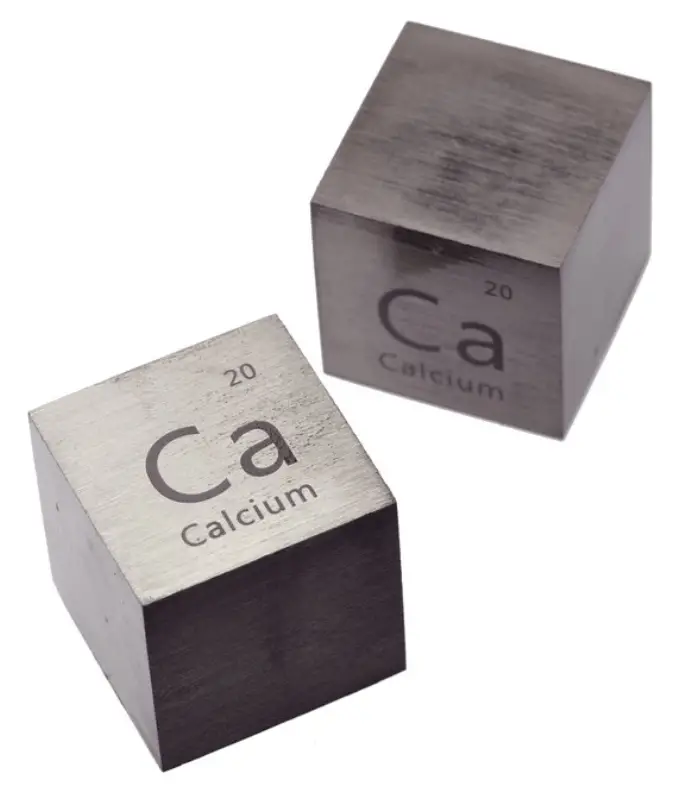
Calcium-periodic-table

Source: www.luciteria.com

Mechanical Properties of Calcium

Calcium-mechanical-properties-strength-hardness-crystal-structure

Strength of Calcium

In mechanics of materials, the strength of a material is its ability to withstand an applied load without failure or plastic deformation. Strength of materials basically considers the relationship between the external loads applied to a material and the resulting deformation or change in material dimensions. In designing structures and machines, it is important to consider these factors, in order that the material selected will have adequate strength to resist applied loads or forces and retain its original shape. Strength of a material is its ability to withstand this applied load without failure or plastic deformation.

For tensile stress, the capacity of a material or structure to withstand loads tending to elongate is known as ultimate tensile strength (UTS). Yield strength or yield stress is the material property defined as the stress at which a material begins to deform plastically whereas yield point is the point where nonlinear (elastic + plastic) deformation begins.

See also: Strength of Materials

Ultimate Tensile Strength of Calcium

Ultimate tensile strength of Calcium is 110 MPa.

Yield Strength of Calcium

Yield strength of Calcium is N/A.

Modulus of Elasticity of Calcium

The Young’s modulus of elasticity of Calcium is 20 GPa.

Hardness of Calcium

In materials science, hardness is the ability to withstand surface indentation (localized plastic deformation) and scratching. Brinell hardness test is one of indentation hardness tests, that has been developed for hardness testing. In Brinell tests, a hard, spherical indenter is forced under a specific load into the surface of the metal to be tested.

Brinell hardness of Calcium is approximately 170 – 400 MPa.

The Vickers hardness test method was developed by Robert L. Smith and George E. Sandland at Vickers Ltd as an alternative to the Brinell method to measure the hardness of materials. The Vickers hardness test method can be also used as a microhardness test method, which is mostly used for small parts, thin sections, or case depth work.

Vickers hardness of Calcium is approximately N/A.

Scratch hardness is the measure of how resistant a sample is to permanent plastic deformation due to friction from a sharp object. The most common scale for this qualitative test is Mohs scale, which is used in mineralogy. The Mohs scale of mineral hardness is based on the ability of one natural sample of mineral to scratch another mineral visibly.

Calcium is has a hardness of approximately 1.5.

See also: Hardness of Materials

Calcium – Crystal Structure

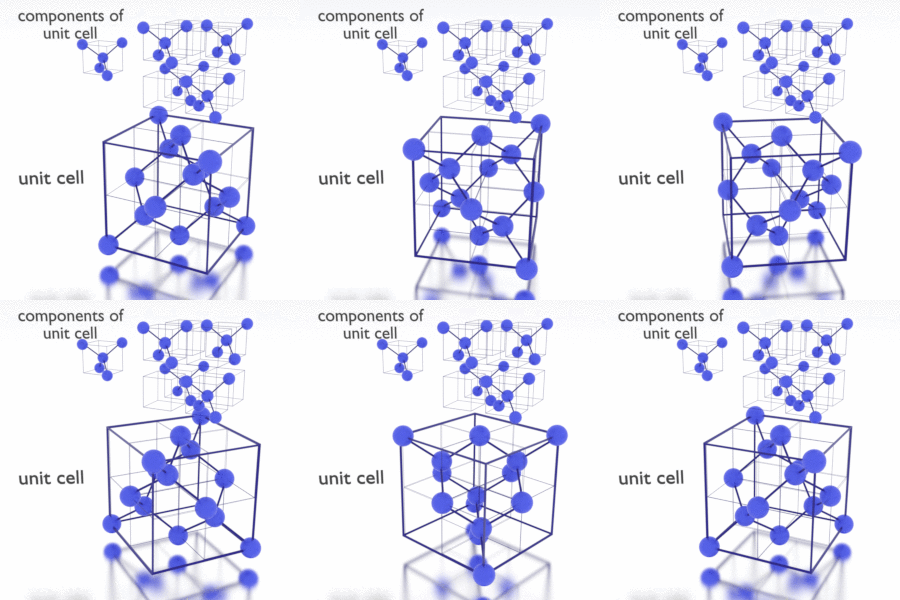
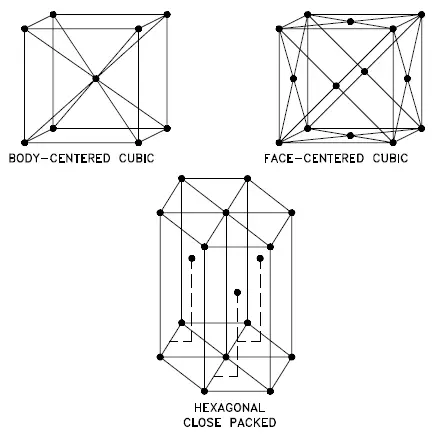
A possible crystal structure of Calcium is face-centered cubic structure.
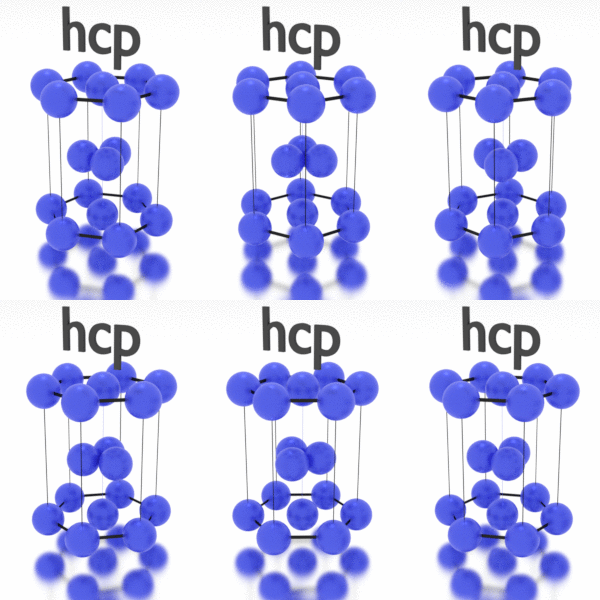
crystal structures - FCC, BCC, HCP

In metals, and in many other solids, the atoms are arranged in regular arrays called crystals. A crystal lattice is a repeating pattern of mathematical points that extends throughout space. The forces of chemical bonding causes this repetition. It is this repeated pattern which control properties like strength, ductility, density, conductivity (property of conducting or transmitting heat, electricity, etc.), and shape. There are 14 general types of such patterns known as Bravais lattices.

See also: Crystal Structure of Materials

Crystal Structure of Calcium

Crystal Structure of Calcium is: face-centered cubic

Strength of Elements

Elasticity of Elements
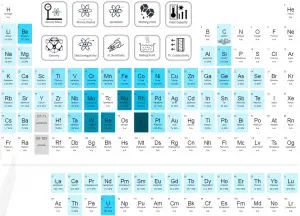
Hardness of Elements
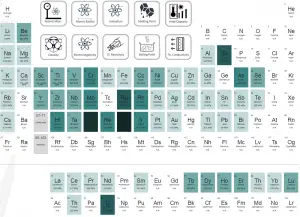
 

Thermal Properties of Calcium

Calcium-melting-point-conductivity-thermal-properties

Calcium – Melting Point and Boiling Point

Melting point of Calcium is 842°C.

Boiling point of Calcium is 1484°C.

Note that, these points are associated with the standard atmospheric pressure.

Calcium – Thermal Conductivity

Thermal conductivity of Calcium is 200 W/(m·K).

The heat transfer characteristics of a solid material are measured by a property called the thermal conductivity, k (or λ), measured in W/m.K. It is a measure of a substance’s ability to transfer heat through a material by conduction. Note that Fourier’s law applies for all matter, regardless of its state (solid, liquid, or gas), therefore, it is also defined for liquids and gases.

Coefficient of Thermal Expansion of Calcium

Linear thermal expansion coefficient of Calcium is 22.3 µm/(m·K)

Thermal expansion is generally the tendency of matter to change its dimensions in response to a change in temperature. It is usually expressed as a fractional change in length or volume per unit temperature change.

Calcium – Specific Heat, Latent Heat of Fusion, Latent Heat of Vaporization

Specific heat of Calcium is 0.63 J/g K.

Heat capacity is an extensive property of matter, meaning it is proportional to the size of the system. Heat capacity C has the unit of energy per degree or energy per kelvin. When expressing the same phenomenon as an intensive property, the heat capacity is divided by the amount of substance, mass, or volume, thus the quantity is independent of the size or extent of the sample.

Latent Heat of Fusion of Calcium is 8.54 kJ/mol.

Latent Heat of Vaporization of Calcium is 153.3 kJ/mol.

Latent heat is the amount of heat added to or removed from a substance to produce a change in phase. This energy breaks down the intermolecular attractive forces, and also must provide the energy necessary to expand the gas (the pΔV work). When latent heat is added, no temperature change occurs. The enthalpy of vaporization is a function of the pressure at which that transformation takes place.

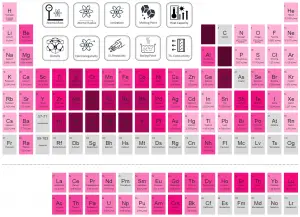
Melting Point of Elements
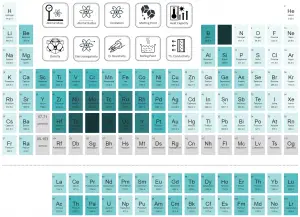
Periodic Table of Elements - melting point

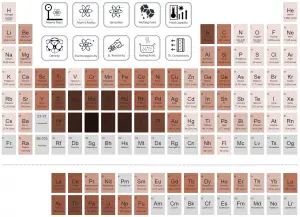
Thermal Conductivity of Elements

Periodic Table of Elements - thermal conductivity

Thermal Expansion of Elements

Periodic Table of Elements - thermal expansion

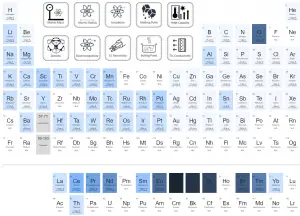
Heat Capacity of Elements

Periodic Table of Elements - heat capacity

Heat of Fusion of Elements

Periodic Table of Elements - latent heat fusion

Heat of Vaporization of Elements

Periodic Table of Elements - latent heat vaporization

Calcium – Electrical Resistivity – Magnetic Susceptibility

Calcium-electrical-resistivity-magnetic-susceptibility

Electrical property refers to the response of a material to an applied electric field. One of the principal characteristics of materials is their ability (or lack of ability) to conduct electrical current. Indeed, materials are classified by this property, that is, they are divided into conductors, semiconductors, and nonconductors.

See also: Electrical Properties

Magnetic property refers to the response of a material to an applied magnetic field. The macroscopic magnetic properties of a material are a consequence of interactions between an external magnetic field and the magnetic dipole moments of the constituent atoms. Different materials react to the application of magnetic field differently.

See also: Magnetic Properties

Electrical Resistivity of Calcium

Electrical resistivity of Calcium is 33.6 nΩ⋅m.

Electrical conductivity and its converse, electrical resistivity, is a fundamental property of a material that quantifies how Calcium conducts the flow of electric current. Electrical conductivity or specific conductance is the reciprocal of electrical resistivity.

Magnetic Susceptibility of Calcium

Magnetic susceptibility of Calcium is +40e-6 cm^3/mol.

In electromagnetism, magnetic susceptibility is the measure of the magnetization of a substance. Magnetic susceptibility is a dimensionless proportionality factor that indicates the degree of magnetization of Calcium in response to an applied magnetic field.

Electrical Resistivity of Elements
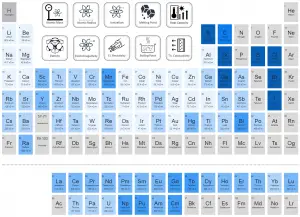
Periodic Table of Elements - electrical resistivity

Magnetic Susceptibility of Elements

Application and prices of other elements

Calcium - Comparison of Properties and Prices

Periodic Table in 8K resolution

Other properties of Calcium


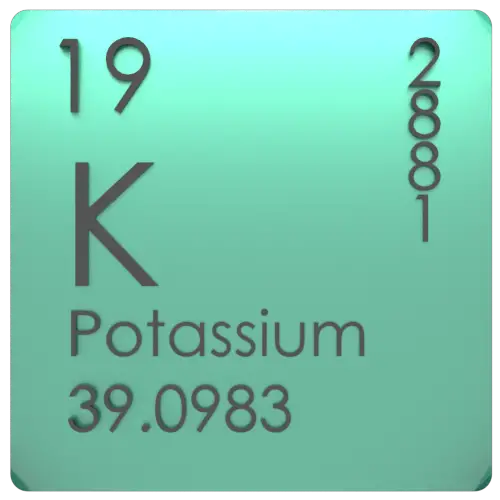
Potassium – Properties – Price – Applications – Production

Potassium-properties-price-application-production

About Potassium

Potassium was first isolated from potash, the ashes of plants, from which its name derives. In the periodic table, potassium is one of the alkali metals. All of the alkali metals have a single valence electron in the outer electron shell, which is easily removed to create an ion with a positive charge – a cation, which combines with anions to form salts. Naturally occurring potassium is composed of three isotopes, of which 40K is radioactive. Traces of 40K are found in all potassium, and it is the most common radioisotope in the human body.

Summary

Element Potassium
Atomic number 19
Element category Alkali Metal
Phase at STP Solid
Density 0.856 g/cm3
Ultimate Tensile Strength N/A
Yield Strength N/A
Young’s Modulus of Elasticity 3.53 GPa
Mohs Scale 0.4
Brinell Hardness 0.36 MPa
Vickers Hardness N/A
Melting Point 63.25 °C
Boiling Point 760 °C
Thermal Conductivity 102.4 W/mK
Thermal Expansion Coefficient 83 µm/mK
Specific Heat 0.75 J/g K
Heat of Fusion 2.334 kJ/mol
Heat of Vaporization 79.87 kJ/mol
Electrical resistivity [nanoOhm meter] 72
Magnetic Susceptibility +20.8e-6 cm^3/mol

Applications of Potassium

Potassium (K) is an essential nutrient for plant growth. It’s classified as a macronutrient because plants take up large quantities of K during their life cycle. Agricultural fertilizers consume 95% of global potassium chemical production, and about 90% of this potassium is supplied as KCl. Due to its high degree of reactivity, pure potassium is rarely used in its elemental /metallic form. It is used as a powerful reducing agent in organic chemistry. Potassium/Sodium alloys are It used as a heat exchange medium . The heat in the potassium warms water and makes it hot enough to boil. Then water is changed into steam, which is used to work devices that generate electricity.

Potassium-applications

Production and Price of Potassium

Raw materials prices change daily. They are primarily driven by supply, demand and energy prices. In 2019, prices of pure Potassium were at around 850 $/kg.

Potassium compounds can be extracted from the earth as it is found in many solids, soil and seawater. The earliest version known to man was potash, which could be easily obtained by simply burning a tree and gathering potash from the ashes. The principal source of potassium – potash – is mined in Canada, Russia, Belarus, Kazakhstan, Germany, Israel, United States, Jordan, and other places around the world.

Potassium-periodic-table

Source: www.luciteria.com

Mechanical Properties of Potassium

Potassium-mechanical-properties-strength-hardness-crystal-structure

Strength of Potassium

In mechanics of materials, the strength of a material is its ability to withstand an applied load without failure or plastic deformation. Strength of materials basically considers the relationship between the external loads applied to a material and the resulting deformation or change in material dimensions. In designing structures and machines, it is important to consider these factors, in order that the material selected will have adequate strength to resist applied loads or forces and retain its original shape. Strength of a material is its ability to withstand this applied load without failure or plastic deformation.

For tensile stress, the capacity of a material or structure to withstand loads tending to elongate is known as ultimate tensile strength (UTS). Yield strength or yield stress is the material property defined as the stress at which a material begins to deform plastically whereas yield point is the point where nonlinear (elastic + plastic) deformation begins.

See also: Strength of Materials

Ultimate Tensile Strength of Potassium

Ultimate tensile strength of Potassium is N/A.

Yield Strength of Potassium

Yield strength of Potassium is N/A.

Modulus of Elasticity of Potassium

The Young’s modulus of elasticity of Potassium is 3.53 GPa.

Hardness of Potassium

In materials science, hardness is the ability to withstand surface indentation (localized plastic deformation) and scratching. Brinell hardness test is one of indentation hardness tests, that has been developed for hardness testing. In Brinell tests, a hard, spherical indenter is forced under a specific load into the surface of the metal to be tested.

Brinell hardness of Potassium is approximately 0.36 MPa.

The Vickers hardness test method was developed by Robert L. Smith and George E. Sandland at Vickers Ltd as an alternative to the Brinell method to measure the hardness of materials. The Vickers hardness test method can be also used as a microhardness test method, which is mostly used for small parts, thin sections, or case depth work.

Vickers hardness of Potassium is approximately N/A.

Scratch hardness is the measure of how resistant a sample is to permanent plastic deformation due to friction from a sharp object. The most common scale for this qualitative test is Mohs scale, which is used in mineralogy. The Mohs scale of mineral hardness is based on the ability of one natural sample of mineral to scratch another mineral visibly.

Potassium is has a hardness of approximately 0.4.

See also: Hardness of Materials

Potassium – Crystal Structure

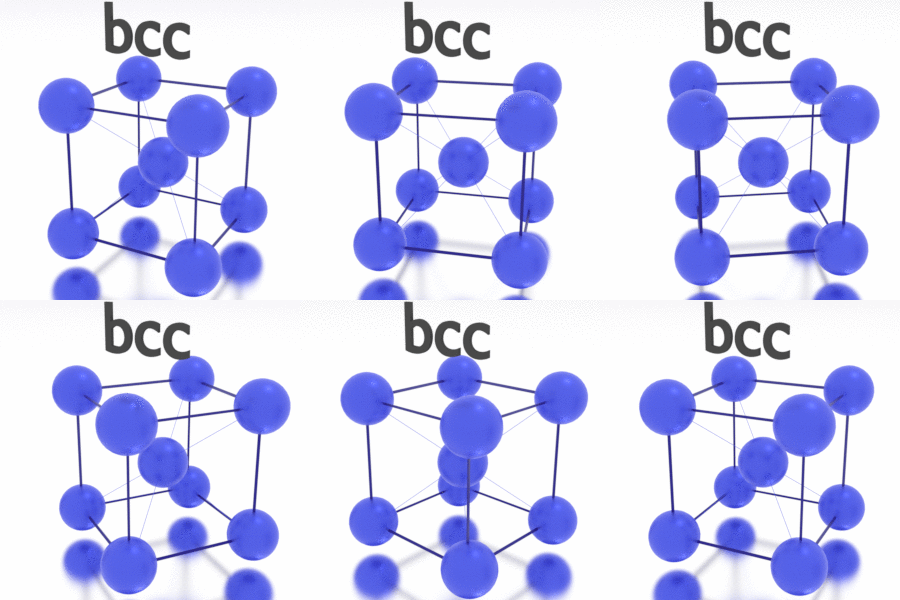
A possible crystal structure of Potassium is body-centered cubic structure.

crystal structures - FCC, BCC, HCP

In metals, and in many other solids, the atoms are arranged in regular arrays called crystals. A crystal lattice is a repeating pattern of mathematical points that extends throughout space. The forces of chemical bonding causes this repetition. It is this repeated pattern which control properties like strength, ductility, density, conductivity (property of conducting or transmitting heat, electricity, etc.), and shape. There are 14 general types of such patterns known as Bravais lattices.

See also: Crystal Structure of Materials

Crystal Structure of Potassium
Crystal Structure of Potassium is: body-centered cubic

Strength of Elements

Elasticity of Elements

Hardness of Elements


Thermal Properties of Potassium

Potassium-melting-point-conductivity-thermal-properties

Potassium – Melting Point and Boiling Point

Melting point of Potassium is 63.25°C.

Boiling point of Potassium is 760°C.

Note that, these points are associated with the standard atmospheric pressure.

Potassium – Thermal Conductivity

Thermal conductivity of Potassium is 102.4 W/(m·K).

The heat transfer characteristics of a solid material are measured by a property called the thermal conductivity, k (or λ), measured in W/m.K. It is a measure of a substance’s ability to transfer heat through a material by conduction. Note that Fourier’s law applies for all matter, regardless of its state (solid, liquid, or gas), therefore, it is also defined for liquids and gases.

Coefficient of Thermal Expansion of Potassium

Linear thermal expansion coefficient of Potassium is 83 µm/(m·K)

Thermal expansion is generally the tendency of matter to change its dimensions in response to a change in temperature. It is usually expressed as a fractional change in length or volume per unit temperature change.

Potassium – Specific Heat, Latent Heat of Fusion, Latent Heat of Vaporization

Specific heat of Potassium is 0.75 J/g K.

Heat capacity is an extensive property of matter, meaning it is proportional to the size of the system. Heat capacity C has the unit of energy per degree or energy per kelvin. When expressing the same phenomenon as an intensive property, the heat capacity is divided by the amount of substance, mass, or volume, thus the quantity is independent of the size or extent of the sample.

Latent Heat of Fusion of Potassium is 2.334 kJ/mol.

Latent Heat of Vaporization of Potassium is 79.87 kJ/mol.

Latent heat is the amount of heat added to or removed from a substance to produce a change in phase. This energy breaks down the intermolecular attractive forces, and also must provide the energy necessary to expand the gas (the pΔV work). When latent heat is added, no temperature change occurs. The enthalpy of vaporization is a function of the pressure at which that transformation takes place.

Melting Point of Elements

Periodic Table of Elements - melting point

Thermal Conductivity of Elements

Periodic Table of Elements - thermal conductivity

Thermal Expansion of Elements

Periodic Table of Elements - thermal expansion

Heat Capacity of Elements

Periodic Table of Elements - heat capacity

Heat of Fusion of Elements

Periodic Table of Elements - latent heat fusion

Heat of Vaporization of Elements

Periodic Table of Elements - latent heat vaporization

Potassium – Electrical Resistivity – Magnetic Susceptibility

Potassium-electrical-resistivity-magnetic-susceptibility

Electrical property refers to the response of a material to an applied electric field. One of the principal characteristics of materials is their ability (or lack of ability) to conduct electrical current. Indeed, materials are classified by this property, that is, they are divided into conductors, semiconductors, and nonconductors.

See also: Electrical Properties

Magnetic property refers to the response of a material to an applied magnetic field. The macroscopic magnetic properties of a material are a consequence of interactions between an external magnetic field and the magnetic dipole moments of the constituent atoms. Different materials react to the application of magnetic field differently.

See also: Magnetic Properties

Electrical Resistivity of Potassium

Electrical resistivity of Potassium is 72 nΩ⋅m.

Electrical conductivity and its converse, electrical resistivity, is a fundamental property of a material that quantifies how Potassium conducts the flow of electric current. Electrical conductivity or specific conductance is the reciprocal of electrical resistivity.

Magnetic Susceptibility of Potassium

Magnetic susceptibility of Potassium is +20.8e-6 cm^3/mol.

In electromagnetism, magnetic susceptibility is the measure of the magnetization of a substance. Magnetic susceptibility is a dimensionless proportionality factor that indicates the degree of magnetization of Potassium in response to an applied magnetic field.

Electrical Resistivity of Elements

Periodic Table of Elements - electrical resistivity

Magnetic Susceptibility of Elements

Application and prices of other elements

Potassium - Comparison of Properties and Prices

Periodic Table in 8K resolution

Other properties of Potassium


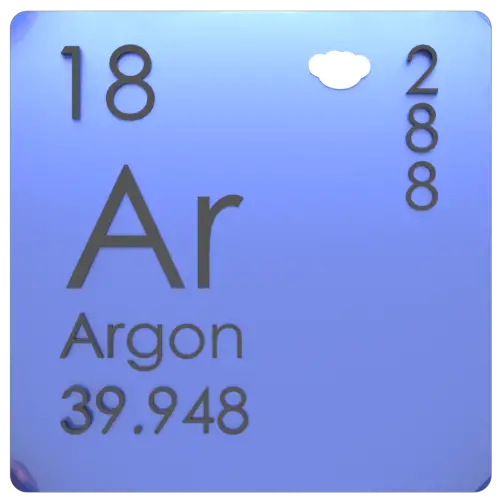
Argon – Properties – Price – Applications – Production

Argon-properties-price-application-production

About Argon

Argon is the third-most abundant gas in the Earth’s atmosphere, at 0.934% (9340 ppmv). It is more than twice as abundant as water vapor (which averages about 4000 ppmv, but varies greatly), 23 times as abundant as carbon dioxide (400 ppmv), and more than 500 times as abundant as neon (18 ppmv). Argon is mostly used as an inert shielding gas in welding and other high-temperature industrial processes where ordinarily unreactive substances become reactive; for example, an argon atmosphere is used in graphite electric furnaces to prevent the graphite from burning.

Summary

Element Argon
Atomic number 18
Element category Noble Gas
Phase at STP Gas
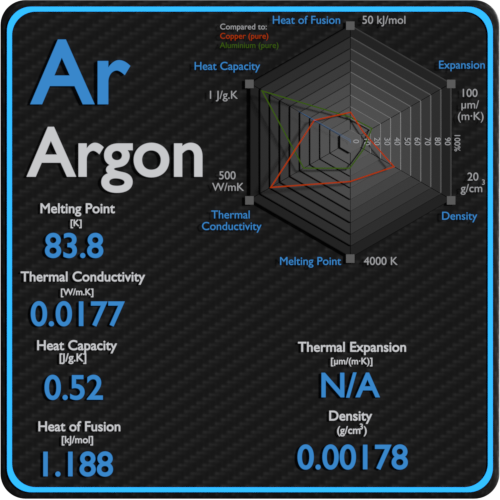
Density 0.00178 g/cm3
Ultimate Tensile Strength N/A
Yield Strength N/A
Young’s Modulus of Elasticity N/A
Mohs Scale N/A
Brinell Hardness N/A
Vickers Hardness N/A
Melting Point -189.2 °C
Boiling Point -185.7 °C
Thermal Conductivity 0.01772 W/mK
Thermal Expansion Coefficient — µm/mK
Specific Heat 0.52 J/g K
Heat of Fusion 1.188 kJ/mol
Heat of Vaporization 6.447 kJ/mol
Electrical resistivity [nanoOhm meter] —
Magnetic Susceptibility −19.6e-6 cm^3/mol

Applications of Argon

The major applications of argon include the following: electric lamps as filler gas, welding purpose, discharge tubes, argon lasers and argon-dye lasers. Argon is mostly used as an inert shielding gas in welding and other high-temperature industrial processes where ordinarily unreactive substances become reactive; for example, an argon atmosphere is used in graphite electric furnaces to prevent the graphite from burning. Argon is also used in incandescent, fluorescent lighting, and other gas-discharge tubes.

Argon-applications

Production and Price of Argon

Raw materials prices change daily. They are primarily driven by supply, demand and energy prices. In 2019, prices of pure Argon were at around 5 $/kg.

Argon is produced industrially by the fractional distillation of liquid air. a process that separates liquid nitrogen, which boils at 77.3 K, from argon, which boils at 87.3 K, and liquid oxygen, which boils at 90.2 K. About 700,000 tonnes of argon are produced worldwide every year.

Argon-periodic-table

Source: www.luciteria.com

Mechanical Properties of Argon

Argon-mechanical-properties-strength-hardness-crystal-structure

Strength of Argon

In mechanics of materials, the strength of a material is its ability to withstand an applied load without failure or plastic deformation. Strength of materials basically considers the relationship between the external loads applied to a material and the resulting deformation or change in material dimensions. In designing structures and machines, it is important to consider these factors, in order that the material selected will have adequate strength to resist applied loads or forces and retain its original shape. Strength of a material is its ability to withstand this applied load without failure or plastic deformation.

For tensile stress, the capacity of a material or structure to withstand loads tending to elongate is known as ultimate tensile strength (UTS). Yield strength or yield stress is the material property defined as the stress at which a material begins to deform plastically whereas yield point is the point where nonlinear (elastic + plastic) deformation begins.

See also: Strength of Materials

Ultimate Tensile Strength of Argon

Ultimate tensile strength of Argon is N/A.

Yield Strength of Argon

Yield strength of Argon is N/A.

Modulus of Elasticity of Argon

The Young’s modulus of elasticity of Argon is N/A.

Hardness of Argon

In materials science, hardness is the ability to withstand surface indentation (localized plastic deformation) and scratching. Brinell hardness test is one of indentation hardness tests, that has been developed for hardness testing. In Brinell tests, a hard, spherical indenter is forced under a specific load into the surface of the metal to be tested.

Brinell hardness of Argon is approximately N/A.

The Vickers hardness test method was developed by Robert L. Smith and George E. Sandland at Vickers Ltd as an alternative to the Brinell method to measure the hardness of materials. The Vickers hardness test method can be also used as a microhardness test method, which is mostly used for small parts, thin sections, or case depth work.

Vickers hardness of Argon is approximately N/A.

Scratch hardness is the measure of how resistant a sample is to permanent plastic deformation due to friction from a sharp object. The most common scale for this qualitative test is Mohs scale, which is used in mineralogy. The Mohs scale of mineral hardness is based on the ability of one natural sample of mineral to scratch another mineral visibly.

Argon is has a hardness of approximately N/A.

See also: Hardness of Materials

Argon – Crystal Structure

A possible crystal structure of Argon is face-centered cubic structure.

crystal structures - FCC, BCC, HCP

In metals, and in many other solids, the atoms are arranged in regular arrays called crystals. A crystal lattice is a repeating pattern of mathematical points that extends throughout space. The forces of chemical bonding causes this repetition. It is this repeated pattern which control properties like strength, ductility, density, conductivity (property of conducting or transmitting heat, electricity, etc.), and shape. There are 14 general types of such patterns known as Bravais lattices.

See also: Crystal Structure of Materials

Crystal Structure of Argon
Crystal Structure of Argon is: face-centered cubic

Strength of Elements

Elasticity of Elements

Hardness of Elements


Thermal Properties of Argon

Argon-melting-point-conductivity-thermal-properties

Argon – Melting Point and Boiling Point

Melting point of Argon is -189.2°C.

Boiling point of Argon is -185.7°C.

Note that, these points are associated with the standard atmospheric pressure.

Argon – Thermal Conductivity

Thermal conductivity of Argon is 0.01772 W/(m·K).

The heat transfer characteristics of a solid material are measured by a property called the thermal conductivity, k (or λ), measured in W/m.K. It is a measure of a substance’s ability to transfer heat through a material by conduction. Note that Fourier’s law applies for all matter, regardless of its state (solid, liquid, or gas), therefore, it is also defined for liquids and gases.

Coefficient of Thermal Expansion of Argon

Linear thermal expansion coefficient of Argon is — µm/(m·K)

Thermal expansion is generally the tendency of matter to change its dimensions in response to a change in temperature. It is usually expressed as a fractional change in length or volume per unit temperature change.

Argon – Specific Heat, Latent Heat of Fusion, Latent Heat of Vaporization

Specific heat of Argon is 0.52 J/g K.

Heat capacity is an extensive property of matter, meaning it is proportional to the size of the system. Heat capacity C has the unit of energy per degree or energy per kelvin. When expressing the same phenomenon as an intensive property, the heat capacity is divided by the amount of substance, mass, or volume, thus the quantity is independent of the size or extent of the sample.

Latent Heat of Fusion of Argon is 1.188 kJ/mol.

Latent Heat of Vaporization of Argon is 6.447 kJ/mol.

Latent heat is the amount of heat added to or removed from a substance to produce a change in phase. This energy breaks down the intermolecular attractive forces, and also must provide the energy necessary to expand the gas (the pΔV work). When latent heat is added, no temperature change occurs. The enthalpy of vaporization is a function of the pressure at which that transformation takes place.

Melting Point of Elements

Periodic Table of Elements - melting point

Thermal Conductivity of Elements

Periodic Table of Elements - thermal conductivity

Thermal Expansion of Elements

Periodic Table of Elements - thermal expansion

Heat Capacity of Elements

Periodic Table of Elements - heat capacity

Heat of Fusion of Elements

Periodic Table of Elements - latent heat fusion

Heat of Vaporization of Elements

Periodic Table of Elements - latent heat vaporization

Argon – Electrical Resistivity – Magnetic Susceptibility

Argon-electrical-resistivity-magnetic-susceptibility

Electrical property refers to the response of a material to an applied electric field. One of the principal characteristics of materials is their ability (or lack of ability) to conduct electrical current. Indeed, materials are classified by this property, that is, they are divided into conductors, semiconductors, and nonconductors.

See also: Electrical Properties

Magnetic property refers to the response of a material to an applied magnetic field. The macroscopic magnetic properties of a material are a consequence of interactions between an external magnetic field and the magnetic dipole moments of the constituent atoms. Different materials react to the application of magnetic field differently.

See also: Magnetic Properties

Electrical Resistivity of Argon

Electrical resistivity of Argon is — nΩ⋅m.

Electrical conductivity and its converse, electrical resistivity, is a fundamental property of a material that quantifies how Argon conducts the flow of electric current. Electrical conductivity or specific conductance is the reciprocal of electrical resistivity.

Magnetic Susceptibility of Argon

Magnetic susceptibility of Argon is −19.6e-6 cm^3/mol.

In electromagnetism, magnetic susceptibility is the measure of the magnetization of a substance. Magnetic susceptibility is a dimensionless proportionality factor that indicates the degree of magnetization of Argon in response to an applied magnetic field.

Electrical Resistivity of Elements

Periodic Table of Elements - electrical resistivity

Magnetic Susceptibility of Elements

Application and prices of other elements

Argon - Comparison of Properties and Prices

Periodic Table in 8K resolution

Other properties of Argon


Chlorine – Properties – Price – Applications – Production

Chlorine-properties-price-application-production

About Chlorine

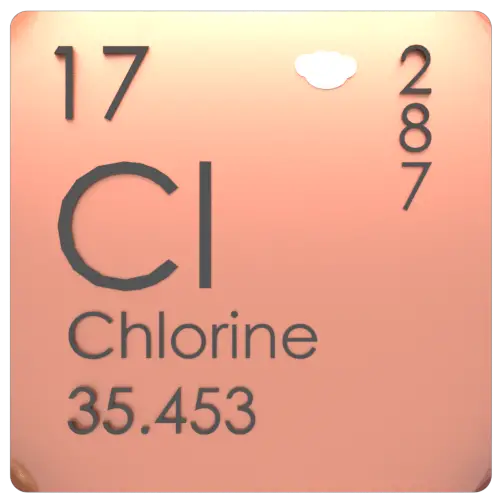
Chlorine is a yellow-green gas at room temperature. It is an extremely reactive element and a strong oxidising agent: among the elements, it has the highest electron affinity and the third-highest electronegativity, behind only oxygen and fluorine.

Summary

Element Chlorine
Atomic number 17
Element category Halogen
Phase at STP Gas
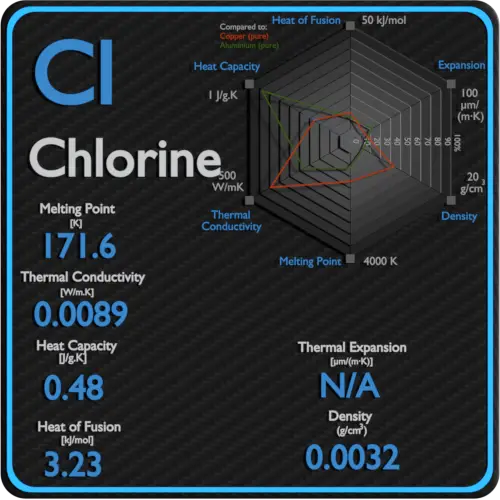
Density 0.0032 g/cm3
Ultimate Tensile Strength N/A
Yield Strength N/A
Young’s Modulus of Elasticity N/A
Mohs Scale N/A
Brinell Hardness N/A
Vickers Hardness N/A
Melting Point -101 °C
Boiling Point -34.6 °C
Thermal Conductivity 0.0089 W/mK
Thermal Expansion Coefficient — µm/mK
Specific Heat 0.48 J/g K
Heat of Fusion 3.23 kJ/mol
Heat of Vaporization 10.2 kJ/mol
Electrical resistivity [nanoOhm meter] 1E10
Magnetic Susceptibility −40.5e-6 cm^3/mol

Applications of Chlorine

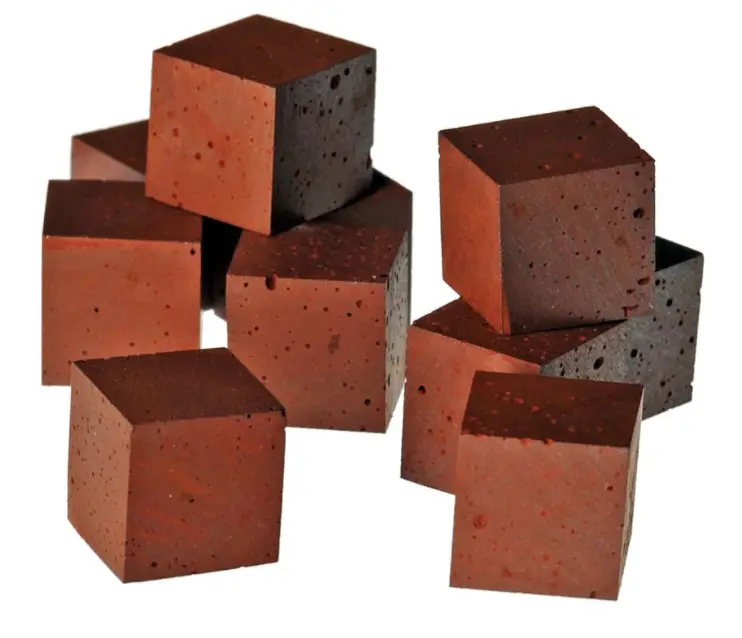
Chlorine is used in the manufacture of a wide range of consumer products, about two-thirds of them organic chemicals such as polyvinyl chloride (PVC), many intermediates for the production of plastics, and other end products which do not contain the element. As a common disinfectant, elemental chlorine and chlorine-generating compounds are used more directly in swimming pools to keep them sanitary. While perhaps best known for its role in providing clean drinking water, chlorine chemistry also helps provide energy-efficient building materials, electronics, fiber optics, solar energy cells, 93 percent of life-saving pharmaceuticals, 86 percent of crop protection compounds, medical plastics, and much more.

Chlorine-applications

Production and Price of Chlorine

Raw materials prices change daily. They are primarily driven by supply, demand and energy prices. In 2019, prices of pure Chlorine were at around 1.5 $/kg.

Elemental chlorine is commercially produced from brine by electrolysis, predominantly in the chlor-alkali process. By electrolysis of a concentrated solution of sodium chloride in water. Hydrogen is generated at the cathode and chlorine at the anode. At the same time, sodium hydroxide is produced in the electrolyte; hence, this process is often referred to as chlorine-alkali electrolysis. According to The Chlorine Institute statistics, in 2010, the U.S. chlor-alkali industry produced 11.6 million short tons of chlorine and 12.2 million short tons of caustic soda (sodium hydroxide).

Chlorine-periodic-table

Source: www.luciteria.com

Mechanical Properties of Chlorine

Chlorine-mechanical-properties-strength-hardness-crystal-structure

Strength of Chlorine

In mechanics of materials, the strength of a material is its ability to withstand an applied load without failure or plastic deformation. Strength of materials basically considers the relationship between the external loads applied to a material and the resulting deformation or change in material dimensions. In designing structures and machines, it is important to consider these factors, in order that the material selected will have adequate strength to resist applied loads or forces and retain its original shape. Strength of a material is its ability to withstand this applied load without failure or plastic deformation.

For tensile stress, the capacity of a material or structure to withstand loads tending to elongate is known as ultimate tensile strength (UTS). Yield strength or yield stress is the material property defined as the stress at which a material begins to deform plastically whereas yield point is the point where nonlinear (elastic + plastic) deformation begins.

See also: Strength of Materials

Ultimate Tensile Strength of Chlorine

Ultimate tensile strength of Chlorine is N/A.

Yield Strength of Chlorine

Yield strength of Chlorine is N/A.

Modulus of Elasticity of Chlorine

The Young’s modulus of elasticity of Chlorine is N/A.

Hardness of Chlorine

In materials science, hardness is the ability to withstand surface indentation (localized plastic deformation) and scratching. Brinell hardness test is one of indentation hardness tests, that has been developed for hardness testing. In Brinell tests, a hard, spherical indenter is forced under a specific load into the surface of the metal to be tested.

Brinell hardness of Chlorine is approximately N/A.

The Vickers hardness test method was developed by Robert L. Smith and George E. Sandland at Vickers Ltd as an alternative to the Brinell method to measure the hardness of materials. The Vickers hardness test method can be also used as a microhardness test method, which is mostly used for small parts, thin sections, or case depth work.

Vickers hardness of Chlorine is approximately N/A.

Scratch hardness is the measure of how resistant a sample is to permanent plastic deformation due to friction from a sharp object. The most common scale for this qualitative test is Mohs scale, which is used in mineralogy. The Mohs scale of mineral hardness is based on the ability of one natural sample of mineral to scratch another mineral visibly.

Chlorine is has a hardness of approximately N/A.

See also: Hardness of Materials

Chlorine – Crystal Structure

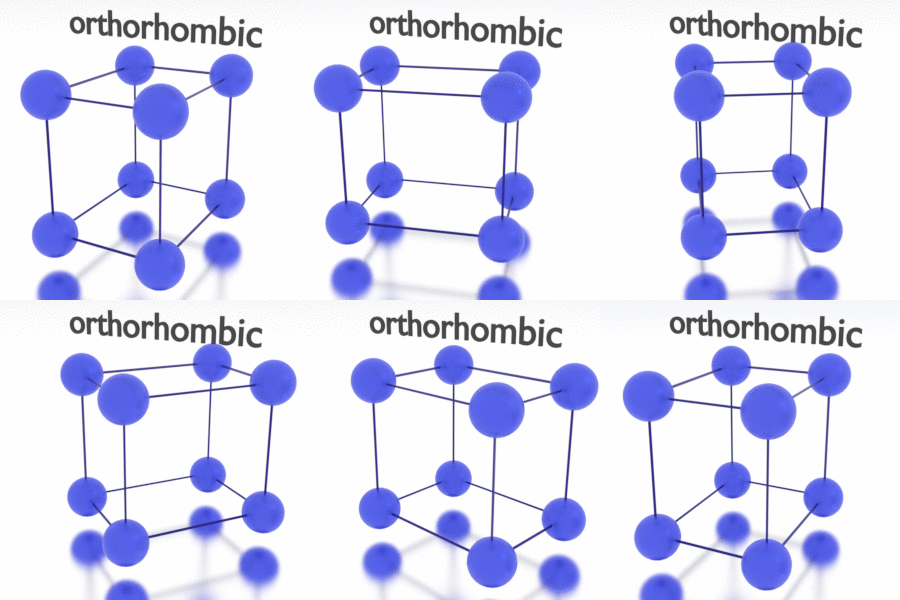
A possible crystal structure of Chlorine is orthorhombic structure.

crystal structures - FCC, BCC, HCP

In metals, and in many other solids, the atoms are arranged in regular arrays called crystals. A crystal lattice is a repeating pattern of mathematical points that extends throughout space. The forces of chemical bonding causes this repetition. It is this repeated pattern which control properties like strength, ductility, density, conductivity (property of conducting or transmitting heat, electricity, etc.), and shape. There are 14 general types of such patterns known as Bravais lattices.

See also: Crystal Structure of Materials

Crystal Structure of Chlorine
Crystal Structure of Chlorine is: orthorhombic

Strength of Elements

Elasticity of Elements

Hardness of Elements


Thermal Properties of Chlorine

Chlorine-melting-point-conductivity-thermal-properties

Chlorine – Melting Point and Boiling Point

Melting point of Chlorine is -101°C.

Boiling point of Chlorine is -34.6°C.

Note that, these points are associated with the standard atmospheric pressure.

Chlorine – Thermal Conductivity

Thermal conductivity of Chlorine is 0.0089 W/(m·K).

The heat transfer characteristics of a solid material are measured by a property called the thermal conductivity, k (or λ), measured in W/m.K. It is a measure of a substance’s ability to transfer heat through a material by conduction. Note that Fourier’s law applies for all matter, regardless of its state (solid, liquid, or gas), therefore, it is also defined for liquids and gases.

Coefficient of Thermal Expansion of Chlorine

Linear thermal expansion coefficient of Chlorine is — µm/(m·K)

Thermal expansion is generally the tendency of matter to change its dimensions in response to a change in temperature. It is usually expressed as a fractional change in length or volume per unit temperature change.

Chlorine – Specific Heat, Latent Heat of Fusion, Latent Heat of Vaporization

Specific heat of Chlorine is 0.48 J/g K.

Heat capacity is an extensive property of matter, meaning it is proportional to the size of the system. Heat capacity C has the unit of energy per degree or energy per kelvin. When expressing the same phenomenon as an intensive property, the heat capacity is divided by the amount of substance, mass, or volume, thus the quantity is independent of the size or extent of the sample.

Latent Heat of Fusion of Chlorine is 3.23 kJ/mol.

Latent Heat of Vaporization of Chlorine is 10.2 kJ/mol.

Latent heat is the amount of heat added to or removed from a substance to produce a change in phase. This energy breaks down the intermolecular attractive forces, and also must provide the energy necessary to expand the gas (the pΔV work). When latent heat is added, no temperature change occurs. The enthalpy of vaporization is a function of the pressure at which that transformation takes place.

Melting Point of Elements

Periodic Table of Elements - melting point

Thermal Conductivity of Elements

Periodic Table of Elements - thermal conductivity

Thermal Expansion of Elements

Periodic Table of Elements - thermal expansion

Heat Capacity of Elements

Periodic Table of Elements - heat capacity

Heat of Fusion of Elements

Periodic Table of Elements - latent heat fusion

Heat of Vaporization of Elements

Periodic Table of Elements - latent heat vaporization

Chlorine – Electrical Resistivity – Magnetic Susceptibility

Chlorine-electrical-resistivity-magnetic-susceptibility

Electrical property refers to the response of a material to an applied electric field. One of the principal characteristics of materials is their ability (or lack of ability) to conduct electrical current. Indeed, materials are classified by this property, that is, they are divided into conductors, semiconductors, and nonconductors.

See also: Electrical Properties

Magnetic property refers to the response of a material to an applied magnetic field. The macroscopic magnetic properties of a material are a consequence of interactions between an external magnetic field and the magnetic dipole moments of the constituent atoms. Different materials react to the application of magnetic field differently.

See also: Magnetic Properties

Electrical Resistivity of Chlorine

Electrical resistivity of Chlorine is 1E10 nΩ⋅m.

Electrical conductivity and its converse, electrical resistivity, is a fundamental property of a material that quantifies how Chlorine conducts the flow of electric current. Electrical conductivity or specific conductance is the reciprocal of electrical resistivity.

Magnetic Susceptibility of Chlorine

Magnetic susceptibility of Chlorine is −40.5e-6 cm^3/mol.

In electromagnetism, magnetic susceptibility is the measure of the magnetization of a substance. Magnetic susceptibility is a dimensionless proportionality factor that indicates the degree of magnetization of Chlorine in response to an applied magnetic field.

Electrical Resistivity of Elements

Periodic Table of Elements - electrical resistivity

Magnetic Susceptibility of Elements

Application and prices of other elements

Chlorine - Comparison of Properties and Prices

Periodic Table in 8K resolution

Other properties of Chlorine


Sulfur – Properties – Price – Applications – Production

Sulfur-properties-price-application-production

About Sulfur

Sulfur is abundant, multivalent, and nonmetallic. Under normal conditions, sulfur atoms form cyclic octatomic molecules with a chemical formula S8. Elemental sulfur is a bright yellow crystalline solid at room temperature. Chemically, sulfur reacts with all elements except for gold, platinum, iridium, tellurium, and the noble gases.

Summary

Element Sulfur
Atomic number 16
Element category Non Metal
Phase at STP Solid
Density 1.96 g/cm3
Ultimate Tensile Strength N/A
Yield Strength N/A
Young’s Modulus of Elasticity N/A
Mohs Scale 2
Brinell Hardness N/A
Vickers Hardness N/A
Melting Point 112.8 °C
Boiling Point 444.7 °C
Thermal Conductivity 0.269 W/mK
Thermal Expansion Coefficient — µm/mK
Specific Heat 0.71 J/g K
Heat of Fusion 1.7175 kJ/mol
Heat of Vaporization 45 kJ/mol
Electrical resistivity [nanoOhm meter] 2E24
Magnetic Susceptibility −15.5e-6 cm^3/mol

Applications of Sulfur

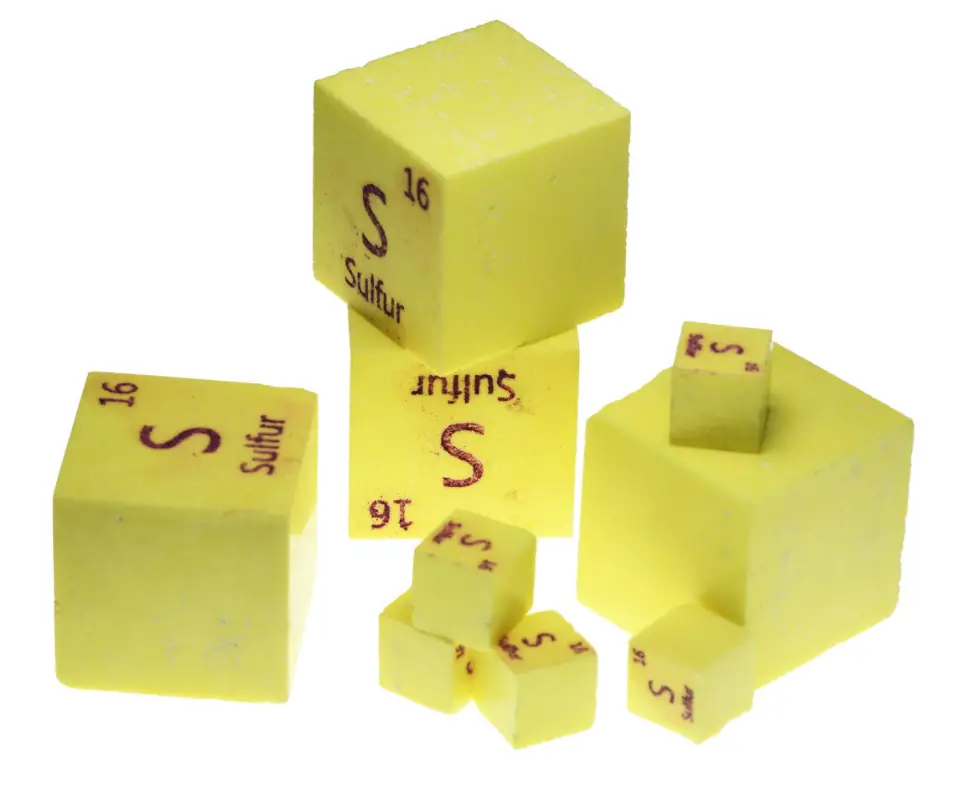
The greatest commercial use of the element is the production of sulfuric acid for sulfate and phosphate fertilizers, and other chemical processes. Sulfur is increasingly used as a component of fertilizers. The most important form of sulfur for fertilizer is the mineral calcium sulfate. The element sulfur is used in matches, insecticides, and fungicides. Many sulfur compounds are odoriferous, and the smells of odorized natural gas, skunk scent, grapefruit, and garlic are due to organosulfur compounds.
Sulfur-applications

Production and Price of Sulfur

Raw materials prices change daily. They are primarily driven by supply, demand and energy prices. In 2019, prices of pure Sulfur were at around 240 $/kg.

Production of Sulphur carried out in three basic ways. It can be mined through the use of wells drilled to sulphur deposits and worked with the “Frasch” method. It can be extracted from the oil or gas stream at a processing plant. And it can be scraped from the surface of the earth or dug out of open pits. “Crude” sulfur is produced from the Frasch process or recovered from “sour” natural gas or petroleum. Although termed “crude”, this sulfur possesses a minimum purity of 99.5 percent and is suitable for a majority of uses. The impurities consist primarily of trapped organic matter. Today, almost all elemental sulfur is produced as a byproduct of removing sulfur-containing contaminants from natural gas and petroleum.

Sulfur-periodic-table

Source: www.luciteria.com

Mechanical Properties of Sulfur

Sulfur-mechanical-properties-strength-hardness-crystal-structure

Strength of Sulfur

In mechanics of materials, the strength of a material is its ability to withstand an applied load without failure or plastic deformation. Strength of materials basically considers the relationship between the external loads applied to a material and the resulting deformation or change in material dimensions. In designing structures and machines, it is important to consider these factors, in order that the material selected will have adequate strength to resist applied loads or forces and retain its original shape. Strength of a material is its ability to withstand this applied load without failure or plastic deformation.

For tensile stress, the capacity of a material or structure to withstand loads tending to elongate is known as ultimate tensile strength (UTS). Yield strength or yield stress is the material property defined as the stress at which a material begins to deform plastically whereas yield point is the point where nonlinear (elastic + plastic) deformation begins.

See also: Strength of Materials

Ultimate Tensile Strength of Sulfur

Ultimate tensile strength of Sulfur is N/A.

Yield Strength of Sulfur

Yield strength of Sulfur is N/A.

Modulus of Elasticity of Sulfur

The Young’s modulus of elasticity of Sulfur is N/A.

Hardness of Sulfur

In materials science, hardness is the ability to withstand surface indentation (localized plastic deformation) and scratching. Brinell hardness test is one of indentation hardness tests, that has been developed for hardness testing. In Brinell tests, a hard, spherical indenter is forced under a specific load into the surface of the metal to be tested.

Brinell hardness of Sulfur is approximately N/A.

The Vickers hardness test method was developed by Robert L. Smith and George E. Sandland at Vickers Ltd as an alternative to the Brinell method to measure the hardness of materials. The Vickers hardness test method can be also used as a microhardness test method, which is mostly used for small parts, thin sections, or case depth work.

Vickers hardness of Sulfur is approximately N/A.

Scratch hardness is the measure of how resistant a sample is to permanent plastic deformation due to friction from a sharp object. The most common scale for this qualitative test is Mohs scale, which is used in mineralogy. The Mohs scale of mineral hardness is based on the ability of one natural sample of mineral to scratch another mineral visibly.

Sulfur is has a hardness of approximately 2.

See also: Hardness of Materials

Sulfur – Crystal Structure

A possible crystal structure of Sulfur is orthorombic structure.

crystal structures - FCC, BCC, HCP

In metals, and in many other solids, the atoms are arranged in regular arrays called crystals. A crystal lattice is a repeating pattern of mathematical points that extends throughout space. The forces of chemical bonding causes this repetition. It is this repeated pattern which control properties like strength, ductility, density, conductivity (property of conducting or transmitting heat, electricity, etc.), and shape. There are 14 general types of such patterns known as Bravais lattices.

See also: Crystal Structure of Materials

Crystal Structure of Sulfur
Crystal Structure of Sulfur is: orthorombic

Strength of Elements

Elasticity of Elements

Hardness of Elements


Thermal Properties of Sulfur

Sulfur-melting-point-conductivity-thermal-properties

Sulfur – Melting Point and Boiling Point

Melting point of Sulfur is 112.8°C.

Boiling point of Sulfur is 444.7°C.

Note that, these points are associated with the standard atmospheric pressure.

Sulfur – Thermal Conductivity

Thermal conductivity of Sulfur is 0.269 W/(m·K).

The heat transfer characteristics of a solid material are measured by a property called the thermal conductivity, k (or λ), measured in W/m.K. It is a measure of a substance’s ability to transfer heat through a material by conduction. Note that Fourier’s law applies for all matter, regardless of its state (solid, liquid, or gas), therefore, it is also defined for liquids and gases.

Coefficient of Thermal Expansion of Sulfur

Linear thermal expansion coefficient of Sulfur is — µm/(m·K)

Thermal expansion is generally the tendency of matter to change its dimensions in response to a change in temperature. It is usually expressed as a fractional change in length or volume per unit temperature change.

Sulfur – Specific Heat, Latent Heat of Fusion, Latent Heat of Vaporization

Specific heat of Sulfur is 0.71 J/g K.

Heat capacity is an extensive property of matter, meaning it is proportional to the size of the system. Heat capacity C has the unit of energy per degree or energy per kelvin. When expressing the same phenomenon as an intensive property, the heat capacity is divided by the amount of substance, mass, or volume, thus the quantity is independent of the size or extent of the sample.

Latent Heat of Fusion of Sulfur is 1.7175 kJ/mol.

Latent Heat of Vaporization of Sulfur is 45 kJ/mol.

Latent heat is the amount of heat added to or removed from a substance to produce a change in phase. This energy breaks down the intermolecular attractive forces, and also must provide the energy necessary to expand the gas (the pΔV work). When latent heat is added, no temperature change occurs. The enthalpy of vaporization is a function of the pressure at which that transformation takes place.

Melting Point of Elements

Periodic Table of Elements - melting point

Thermal Conductivity of Elements

Periodic Table of Elements - thermal conductivity

Thermal Expansion of Elements

Periodic Table of Elements - thermal expansion

Heat Capacity of Elements

Periodic Table of Elements - heat capacity

Heat of Fusion of Elements

Periodic Table of Elements - latent heat fusion

Heat of Vaporization of Elements

Periodic Table of Elements - latent heat vaporization

Sulfur – Electrical Resistivity – Magnetic Susceptibility

Sulfur-electrical-resistivity-magnetic-susceptibility

Electrical property refers to the response of a material to an applied electric field. One of the principal characteristics of materials is their ability (or lack of ability) to conduct electrical current. Indeed, materials are classified by this property, that is, they are divided into conductors, semiconductors, and nonconductors.

See also: Electrical Properties

Magnetic property refers to the response of a material to an applied magnetic field. The macroscopic magnetic properties of a material are a consequence of interactions between an external magnetic field and the magnetic dipole moments of the constituent atoms. Different materials react to the application of magnetic field differently.

See also: Magnetic Properties

Electrical Resistivity of Sulfur

Electrical resistivity of Sulfur is 2E24 nΩ⋅m.

Electrical conductivity and its converse, electrical resistivity, is a fundamental property of a material that quantifies how Sulfur conducts the flow of electric current. Electrical conductivity or specific conductance is the reciprocal of electrical resistivity.

Magnetic Susceptibility of Sulfur

Magnetic susceptibility of Sulfur is −15.5e-6 cm^3/mol.

In electromagnetism, magnetic susceptibility is the measure of the magnetization of a substance. Magnetic susceptibility is a dimensionless proportionality factor that indicates the degree of magnetization of Sulfur in response to an applied magnetic field.

Electrical Resistivity of Elements

Periodic Table of Elements - electrical resistivity

Magnetic Susceptibility of Elements

Application and prices of other elements

Sulfur - Comparison of Properties and Prices

Periodic Table in 8K resolution

Other properties of Sulfur


Phosphorus – Properties – Price – Applications – Production

Phosphorus-properties-price-application-production

About Phosphorus

As an element, phosphorus exists in two major forms—white phosphorus and red phosphorus—but because it is highly reactive, phosphorus is never found as a free element on Earth. At 0.099%, phosphorus is the most abundant pnictogen in the Earth’s crust.

Summary

Element Phosphorus
Atomic number 15
Element category Non Metal
Phase at STP Solid
Density 1.823 g/cm3
Ultimate Tensile Strength N/A
Yield Strength N/A
Young’s Modulus of Elasticity N/A
Mohs Scale 0.5
Brinell Hardness N/A
Vickers Hardness N/A
Melting Point 44.1 °C
Boiling Point 280 °C
Thermal Conductivity 0.235 W/mK
Thermal Expansion Coefficient — µm/mK
Specific Heat 0.77 J/g K
Heat of Fusion 0.657 kJ/mol
Heat of Vaporization 51.9 kJ/mol
Electrical resistivity [nanoOhm meter] —
Magnetic Susceptibility −20.8e-6 cm^3/mol

Applications of Phosphorus

Phosphorus is an essential plant nutrient (the most often limiting nutrient, after nitrogen), and the bulk of all phosphorus production is in concentrated phosphoric acids for agriculture fertilisers, containing as much as 70% to 75% P2O5. The vast majority of phosphorus compounds mined are consumed as fertilisers. Phosphate is needed to replace the phosphorus that plants remove from the soil, and its annual demand is rising nearly twice as fast as the growth of the human population. Other applications include organophosphorus compounds in detergents, pesticides, and nerve agents.

Phosphorus-applications

Production and Price of Phosphorus

Raw materials prices change daily. They are primarily driven by supply, demand and energy prices. In 2019, prices of pure Phosphorus were at around 40 $/kg.

Most production of phosphorus-bearing material is for agriculture fertilisers. For this purpose, phosphate minerals are converted to phosphoric acid. It follows two distinct chemical routes, the main one being treatment of phosphate minerals with sulfuric acid. The other process utilises white phosphorus, which may be produced by reaction and distillation from very low grade phosphate sources. Peak phosphorus is a concept to describe the point in time when humanity reaches the maximum global production rate of phosphorus as an industrial and commercial raw material. The predominant source of phosphorus in modern times is phosphate rock (as opposed to the guano that preceded it).

Phosphorus-periodic-table

Source: www.luciteria.com

Mechanical Properties of Phosphorus

Phosphorus-mechanical-properties-strength-hardness-crystal-structure

Strength of Phosphorus

In mechanics of materials, the strength of a material is its ability to withstand an applied load without failure or plastic deformation. Strength of materials basically considers the relationship between the external loads applied to a material and the resulting deformation or change in material dimensions. In designing structures and machines, it is important to consider these factors, in order that the material selected will have adequate strength to resist applied loads or forces and retain its original shape. Strength of a material is its ability to withstand this applied load without failure or plastic deformation.

For tensile stress, the capacity of a material or structure to withstand loads tending to elongate is known as ultimate tensile strength (UTS). Yield strength or yield stress is the material property defined as the stress at which a material begins to deform plastically whereas yield point is the point where nonlinear (elastic + plastic) deformation begins.

See also: Strength of Materials

Ultimate Tensile Strength of Phosphorus

Ultimate tensile strength of Phosphorus is N/A.

Yield Strength of Phosphorus

Yield strength of Phosphorus is N/A.

Modulus of Elasticity of Phosphorus

The Young’s modulus of elasticity of Phosphorus is N/A.

Hardness of Phosphorus

In materials science, hardness is the ability to withstand surface indentation (localized plastic deformation) and scratching. Brinell hardness test is one of indentation hardness tests, that has been developed for hardness testing. In Brinell tests, a hard, spherical indenter is forced under a specific load into the surface of the metal to be tested.

Brinell hardness of Phosphorus is approximately N/A.

The Vickers hardness test method was developed by Robert L. Smith and George E. Sandland at Vickers Ltd as an alternative to the Brinell method to measure the hardness of materials. The Vickers hardness test method can be also used as a microhardness test method, which is mostly used for small parts, thin sections, or case depth work.

Vickers hardness of Phosphorus is approximately N/A.

Scratch hardness is the measure of how resistant a sample is to permanent plastic deformation due to friction from a sharp object. The most common scale for this qualitative test is Mohs scale, which is used in mineralogy. The Mohs scale of mineral hardness is based on the ability of one natural sample of mineral to scratch another mineral visibly.

Phosphorus is has a hardness of approximately 0.5.

See also: Hardness of Materials

Phosphorus – Crystal Structure

A possible crystal structure of Phosphorus is body-centered cubic structure.

crystal structures - FCC, BCC, HCP

In metals, and in many other solids, the atoms are arranged in regular arrays called crystals. A crystal lattice is a repeating pattern of mathematical points that extends throughout space. The forces of chemical bonding causes this repetition. It is this repeated pattern which control properties like strength, ductility, density, conductivity (property of conducting or transmitting heat, electricity, etc.), and shape. There are 14 general types of such patterns known as Bravais lattices.

See also: Crystal Structure of Materials

Crystal Structure of Phosphorus
Crystal Structure of Phosphorus is: body-centered cubic

Strength of Elements

Elasticity of Elements

Hardness of Elements


Thermal Properties of Phosphorus

Phosphorus-melting-point-conductivity-thermal-properties

Phosphorus – Melting Point and Boiling Point

Melting point of Phosphorus is 44.1°C.

Boiling point of Phosphorus is 280°C.

Note that, these points are associated with the standard atmospheric pressure.

Phosphorus – Thermal Conductivity

Thermal conductivity of Phosphorus is 0.235 W/(m·K).

The heat transfer characteristics of a solid material are measured by a property called the thermal conductivity, k (or λ), measured in W/m.K. It is a measure of a substance’s ability to transfer heat through a material by conduction. Note that Fourier’s law applies for all matter, regardless of its state (solid, liquid, or gas), therefore, it is also defined for liquids and gases.

Coefficient of Thermal Expansion of Phosphorus

Linear thermal expansion coefficient of Phosphorus is — µm/(m·K)

Thermal expansion is generally the tendency of matter to change its dimensions in response to a change in temperature. It is usually expressed as a fractional change in length or volume per unit temperature change.

Phosphorus – Specific Heat, Latent Heat of Fusion, Latent Heat of Vaporization

Specific heat of Phosphorus is 0.77 J/g K.

Heat capacity is an extensive property of matter, meaning it is proportional to the size of the system. Heat capacity C has the unit of energy per degree or energy per kelvin. When expressing the same phenomenon as an intensive property, the heat capacity is divided by the amount of substance, mass, or volume, thus the quantity is independent of the size or extent of the sample.

Latent Heat of Fusion of Phosphorus is 0.657 kJ/mol.

Latent Heat of Vaporization of Phosphorus is 51.9 kJ/mol.

Latent heat is the amount of heat added to or removed from a substance to produce a change in phase. This energy breaks down the intermolecular attractive forces, and also must provide the energy necessary to expand the gas (the pΔV work). When latent heat is added, no temperature change occurs. The enthalpy of vaporization is a function of the pressure at which that transformation takes place.

Melting Point of Elements

Periodic Table of Elements - melting point

Thermal Conductivity of Elements

Periodic Table of Elements - thermal conductivity

Thermal Expansion of Elements

Periodic Table of Elements - thermal expansion

Heat Capacity of Elements

Periodic Table of Elements - heat capacity

Heat of Fusion of Elements

Periodic Table of Elements - latent heat fusion

Heat of Vaporization of Elements

Periodic Table of Elements - latent heat vaporization

Phosphorus – Electrical Resistivity – Magnetic Susceptibility

Phosphorus-electrical-resistivity-magnetic-susceptibility

Electrical property refers to the response of a material to an applied electric field. One of the principal characteristics of materials is their ability (or lack of ability) to conduct electrical current. Indeed, materials are classified by this property, that is, they are divided into conductors, semiconductors, and nonconductors.

See also: Electrical Properties

Magnetic property refers to the response of a material to an applied magnetic field. The macroscopic magnetic properties of a material are a consequence of interactions between an external magnetic field and the magnetic dipole moments of the constituent atoms. Different materials react to the application of magnetic field differently.

See also: Magnetic Properties

Electrical Resistivity of Phosphorus

Electrical resistivity of Phosphorus is — nΩ⋅m.

Electrical conductivity and its converse, electrical resistivity, is a fundamental property of a material that quantifies how Phosphorus conducts the flow of electric current. Electrical conductivity or specific conductance is the reciprocal of electrical resistivity.

Magnetic Susceptibility of Phosphorus

Magnetic susceptibility of Phosphorus is −20.8e-6 cm^3/mol.

In electromagnetism, magnetic susceptibility is the measure of the magnetization of a substance. Magnetic susceptibility is a dimensionless proportionality factor that indicates the degree of magnetization of Phosphorus in response to an applied magnetic field.

Electrical Resistivity of Elements

Periodic Table of Elements - electrical resistivity

Magnetic Susceptibility of Elements

Application and prices of other elements

Phosphorus - Comparison of Properties and Prices

Periodic Table in 8K resolution

Other properties of Phosphorus


Silicon – Properties – Price – Applications – Production

Silicon-properties-price-application-production

About Silicon

Silicon is a hard and brittle crystalline solid with a blue-grey metallic lustre, it is a tetravalent metalloid and semiconductor.

Summary

Element Silicon
Atomic number 14
Element category Metalloids
Phase at STP Solid
Density 2.33 g/cm3
Ultimate Tensile Strength 170 MPa
Yield Strength 165 MPa
Young’s Modulus of Elasticity 150 GPa
Mohs Scale 7
Brinell Hardness 2300 MPa
Vickers Hardness N/A
Melting Point 1410 °C
Boiling Point 3265 °C
Thermal Conductivity 148 W/mK
Thermal Expansion Coefficient 2.6 µm/mK
Specific Heat 0.71 J/g K
Heat of Fusion 50.55 kJ/mol
Heat of Vaporization 384.22 kJ/mol
Electrical resistivity [nanoOhm meter] 2.3E12
Magnetic Susceptibility −3.9e-6 cm^3/mol

Applications of Silicon

Most silicon is used industrially without being purified, and indeed, often with comparatively little processing from its natural form. Silicon is a vital ingredient in aluminum, steel, and iron alloys. It is added as a fluxing agent for copper alloys. In the form of clay and sand, it is used to manufacture bricks and concrete; it is a valuable refractory material for high-temperature work, for example, molding sands for castings in foundry applications. Silica is used to make fire brick, a type of ceramic. Silicate minerals are also in whiteware ceramics, an important class of products usually containing various types of fired clay minerals (natural aluminium phyllosilicates). An example is porcelain, which is based on the silicate mineral kaolinite. Traditional glass (silica-based soda-lime glass) also functions in many of the same ways, and also is used for windows and containers. Hyperpure silicon metal and doped hyperpure silicon (doping with boron, phosphorous, gallium, or arsenic) are used in solar cells, transistors and semiconductors.

Silicon-applications

Production and Price of Silicon

Raw materials prices change daily. They are primarily driven by supply, demand and energy prices. In 2019, prices of pure Silicon were at around 500 $/kg.

Second only to oxygen, silicon is the most abundant element in Earth’s crust. It is found in rocks, sand, clays and soils, combined with either oxygen as silicon dioxide, or with oxygen and other elements as silicates. Silicon’s compounds are also found in water, in the atmosphere, in many plants, and even in certain animals. Silicon of 96–99% purity is made by reducing quartzite or sand with highly pure coke. The reduction is carried out in an electric arc furnace.

Silicon-periodic-table

Source: www.luciteria.com

Mechanical Properties of Silicon

Silicon-mechanical-properties-strength-hardness-crystal-structure

Strength of Silicon

In mechanics of materials, the strength of a material is its ability to withstand an applied load without failure or plastic deformation. Strength of materials basically considers the relationship between the external loads applied to a material and the resulting deformation or change in material dimensions. In designing structures and machines, it is important to consider these factors, in order that the material selected will have adequate strength to resist applied loads or forces and retain its original shape. Strength of a material is its ability to withstand this applied load without failure or plastic deformation.

For tensile stress, the capacity of a material or structure to withstand loads tending to elongate is known as ultimate tensile strength (UTS). Yield strength or yield stress is the material property defined as the stress at which a material begins to deform plastically whereas yield point is the point where nonlinear (elastic + plastic) deformation begins.

See also: Strength of Materials

Ultimate Tensile Strength of Silicon

Ultimate tensile strength of Silicon is 170 MPa.

Yield Strength of Silicon

Yield strength of Silicon is 165 MPa.

Modulus of Elasticity of Silicon

The Young’s modulus of elasticity of Silicon is 150 GPa.

Hardness of Silicon

In materials science, hardness is the ability to withstand surface indentation (localized plastic deformation) and scratching. Brinell hardness test is one of indentation hardness tests, that has been developed for hardness testing. In Brinell tests, a hard, spherical indenter is forced under a specific load into the surface of the metal to be tested.

Brinell hardness of Silicon is approximately 2300 MPa.

The Vickers hardness test method was developed by Robert L. Smith and George E. Sandland at Vickers Ltd as an alternative to the Brinell method to measure the hardness of materials. The Vickers hardness test method can be also used as a microhardness test method, which is mostly used for small parts, thin sections, or case depth work.

Vickers hardness of Silicon is approximately N/A.

Scratch hardness is the measure of how resistant a sample is to permanent plastic deformation due to friction from a sharp object. The most common scale for this qualitative test is Mohs scale, which is used in mineralogy. The Mohs scale of mineral hardness is based on the ability of one natural sample of mineral to scratch another mineral visibly.

Silicon is has a hardness of approximately 7.

See also: Hardness of Materials

Silicon – Crystal Structure

A possible crystal structure of Silicon is face-centered diamond-cubic structure.

crystal structures - FCC, BCC, HCP

In metals, and in many other solids, the atoms are arranged in regular arrays called crystals. A crystal lattice is a repeating pattern of mathematical points that extends throughout space. The forces of chemical bonding causes this repetition. It is this repeated pattern which control properties like strength, ductility, density, conductivity (property of conducting or transmitting heat, electricity, etc.), and shape. There are 14 general types of such patterns known as Bravais lattices.

See also: Crystal Structure of Materials

Crystal Structure of Silicon
Crystal Structure of Silicon is: face-centered diamond-cubic

Strength of Elements

Elasticity of Elements

Hardness of Elements


Thermal Properties of Silicon

Silicon-melting-point-conductivity-thermal-properties

Silicon – Melting Point and Boiling Point

Melting point of Silicon is 1410°C.

Boiling point of Silicon is 3265°C.

Note that, these points are associated with the standard atmospheric pressure.

Silicon – Thermal Conductivity

Thermal conductivity of Silicon is 148 W/(m·K).

The heat transfer characteristics of a solid material are measured by a property called the thermal conductivity, k (or λ), measured in W/m.K. It is a measure of a substance’s ability to transfer heat through a material by conduction. Note that Fourier’s law applies for all matter, regardless of its state (solid, liquid, or gas), therefore, it is also defined for liquids and gases.

Coefficient of Thermal Expansion of Silicon

Linear thermal expansion coefficient of Silicon is 2.6 µm/(m·K)

Thermal expansion is generally the tendency of matter to change its dimensions in response to a change in temperature. It is usually expressed as a fractional change in length or volume per unit temperature change.

Silicon – Specific Heat, Latent Heat of Fusion, Latent Heat of Vaporization

Specific heat of Silicon is 0.71 J/g K.

Heat capacity is an extensive property of matter, meaning it is proportional to the size of the system. Heat capacity C has the unit of energy per degree or energy per kelvin. When expressing the same phenomenon as an intensive property, the heat capacity is divided by the amount of substance, mass, or volume, thus the quantity is independent of the size or extent of the sample.

Latent Heat of Fusion of Silicon is 50.55 kJ/mol.

Latent Heat of Vaporization of Silicon is 384.22 kJ/mol.

Latent heat is the amount of heat added to or removed from a substance to produce a change in phase. This energy breaks down the intermolecular attractive forces, and also must provide the energy necessary to expand the gas (the pΔV work). When latent heat is added, no temperature change occurs. The enthalpy of vaporization is a function of the pressure at which that transformation takes place.

Melting Point of Elements

Periodic Table of Elements - melting point

Thermal Conductivity of Elements

Periodic Table of Elements - thermal conductivity

Thermal Expansion of Elements

Periodic Table of Elements - thermal expansion

Heat Capacity of Elements

Periodic Table of Elements - heat capacity

Heat of Fusion of Elements

Periodic Table of Elements - latent heat fusion

Heat of Vaporization of Elements

Periodic Table of Elements - latent heat vaporization

Silicon – Electrical Resistivity – Magnetic Susceptibility

Silicon-electrical-resistivity-magnetic-susceptibility

Electrical property refers to the response of a material to an applied electric field. One of the principal characteristics of materials is their ability (or lack of ability) to conduct electrical current. Indeed, materials are classified by this property, that is, they are divided into conductors, semiconductors, and nonconductors.

See also: Electrical Properties

Magnetic property refers to the response of a material to an applied magnetic field. The macroscopic magnetic properties of a material are a consequence of interactions between an external magnetic field and the magnetic dipole moments of the constituent atoms. Different materials react to the application of magnetic field differently.

See also: Magnetic Properties

Electrical Resistivity of Silicon

Electrical resistivity of Silicon is 2.3E12 nΩ⋅m.

Electrical conductivity and its converse, electrical resistivity, is a fundamental property of a material that quantifies how Silicon conducts the flow of electric current. Electrical conductivity or specific conductance is the reciprocal of electrical resistivity.

Magnetic Susceptibility of Silicon

Magnetic susceptibility of Silicon is −3.9e-6 cm^3/mol.

In electromagnetism, magnetic susceptibility is the measure of the magnetization of a substance. Magnetic susceptibility is a dimensionless proportionality factor that indicates the degree of magnetization of Silicon in response to an applied magnetic field.

Electrical Resistivity of Elements

Periodic Table of Elements - electrical resistivity

Magnetic Susceptibility of Elements

Application and prices of other elements

Silicon - Comparison of Properties and Prices

Periodic Table in 8K resolution

Other properties of Silicon


Aluminium – Properties – Price – Applications – Production

Aluminium-properties-price-application-production

About Aluminium

Aluminium is a silvery-white, soft, nonmagnetic, ductile metal in the boron group. By mass, aluminium makes up about 8% of the Earth’s crust; it is the third most abundant element after oxygen and silicon and the most abundant metal in the crust, though it is less common in the mantle below.

Summary

Element Aluminium
Atomic number 13
Element category Poor Metal
Phase at STP Solid
Density 2.7 g/cm3
Ultimate Tensile Strength 90 MPa (pure), 600 MPa (alloys)
Yield Strength 11 MPa (pure), 400 MPa (alloys)
Young’s Modulus of Elasticity 70 GPa
Mohs Scale 2.8
Brinell Hardness 240 MPa
Vickers Hardness 167 MPa
Melting Point 660 °C
Boiling Point 2467 °C
Thermal Conductivity 237 W/mK
Thermal Expansion Coefficient 23.1 µm/mK
Specific Heat 0.9 J/g K
Heat of Fusion 10.79 kJ/mol
Heat of Vaporization 293.4 kJ/mol
Electrical resistivity [nanoOhm meter] 26.5
Magnetic Susceptibility +16.5e-6 cm^3/mol

Applications of Aluminium

Aluminium and its alloys are used widely in aerospace, automotive, architectural, lithographic, packaging, electrical and electronic applications. It is the prime material of construction for the aircraft industry throughout most of its history. About 70% of commercial civil aircraft airframes are made from aluminium alloys, and without aluminium civil aviation would not be economically viable. Automotive industry now includes aluminium as engine castings, wheels, radiators and increasingly as body parts. 6111 aluminium and 2008 aluminium alloy are extensively used for external automotive body panels. Cylinder blocks and crankcases are often cast made of aluminium alloys.

Aluminium-applications

Production and Price of Aluminium

Raw materials prices change daily. They are primarily driven by supply, demand and energy prices. In 2019, prices of pure Aluminium were at around 18 $/kg.

Aluminium is extracted from the principal ore, bauxite. Significant bauxite deposits are found throughout Australia, the Caribbean, Africa, China and South America. Open cut techniques are commonly used to mine the bauxite. The bauxite is purified using the Bayer process. Aluminium production is highly energy-consuming, and so the producers tend to locate smelters in places where electric power is both plentiful and inexpensive. As of 2012, the world’s largest smelters of aluminium are located in China, Russia, Bahrain, United Arab Emirates, and South Africa.

Aluminium-periodic-table

Source: www.luciteria.com

Mechanical Properties of Aluminium

Aluminium-mechanical-properties-strength-hardness-crystal-structure

Strength of Aluminium

In mechanics of materials, the strength of a material is its ability to withstand an applied load without failure or plastic deformation. Strength of materials basically considers the relationship between the external loads applied to a material and the resulting deformation or change in material dimensions. In designing structures and machines, it is important to consider these factors, in order that the material selected will have adequate strength to resist applied loads or forces and retain its original shape. Strength of a material is its ability to withstand this applied load without failure or plastic deformation.

For tensile stress, the capacity of a material or structure to withstand loads tending to elongate is known as ultimate tensile strength (UTS). Yield strength or yield stress is the material property defined as the stress at which a material begins to deform plastically whereas yield point is the point where nonlinear (elastic + plastic) deformation begins.

See also: Strength of Materials

Ultimate Tensile Strength of Aluminium

Ultimate tensile strength of Aluminium is 90 MPa (pure), 600 MPa (alloys).

Yield Strength of Aluminium

Yield strength of Aluminium is 11 MPa (pure), 400 MPa (alloys).

Modulus of Elasticity of Aluminium

The Young’s modulus of elasticity of Aluminium is 70 GPa.

Hardness of Aluminium

In materials science, hardness is the ability to withstand surface indentation (localized plastic deformation) and scratching. Brinell hardness test is one of indentation hardness tests, that has been developed for hardness testing. In Brinell tests, a hard, spherical indenter is forced under a specific load into the surface of the metal to be tested.

Brinell hardness of Aluminium is approximately 240 MPa.

The Vickers hardness test method was developed by Robert L. Smith and George E. Sandland at Vickers Ltd as an alternative to the Brinell method to measure the hardness of materials. The Vickers hardness test method can be also used as a microhardness test method, which is mostly used for small parts, thin sections, or case depth work.

Vickers hardness of Aluminium is approximately 167 MPa.

Scratch hardness is the measure of how resistant a sample is to permanent plastic deformation due to friction from a sharp object. The most common scale for this qualitative test is Mohs scale, which is used in mineralogy. The Mohs scale of mineral hardness is based on the ability of one natural sample of mineral to scratch another mineral visibly.

Aluminium is has a hardness of approximately 2.8.

See also: Hardness of Materials

Aluminium – Crystal Structure

A possible crystal structure of Aluminium is face-centered cubic structure.

crystal structures - FCC, BCC, HCP

In metals, and in many other solids, the atoms are arranged in regular arrays called crystals. A crystal lattice is a repeating pattern of mathematical points that extends throughout space. The forces of chemical bonding causes this repetition. It is this repeated pattern which control properties like strength, ductility, density, conductivity (property of conducting or transmitting heat, electricity, etc.), and shape. There are 14 general types of such patterns known as Bravais lattices.

See also: Crystal Structure of Materials

Crystal Structure of Aluminium
Crystal Structure of Aluminium is: face-centered cubic

Strength of Elements

Elasticity of Elements

Hardness of Elements


Thermal Properties of Aluminium

Aluminium-melting-point-conductivity-thermal-properties

Aluminium – Melting Point and Boiling Point

Melting point of Aluminium is 660°C.

Boiling point of Aluminium is 2467°C.

Note that, these points are associated with the standard atmospheric pressure.

Aluminium – Thermal Conductivity

Thermal conductivity of Aluminium is 237 W/(m·K).

The heat transfer characteristics of a solid material are measured by a property called the thermal conductivity, k (or λ), measured in W/m.K. It is a measure of a substance’s ability to transfer heat through a material by conduction. Note that Fourier’s law applies for all matter, regardless of its state (solid, liquid, or gas), therefore, it is also defined for liquids and gases.

Coefficient of Thermal Expansion of Aluminium

Linear thermal expansion coefficient of Aluminium is 23.1 µm/(m·K)

Thermal expansion is generally the tendency of matter to change its dimensions in response to a change in temperature. It is usually expressed as a fractional change in length or volume per unit temperature change.

Aluminium – Specific Heat, Latent Heat of Fusion, Latent Heat of Vaporization

Specific heat of Aluminium is 0.9 J/g K.

Heat capacity is an extensive property of matter, meaning it is proportional to the size of the system. Heat capacity C has the unit of energy per degree or energy per kelvin. When expressing the same phenomenon as an intensive property, the heat capacity is divided by the amount of substance, mass, or volume, thus the quantity is independent of the size or extent of the sample.

Latent Heat of Fusion of Aluminium is 10.79 kJ/mol.

Latent Heat of Vaporization of Aluminium is 293.4 kJ/mol.

Latent heat is the amount of heat added to or removed from a substance to produce a change in phase. This energy breaks down the intermolecular attractive forces, and also must provide the energy necessary to expand the gas (the pΔV work). When latent heat is added, no temperature change occurs. The enthalpy of vaporization is a function of the pressure at which that transformation takes place.

Melting Point of Elements

Periodic Table of Elements - melting point

Thermal Conductivity of Elements

Periodic Table of Elements - thermal conductivity

Thermal Expansion of Elements

Periodic Table of Elements - thermal expansion

Heat Capacity of Elements

Periodic Table of Elements - heat capacity

Heat of Fusion of Elements

Periodic Table of Elements - latent heat fusion

Heat of Vaporization of Elements

Periodic Table of Elements - latent heat vaporization

Aluminium – Electrical Resistivity – Magnetic Susceptibility

Aluminium-electrical-resistivity-magnetic-susceptibility

Electrical property refers to the response of a material to an applied electric field. One of the principal characteristics of materials is their ability (or lack of ability) to conduct electrical current. Indeed, materials are classified by this property, that is, they are divided into conductors, semiconductors, and nonconductors.

See also: Electrical Properties

Magnetic property refers to the response of a material to an applied magnetic field. The macroscopic magnetic properties of a material are a consequence of interactions between an external magnetic field and the magnetic dipole moments of the constituent atoms. Different materials react to the application of magnetic field differently.

See also: Magnetic Properties

Electrical Resistivity of Aluminium

Electrical resistivity of Aluminium is 26.5 nΩ⋅m.

Electrical conductivity and its converse, electrical resistivity, is a fundamental property of a material that quantifies how Aluminium conducts the flow of electric current. Electrical conductivity or specific conductance is the reciprocal of electrical resistivity.

Magnetic Susceptibility of Aluminium

Magnetic susceptibility of Aluminium is +16.5e-6 cm^3/mol.

In electromagnetism, magnetic susceptibility is the measure of the magnetization of a substance. Magnetic susceptibility is a dimensionless proportionality factor that indicates the degree of magnetization of Aluminium in response to an applied magnetic field.

Electrical Resistivity of Elements

Periodic Table of Elements - electrical resistivity

Magnetic Susceptibility of Elements

Application and prices of other elements

Aluminium - Comparison of Properties and Prices

Periodic Table in 8K resolution

Other properties of Aluminium


Magnesium – Properties – Price – Applications – Production

Magnesium-properties-price-application-production

About Magnesium

Magnesium is a shiny gray solid which bears a close physical resemblance to the other five elements in the second column (group 2, or alkaline earth metals) of the periodic table: all group 2 elements have the same electron configuration in the outer electron shell and a similar crystal structure.

Summary

Element Magnesium
Atomic number 12
Element category Alkaline Earth Metal
Phase at STP Solid
Density 1.738 g/cm3
Ultimate Tensile Strength 200 MPa
Yield Strength N/A
Young’s Modulus of Elasticity 45 GPa
Mohs Scale 2.5
Brinell Hardness 260 MPa
Vickers Hardness N/A
Melting Point 649 °C
Boiling Point 1090 °C
Thermal Conductivity 156 W/mK
Thermal Expansion Coefficient 24.8 µm/mK
Specific Heat 1.02 J/g K
Heat of Fusion 8.954 kJ/mol
Heat of Vaporization 127.4 kJ/mol
Electrical resistivity [nanoOhm meter] 43.9
Magnetic Susceptibility +13.1e-6 cm^3/mol

Applications of Magnesium

Magnesium is the third-most-commonly-used structural metal, following iron and aluminium.[35] The main applications of magnesium are, in order: aluminium alloys, die-casting (alloyed with zinc), removing sulfur in the production of iron and steel, and the production of titanium in the Kroll process. Magnesium alloys are used in a wide variety of structural and nonstructural applications. Structural applications include automotive, industrial, materials-handling, commercial, and aerospace equipment. Magnesium alloys are used for parts that operate at high speeds and thus must be light weight to minimize inertial forces. Commercial applications include hand-held tools, laptops, luggage, and ladders, automobiles (e.g., steering wheels and columns, seat frames, transmission cases). Magnox (alloy), whose name is an abbreviation for “magnesium non-oxidizing”, is 99% magnesium and 1% aluminum, and is used in the cladding of fuel rods in magnox nuclear power reactors.

Magnesium-applications

Production and Price of Magnesium

Raw materials prices change daily. They are primarily driven by supply, demand and energy prices. In 2019, prices of pure Magnesium were at around 37 $/kg.

Magnesium is today obtained mainly by electrolysis of magnesium salts obtained from brine, and is used primarily as a component in aluminium-magnesium alloys, sometimes called magnalium or magnelium. World production was approximately 1,100 kt in 2017, with the bulk being produced in China (930 kt) and Russia (60 kt). Magnesium is less dense than aluminium, and the alloy is prized for its combination of lightness and strength.

Magnesium-periodic-table

Source: www.luciteria.com

Mechanical Properties of Magnesium

Magnesium-mechanical-properties-strength-hardness-crystal-structure

Strength of Magnesium

In mechanics of materials, the strength of a material is its ability to withstand an applied load without failure or plastic deformation. Strength of materials basically considers the relationship between the external loads applied to a material and the resulting deformation or change in material dimensions. In designing structures and machines, it is important to consider these factors, in order that the material selected will have adequate strength to resist applied loads or forces and retain its original shape. Strength of a material is its ability to withstand this applied load without failure or plastic deformation.

For tensile stress, the capacity of a material or structure to withstand loads tending to elongate is known as ultimate tensile strength (UTS). Yield strength or yield stress is the material property defined as the stress at which a material begins to deform plastically whereas yield point is the point where nonlinear (elastic + plastic) deformation begins.

See also: Strength of Materials

Ultimate Tensile Strength of Magnesium

Ultimate tensile strength of Magnesium is 200 MPa.

Yield Strength of Magnesium

Yield strength of Magnesium is N/A.

Modulus of Elasticity of Magnesium

The Young’s modulus of elasticity of Magnesium is 45 GPa.

Hardness of Magnesium

In materials science, hardness is the ability to withstand surface indentation (localized plastic deformation) and scratching. Brinell hardness test is one of indentation hardness tests, that has been developed for hardness testing. In Brinell tests, a hard, spherical indenter is forced under a specific load into the surface of the metal to be tested.

Brinell hardness of Magnesium is approximately 260 MPa.

The Vickers hardness test method was developed by Robert L. Smith and George E. Sandland at Vickers Ltd as an alternative to the Brinell method to measure the hardness of materials. The Vickers hardness test method can be also used as a microhardness test method, which is mostly used for small parts, thin sections, or case depth work.

Vickers hardness of Magnesium is approximately N/A.

Scratch hardness is the measure of how resistant a sample is to permanent plastic deformation due to friction from a sharp object. The most common scale for this qualitative test is Mohs scale, which is used in mineralogy. The Mohs scale of mineral hardness is based on the ability of one natural sample of mineral to scratch another mineral visibly.

Magnesium is has a hardness of approximately 2.5.

See also: Hardness of Materials

Magnesium – Crystal Structure

A possible crystal structure of Magnesium is hexagonal close-packed structure.

crystal structures - FCC, BCC, HCP

In metals, and in many other solids, the atoms are arranged in regular arrays called crystals. A crystal lattice is a repeating pattern of mathematical points that extends throughout space. The forces of chemical bonding causes this repetition. It is this repeated pattern which control properties like strength, ductility, density, conductivity (property of conducting or transmitting heat, electricity, etc.), and shape. There are 14 general types of such patterns known as Bravais lattices.

See also: Crystal Structure of Materials

Crystal Structure of Magnesium
Crystal Structure of Magnesium is: hexagonal close-packed

Strength of Elements

Elasticity of Elements

Hardness of Elements


Thermal Properties of Magnesium

Magnesium-melting-point-conductivity-thermal-properties

Magnesium – Melting Point and Boiling Point

Melting point of Magnesium is 649°C.

Boiling point of Magnesium is 1090°C.

Note that, these points are associated with the standard atmospheric pressure.

Magnesium – Thermal Conductivity

Thermal conductivity of Magnesium is 156 W/(m·K).

The heat transfer characteristics of a solid material are measured by a property called the thermal conductivity, k (or λ), measured in W/m.K. It is a measure of a substance’s ability to transfer heat through a material by conduction. Note that Fourier’s law applies for all matter, regardless of its state (solid, liquid, or gas), therefore, it is also defined for liquids and gases.

Coefficient of Thermal Expansion of Magnesium

Linear thermal expansion coefficient of Magnesium is 24.8 µm/(m·K)

Thermal expansion is generally the tendency of matter to change its dimensions in response to a change in temperature. It is usually expressed as a fractional change in length or volume per unit temperature change.

Magnesium – Specific Heat, Latent Heat of Fusion, Latent Heat of Vaporization

Specific heat of Magnesium is 1.02 J/g K.

Heat capacity is an extensive property of matter, meaning it is proportional to the size of the system. Heat capacity C has the unit of energy per degree or energy per kelvin. When expressing the same phenomenon as an intensive property, the heat capacity is divided by the amount of substance, mass, or volume, thus the quantity is independent of the size or extent of the sample.

Latent Heat of Fusion of Magnesium is 8.954 kJ/mol.

Latent Heat of Vaporization of Magnesium is 127.4 kJ/mol.

Latent heat is the amount of heat added to or removed from a substance to produce a change in phase. This energy breaks down the intermolecular attractive forces, and also must provide the energy necessary to expand the gas (the pΔV work). When latent heat is added, no temperature change occurs. The enthalpy of vaporization is a function of the pressure at which that transformation takes place.

Melting Point of Elements

Periodic Table of Elements - melting point

Thermal Conductivity of Elements

Periodic Table of Elements - thermal conductivity

Thermal Expansion of Elements

Periodic Table of Elements - thermal expansion

Heat Capacity of Elements

Periodic Table of Elements - heat capacity

Heat of Fusion of Elements

Periodic Table of Elements - latent heat fusion

Heat of Vaporization of Elements

Periodic Table of Elements - latent heat vaporization

Magnesium – Electrical Resistivity – Magnetic Susceptibility

Magnesium-electrical-resistivity-magnetic-susceptibility

Electrical property refers to the response of a material to an applied electric field. One of the principal characteristics of materials is their ability (or lack of ability) to conduct electrical current. Indeed, materials are classified by this property, that is, they are divided into conductors, semiconductors, and nonconductors.

See also: Electrical Properties

Magnetic property refers to the response of a material to an applied magnetic field. The macroscopic magnetic properties of a material are a consequence of interactions between an external magnetic field and the magnetic dipole moments of the constituent atoms. Different materials react to the application of magnetic field differently.

See also: Magnetic Properties

Electrical Resistivity of Magnesium

Electrical resistivity of Magnesium is 43.9 nΩ⋅m.

Electrical conductivity and its converse, electrical resistivity, is a fundamental property of a material that quantifies how Magnesium conducts the flow of electric current. Electrical conductivity or specific conductance is the reciprocal of electrical resistivity.

Magnetic Susceptibility of Magnesium

Magnetic susceptibility of Magnesium is +13.1e-6 cm^3/mol.

In electromagnetism, magnetic susceptibility is the measure of the magnetization of a substance. Magnetic susceptibility is a dimensionless proportionality factor that indicates the degree of magnetization of Magnesium in response to an applied magnetic field.

Electrical Resistivity of Elements

Periodic Table of Elements - electrical resistivity

Magnetic Susceptibility of Elements

Application and prices of other elements

Magnesium - Comparison of Properties and Prices

Periodic Table in 8K resolution

Other properties of Magnesium


Sodium – Properties – Price – Applications – Production

Sodium-properties-price-application-production

About Sodium

Sodium is a soft, silvery-white, highly reactive metal. Sodium is an alkali metal, being in group 1 of the periodic table, because it has a single electron in its outer shell that it readily donates, creating a positively charged atom—the Na+ cation.

Summary

Element Sodium
Atomic number 11
Element category Alkali Metal
Phase at STP Solid
Density 0.968 g/cm3
Ultimate Tensile Strength N/A
Yield Strength N/A
Young’s Modulus of Elasticity 10 GPa
Mohs Scale 0.4
Brinell Hardness 0.69 MPa
Vickers Hardness N/A
Melting Point 97.8 °C
Boiling Point 883 °C
Thermal Conductivity 141 W/mK
Thermal Expansion Coefficient 71 µm/mK
Specific Heat 1.23 J/g K
Heat of Fusion 2.598 kJ/mol
Heat of Vaporization 96.96 kJ/mol
Electrical resistivity [nanoOhm meter] 47.7
Magnetic Susceptibility +16e-6 cm^3/mol

Applications of Sodium

Metallic sodium is used mainly for the production of sodium borohydride, sodium azide, indigo, and triphenylphosphine. A once-common use was the making of tetraethyllead and titanium metal; because of the move away from TEL and new titanium production methods. An electric current and sodium vapor combine to form a yellowish glow. This principle is used for the making of sodium vapor lamps. Sodium is occasionally used as a heat exchange medium in nuclear power plants. Liquid sodium is sealed into pipes surrounding the reactor core. Generated heat is absorbed by sodium and forced through the pipes in a heat exchanger which can be used to generate electricity.

Sodium-applications

Production and Price of Sodium

Raw materials prices change daily. They are primarily driven by supply, demand and energy prices. In 2019, prices of pure Sodium were at around 70 $/kg.

Employed only in rather specialized applications, only about 100,000 tonnes of metallic sodium are produced annually. Sodium is now produced commercially through the electrolysis of molten sodium chloride, based on a process patented in 1924. This is done in a Downs cell in which the NaCl is mixed with calcium chloride to lower the melting point below 700 °C.

Sodium-periodic-table

Source: www.luciteria.com

Mechanical Properties of Sodium

Sodium-mechanical-properties-strength-hardness-crystal-structure

Strength of Sodium

In mechanics of materials, the strength of a material is its ability to withstand an applied load without failure or plastic deformation. Strength of materials basically considers the relationship between the external loads applied to a material and the resulting deformation or change in material dimensions. In designing structures and machines, it is important to consider these factors, in order that the material selected will have adequate strength to resist applied loads or forces and retain its original shape. Strength of a material is its ability to withstand this applied load without failure or plastic deformation.

For tensile stress, the capacity of a material or structure to withstand loads tending to elongate is known as ultimate tensile strength (UTS). Yield strength or yield stress is the material property defined as the stress at which a material begins to deform plastically whereas yield point is the point where nonlinear (elastic + plastic) deformation begins.

See also: Strength of Materials

Ultimate Tensile Strength of Sodium

Ultimate tensile strength of Sodium is N/A.

Yield Strength of Sodium

Yield strength of Sodium is N/A.

Modulus of Elasticity of Sodium

The Young’s modulus of elasticity of Sodium is 10 GPa.

Hardness of Sodium

In materials science, hardness is the ability to withstand surface indentation (localized plastic deformation) and scratching. Brinell hardness test is one of indentation hardness tests, that has been developed for hardness testing. In Brinell tests, a hard, spherical indenter is forced under a specific load into the surface of the metal to be tested.

Brinell hardness of Sodium is approximately 0.69 MPa.

The Vickers hardness test method was developed by Robert L. Smith and George E. Sandland at Vickers Ltd as an alternative to the Brinell method to measure the hardness of materials. The Vickers hardness test method can be also used as a microhardness test method, which is mostly used for small parts, thin sections, or case depth work.

Vickers hardness of Sodium is approximately N/A.

Scratch hardness is the measure of how resistant a sample is to permanent plastic deformation due to friction from a sharp object. The most common scale for this qualitative test is Mohs scale, which is used in mineralogy. The Mohs scale of mineral hardness is based on the ability of one natural sample of mineral to scratch another mineral visibly.

Sodium is has a hardness of approximately 0.4.

See also: Hardness of Materials

Sodium – Crystal Structure

A possible crystal structure of Sodium is body-centered cubic structure.

crystal structures - FCC, BCC, HCP

In metals, and in many other solids, the atoms are arranged in regular arrays called crystals. A crystal lattice is a repeating pattern of mathematical points that extends throughout space. The forces of chemical bonding causes this repetition. It is this repeated pattern which control properties like strength, ductility, density, conductivity (property of conducting or transmitting heat, electricity, etc.), and shape. There are 14 general types of such patterns known as Bravais lattices.

See also: Crystal Structure of Materials

Crystal Structure of Sodium
Crystal Structure of Sodium is: body-centered cubic

Strength of Elements

Elasticity of Elements

Hardness of Elements


Thermal Properties of Sodium

Sodium-melting-point-conductivity-thermal-properties

Sodium – Melting Point and Boiling Point

Melting point of Sodium is 97.8°C.

Boiling point of Sodium is 883°C.

Note that, these points are associated with the standard atmospheric pressure.

Sodium – Thermal Conductivity

Thermal conductivity of Sodium is 141 W/(m·K).

The heat transfer characteristics of a solid material are measured by a property called the thermal conductivity, k (or λ), measured in W/m.K. It is a measure of a substance’s ability to transfer heat through a material by conduction. Note that Fourier’s law applies for all matter, regardless of its state (solid, liquid, or gas), therefore, it is also defined for liquids and gases.

Coefficient of Thermal Expansion of Sodium

Linear thermal expansion coefficient of Sodium is 71 µm/(m·K)

Thermal expansion is generally the tendency of matter to change its dimensions in response to a change in temperature. It is usually expressed as a fractional change in length or volume per unit temperature change.

Sodium – Specific Heat, Latent Heat of Fusion, Latent Heat of Vaporization

Specific heat of Sodium is 1.23 J/g K.

Heat capacity is an extensive property of matter, meaning it is proportional to the size of the system. Heat capacity C has the unit of energy per degree or energy per kelvin. When expressing the same phenomenon as an intensive property, the heat capacity is divided by the amount of substance, mass, or volume, thus the quantity is independent of the size or extent of the sample.

Latent Heat of Fusion of Sodium is 2.598 kJ/mol.

Latent Heat of Vaporization of Sodium is 96.96 kJ/mol.

Latent heat is the amount of heat added to or removed from a substance to produce a change in phase. This energy breaks down the intermolecular attractive forces, and also must provide the energy necessary to expand the gas (the pΔV work). When latent heat is added, no temperature change occurs. The enthalpy of vaporization is a function of the pressure at which that transformation takes place.

Melting Point of Elements

Periodic Table of Elements - melting point

Thermal Conductivity of Elements

Periodic Table of Elements - thermal conductivity

Thermal Expansion of Elements

Periodic Table of Elements - thermal expansion

Heat Capacity of Elements

Periodic Table of Elements - heat capacity

Heat of Fusion of Elements

Periodic Table of Elements - latent heat fusion

Heat of Vaporization of Elements

Periodic Table of Elements - latent heat vaporization

Sodium – Electrical Resistivity – Magnetic Susceptibility

Sodium-electrical-resistivity-magnetic-susceptibility

Electrical property refers to the response of a material to an applied electric field. One of the principal characteristics of materials is their ability (or lack of ability) to conduct electrical current. Indeed, materials are classified by this property, that is, they are divided into conductors, semiconductors, and nonconductors.

See also: Electrical Properties

Magnetic property refers to the response of a material to an applied magnetic field. The macroscopic magnetic properties of a material are a consequence of interactions between an external magnetic field and the magnetic dipole moments of the constituent atoms. Different materials react to the application of magnetic field differently.

See also: Magnetic Properties

Electrical Resistivity of Sodium

Electrical resistivity of Sodium is 47.7 nΩ⋅m.

Electrical conductivity and its converse, electrical resistivity, is a fundamental property of a material that quantifies how Sodium conducts the flow of electric current. Electrical conductivity or specific conductance is the reciprocal of electrical resistivity.

Magnetic Susceptibility of Sodium

Magnetic susceptibility of Sodium is +16e-6 cm^3/mol.

In electromagnetism, magnetic susceptibility is the measure of the magnetization of a substance. Magnetic susceptibility is a dimensionless proportionality factor that indicates the degree of magnetization of Sodium in response to an applied magnetic field.

Electrical Resistivity of Elements

Periodic Table of Elements - electrical resistivity

Magnetic Susceptibility of Elements

Application and prices of other elements

Sodium - Comparison of Properties and Prices

Periodic Table in 8K resolution

Other properties of Sodium