Facebook Instagram Youtube Twitter

Neon – Properties – Price – Applications – Production

Neon-properties-price-application-production

About Neon

Neon is a colorless, odorless, inert monatomic gas under standard conditions, with about two-thirds the density of air.

Summary

Element Neon
Atomic number 10
Element category Noble Gas
Phase at STP Gas
Density 0.0009 g/cm3
Ultimate Tensile Strength N/A
Yield Strength N/A
Young’s Modulus of Elasticity N/A
Mohs Scale N/A
Brinell Hardness N/A
Vickers Hardness N/A
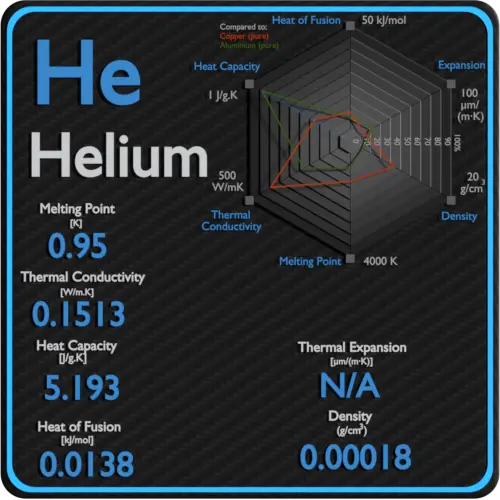
Melting Point -248 °C
Boiling Point -248.7 °C
Thermal Conductivity 0.0493 W/mK
Thermal Expansion Coefficient — µm/mK
Specific Heat 0.904 J/g K
Heat of Fusion 0.3317 kJ/mol
Heat of Vaporization 1.7326 kJ/mol
Electrical resistivity [nanoOhm meter] —
Magnetic Susceptibility N/A

Applications of Neon

Neon is often used in signs and produces an unmistakable bright reddish-orange light. Although tube lights with other colors are often called “neon”, they use different noble gases or varied colors of fluorescent lighting. Neon is also used to make high-voltage indicators and switching gear, lightning arresters, diving equipment and lasers. Liquid neon is an important cryogenic refrigerant. It has over 40 times more refrigerating capacity per unit volume than liquid helium, and more than 3 times that of liquid hydrogen.

Neon-applications

Production and Price of Neon

Raw materials prices change daily. They are primarily driven by supply, demand and energy prices. In 2019, prices of pure Neon were at around 330 $/kg.

It is commercially extracted by the fractional distillation of liquid air. Since air is the only source, it is considerably more expensive than helium. Neon, as liquid or gas, is relatively expensive – for small quantities, the price of liquid neon can be more than 55 times that of liquid helium. Driving neon’s expense is the rarity of neon, which, unlike helium, can only be obtained from air.
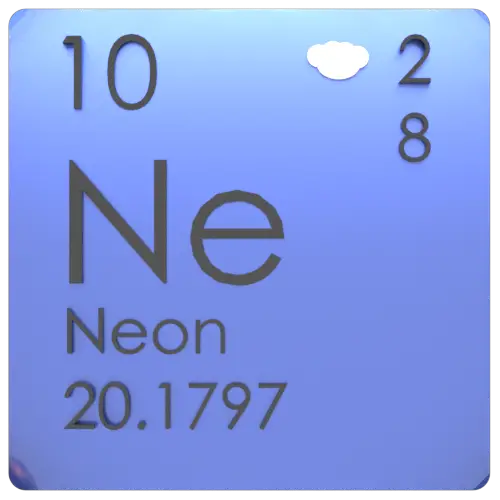
Neon-periodic-table

Source: www.luciteria.com

Mechanical Properties of Neon

Neon-mechanical-properties-strength-hardness-crystal-structure

Strength of Neon

In mechanics of materials, the strength of a material is its ability to withstand an applied load without failure or plastic deformation. Strength of materials basically considers the relationship between the external loads applied to a material and the resulting deformation or change in material dimensions. In designing structures and machines, it is important to consider these factors, in order that the material selected will have adequate strength to resist applied loads or forces and retain its original shape. Strength of a material is its ability to withstand this applied load without failure or plastic deformation.

For tensile stress, the capacity of a material or structure to withstand loads tending to elongate is known as ultimate tensile strength (UTS). Yield strength or yield stress is the material property defined as the stress at which a material begins to deform plastically whereas yield point is the point where nonlinear (elastic + plastic) deformation begins.

See also: Strength of Materials

Ultimate Tensile Strength of Neon

Ultimate tensile strength of Neon is N/A.

Yield Strength of Neon

Yield strength of Neon is N/A.

Modulus of Elasticity of Neon

The Young’s modulus of elasticity of Neon is N/A.

Hardness of Neon

In materials science, hardness is the ability to withstand surface indentation (localized plastic deformation) and scratching. Brinell hardness test is one of indentation hardness tests, that has been developed for hardness testing. In Brinell tests, a hard, spherical indenter is forced under a specific load into the surface of the metal to be tested.

Brinell hardness of Neon is approximately N/A.

The Vickers hardness test method was developed by Robert L. Smith and George E. Sandland at Vickers Ltd as an alternative to the Brinell method to measure the hardness of materials. The Vickers hardness test method can be also used as a microhardness test method, which is mostly used for small parts, thin sections, or case depth work.

Vickers hardness of Neon is approximately N/A.

Scratch hardness is the measure of how resistant a sample is to permanent plastic deformation due to friction from a sharp object. The most common scale for this qualitative test is Mohs scale, which is used in mineralogy. The Mohs scale of mineral hardness is based on the ability of one natural sample of mineral to scratch another mineral visibly.

Neon is has a hardness of approximately N/A.

See also: Hardness of Materials

Neon – Crystal Structure

A possible crystal structure of Neon is face-centered cubic structure.
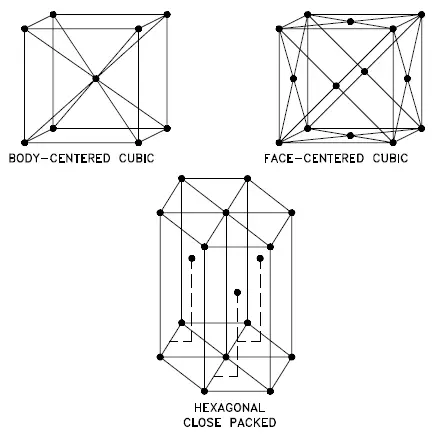
crystal structures - FCC, BCC, HCP

In metals, and in many other solids, the atoms are arranged in regular arrays called crystals. A crystal lattice is a repeating pattern of mathematical points that extends throughout space. The forces of chemical bonding causes this repetition. It is this repeated pattern which control properties like strength, ductility, density, conductivity (property of conducting or transmitting heat, electricity, etc.), and shape. There are 14 general types of such patterns known as Bravais lattices.

See also: Crystal Structure of Materials

Crystal Structure of Neon

Crystal Structure of Neon is: face-centered cubic

Strength of Elements

Elasticity of Elements
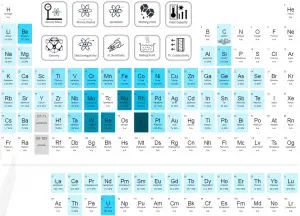
Hardness of Elements
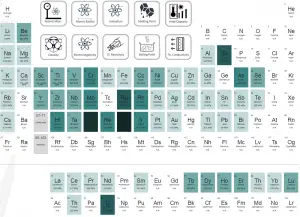
 

Thermal Properties of Neon

Neon-melting-point-conductivity-thermal-properties

Neon – Melting Point and Boiling Point

Melting point of Neon is -248°C.

Boiling point of Neon is -248.7°C.

Note that, these points are associated with the standard atmospheric pressure.

Neon – Thermal Conductivity

Thermal conductivity of Neon is 0.0493 W/(m·K).

The heat transfer characteristics of a solid material are measured by a property called the thermal conductivity, k (or λ), measured in W/m.K. It is a measure of a substance’s ability to transfer heat through a material by conduction. Note that Fourier’s law applies for all matter, regardless of its state (solid, liquid, or gas), therefore, it is also defined for liquids and gases.

Coefficient of Thermal Expansion of Neon

Linear thermal expansion coefficient of Neon is — µm/(m·K)

Thermal expansion is generally the tendency of matter to change its dimensions in response to a change in temperature. It is usually expressed as a fractional change in length or volume per unit temperature change.

Neon – Specific Heat, Latent Heat of Fusion, Latent Heat of Vaporization

Specific heat of Neon is 0.904 J/g K.

Heat capacity is an extensive property of matter, meaning it is proportional to the size of the system. Heat capacity C has the unit of energy per degree or energy per kelvin. When expressing the same phenomenon as an intensive property, the heat capacity is divided by the amount of substance, mass, or volume, thus the quantity is independent of the size or extent of the sample.

Latent Heat of Fusion of Neon is 0.3317 kJ/mol.

Latent Heat of Vaporization of Neon is 1.7326 kJ/mol.

Latent heat is the amount of heat added to or removed from a substance to produce a change in phase. This energy breaks down the intermolecular attractive forces, and also must provide the energy necessary to expand the gas (the pΔV work). When latent heat is added, no temperature change occurs. The enthalpy of vaporization is a function of the pressure at which that transformation takes place.

Melting Point of Elements
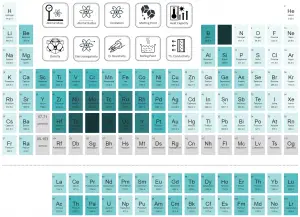
Periodic Table of Elements - melting point

Thermal Conductivity of Elements

Periodic Table of Elements - thermal conductivity

Thermal Expansion of Elements

Periodic Table of Elements - thermal expansion

Heat Capacity of Elements

Periodic Table of Elements - heat capacity

Heat of Fusion of Elements

Periodic Table of Elements - latent heat fusion

Heat of Vaporization of Elements

Periodic Table of Elements - latent heat vaporization

Neon – Electrical Resistivity – Magnetic Susceptibility

Neon-electrical-resistivity-magnetic-susceptibility

Electrical property refers to the response of a material to an applied electric field. One of the principal characteristics of materials is their ability (or lack of ability) to conduct electrical current. Indeed, materials are classified by this property, that is, they are divided into conductors, semiconductors, and nonconductors.

See also: Electrical Properties

Magnetic property refers to the response of a material to an applied magnetic field. The macroscopic magnetic properties of a material are a consequence of interactions between an external magnetic field and the magnetic dipole moments of the constituent atoms. Different materials react to the application of magnetic field differently.

See also: Magnetic Properties

Electrical Resistivity of Neon

Electrical resistivity of Neon is — nΩ⋅m.

Electrical conductivity and its converse, electrical resistivity, is a fundamental property of a material that quantifies how Neon conducts the flow of electric current. Electrical conductivity or specific conductance is the reciprocal of electrical resistivity.

Magnetic Susceptibility of Neon

Magnetic susceptibility of Neon is N/A.

In electromagnetism, magnetic susceptibility is the measure of the magnetization of a substance. Magnetic susceptibility is a dimensionless proportionality factor that indicates the degree of magnetization of Neon in response to an applied magnetic field.

Electrical Resistivity of Elements
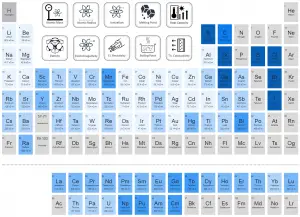
Periodic Table of Elements - electrical resistivity

Magnetic Susceptibility of Elements

Application and prices of other elements

Neon - Comparison of Properties and Prices

Periodic Table in 8K resolution

Other properties of Neon


Fluorine – Properties – Price – Applications – Production

Fluorine-properties-price-application-production

About Fluorine

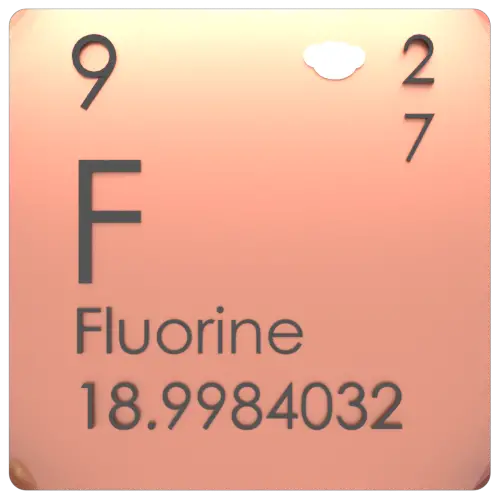
Fluorine is the lightest halogen and exists as a highly toxic pale yellow diatomic gas at standard conditions. As the most electronegative element, it is extremely reactive: almost all other elements, including some noble gases, form compounds with fluorine.

Summary

Element Fluorine
Atomic number 9
Element category Halogen
Phase at STP Gas
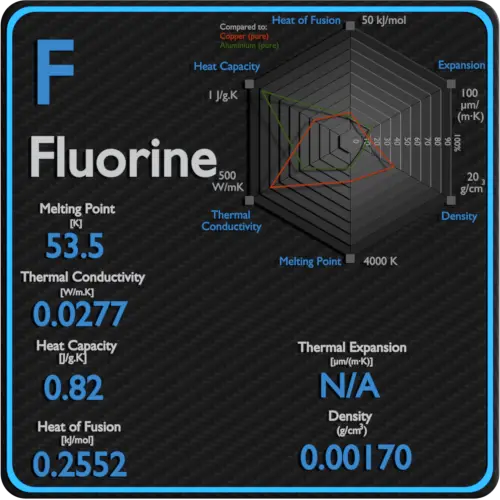
Density 0.0017 g/cm3
Ultimate Tensile Strength N/A
Yield Strength N/A
Young’s Modulus of Elasticity N/A
Mohs Scale N/A
Brinell Hardness N/A
Vickers Hardness N/A
Melting Point -219.8 °C
Boiling Point -188.1 °C
Thermal Conductivity 0.0279 W/mK
Thermal Expansion Coefficient — µm/mK
Specific Heat 0.82 J/g K
Heat of Fusion 0.2552 kJ/mol
Heat of Vaporization 3.2698 kJ/mol
Electrical resistivity [nanoOhm meter] —
Magnetic Susceptibility N/A

Applications of Fluorine

Owing to the expense of refining pure fluorine, most commercial applications use fluorine compounds, with about half of mined fluorite used in steelmaking. The rest of the fluorite is converted into corrosive hydrogen fluoride en route to various organic fluorides, or into cryolite, which plays a key role in aluminium refining. Most commercial uranium enrichment processes (gaseous diffusion and the gas centrifuge method) require the uranium to be in a gaseous form, therefore the uranium oxide concentrate must be first converted to uranium hexafluoride, which is a gas at relatively low temperatures. Molecules containing a carbon–fluorine bond often have very high chemical and thermal stability; their major uses are as refrigerants, electrical insulation and cookware, the last as PTFE (Teflon).

Fluorine-applications

Production and Price of Fluorine

Raw materials prices change daily. They are primarily driven by supply, demand and energy prices. In 2019, prices of pure Fluorine were at around 1900 $/kg.

Fluorine is obtained by the electrolysis of a solution of potassium hydrogendifluoride in anhydrous hydrofluoric acid. Hydrogen fluoride is produced in kilns by the endothermic reaction of fluorite (CaF2) with sulfuric acid.

Fluorine-periodic-table

Source: www.luciteria.com

Mechanical Properties of Fluorine

Fluorine-mechanical-properties-strength-hardness-crystal-structure

Strength of Fluorine

In mechanics of materials, the strength of a material is its ability to withstand an applied load without failure or plastic deformation. Strength of materials basically considers the relationship between the external loads applied to a material and the resulting deformation or change in material dimensions. In designing structures and machines, it is important to consider these factors, in order that the material selected will have adequate strength to resist applied loads or forces and retain its original shape. Strength of a material is its ability to withstand this applied load without failure or plastic deformation.

For tensile stress, the capacity of a material or structure to withstand loads tending to elongate is known as ultimate tensile strength (UTS). Yield strength or yield stress is the material property defined as the stress at which a material begins to deform plastically whereas yield point is the point where nonlinear (elastic + plastic) deformation begins.

See also: Strength of Materials

Ultimate Tensile Strength of Fluorine

Ultimate tensile strength of Fluorine is N/A.

Yield Strength of Fluorine

Yield strength of Fluorine is N/A.

Modulus of Elasticity of Fluorine

The Young’s modulus of elasticity of Fluorine is N/A.

Hardness of Fluorine

In materials science, hardness is the ability to withstand surface indentation (localized plastic deformation) and scratching. Brinell hardness test is one of indentation hardness tests, that has been developed for hardness testing. In Brinell tests, a hard, spherical indenter is forced under a specific load into the surface of the metal to be tested.

Brinell hardness of Fluorine is approximately N/A.

The Vickers hardness test method was developed by Robert L. Smith and George E. Sandland at Vickers Ltd as an alternative to the Brinell method to measure the hardness of materials. The Vickers hardness test method can be also used as a microhardness test method, which is mostly used for small parts, thin sections, or case depth work.

Vickers hardness of Fluorine is approximately N/A.

Scratch hardness is the measure of how resistant a sample is to permanent plastic deformation due to friction from a sharp object. The most common scale for this qualitative test is Mohs scale, which is used in mineralogy. The Mohs scale of mineral hardness is based on the ability of one natural sample of mineral to scratch another mineral visibly.

Fluorine is has a hardness of approximately N/A.

See also: Hardness of Materials

Fluorine – Crystal Structure

A possible crystal structure of Fluorine is cubic structure.

crystal structures - FCC, BCC, HCP

In metals, and in many other solids, the atoms are arranged in regular arrays called crystals. A crystal lattice is a repeating pattern of mathematical points that extends throughout space. The forces of chemical bonding causes this repetition. It is this repeated pattern which control properties like strength, ductility, density, conductivity (property of conducting or transmitting heat, electricity, etc.), and shape. There are 14 general types of such patterns known as Bravais lattices.

See also: Crystal Structure of Materials

Crystal Structure of Fluorine
Crystal Structure of Fluorine is: cubic

Strength of Elements

Elasticity of Elements

Hardness of Elements


Thermal Properties of Fluorine

Fluorine-melting-point-conductivity-thermal-properties

Fluorine – Melting Point and Boiling Point

Melting point of Fluorine is -219.8°C.

Boiling point of Fluorine is -188.1°C.

Note that, these points are associated with the standard atmospheric pressure.

Fluorine – Thermal Conductivity

Thermal conductivity of Fluorine is 0.0279 W/(m·K).

The heat transfer characteristics of a solid material are measured by a property called the thermal conductivity, k (or λ), measured in W/m.K. It is a measure of a substance’s ability to transfer heat through a material by conduction. Note that Fourier’s law applies for all matter, regardless of its state (solid, liquid, or gas), therefore, it is also defined for liquids and gases.

Coefficient of Thermal Expansion of Fluorine

Linear thermal expansion coefficient of Fluorine is — µm/(m·K)

Thermal expansion is generally the tendency of matter to change its dimensions in response to a change in temperature. It is usually expressed as a fractional change in length or volume per unit temperature change.

Fluorine – Specific Heat, Latent Heat of Fusion, Latent Heat of Vaporization

Specific heat of Fluorine is 0.82 J/g K.

Heat capacity is an extensive property of matter, meaning it is proportional to the size of the system. Heat capacity C has the unit of energy per degree or energy per kelvin. When expressing the same phenomenon as an intensive property, the heat capacity is divided by the amount of substance, mass, or volume, thus the quantity is independent of the size or extent of the sample.

Latent Heat of Fusion of Fluorine is 0.2552 kJ/mol.

Latent Heat of Vaporization of Fluorine is 3.2698 kJ/mol.

Latent heat is the amount of heat added to or removed from a substance to produce a change in phase. This energy breaks down the intermolecular attractive forces, and also must provide the energy necessary to expand the gas (the pΔV work). When latent heat is added, no temperature change occurs. The enthalpy of vaporization is a function of the pressure at which that transformation takes place.

Melting Point of Elements

Periodic Table of Elements - melting point

Thermal Conductivity of Elements

Periodic Table of Elements - thermal conductivity

Thermal Expansion of Elements

Periodic Table of Elements - thermal expansion

Heat Capacity of Elements

Periodic Table of Elements - heat capacity

Heat of Fusion of Elements

Periodic Table of Elements - latent heat fusion

Heat of Vaporization of Elements

Periodic Table of Elements - latent heat vaporization

Fluorine – Electrical Resistivity – Magnetic Susceptibility

Fluorine-electrical-resistivity-magnetic-susceptibility

Electrical property refers to the response of a material to an applied electric field. One of the principal characteristics of materials is their ability (or lack of ability) to conduct electrical current. Indeed, materials are classified by this property, that is, they are divided into conductors, semiconductors, and nonconductors.

See also: Electrical Properties

Magnetic property refers to the response of a material to an applied magnetic field. The macroscopic magnetic properties of a material are a consequence of interactions between an external magnetic field and the magnetic dipole moments of the constituent atoms. Different materials react to the application of magnetic field differently.

See also: Magnetic Properties

Electrical Resistivity of Fluorine

Electrical resistivity of Fluorine is — nΩ⋅m.

Electrical conductivity and its converse, electrical resistivity, is a fundamental property of a material that quantifies how Fluorine conducts the flow of electric current. Electrical conductivity or specific conductance is the reciprocal of electrical resistivity.

Magnetic Susceptibility of Fluorine

Magnetic susceptibility of Fluorine is N/A.

In electromagnetism, magnetic susceptibility is the measure of the magnetization of a substance. Magnetic susceptibility is a dimensionless proportionality factor that indicates the degree of magnetization of Fluorine in response to an applied magnetic field.

Electrical Resistivity of Elements

Periodic Table of Elements - electrical resistivity

Magnetic Susceptibility of Elements

Application and prices of other elements

Fluorine - Comparison of Properties and Prices

Periodic Table in 8K resolution

Other properties of Fluorine


Oxygen – Properties – Price – Applications – Production

Oxygen-properties-price-application-production

About Oxygen

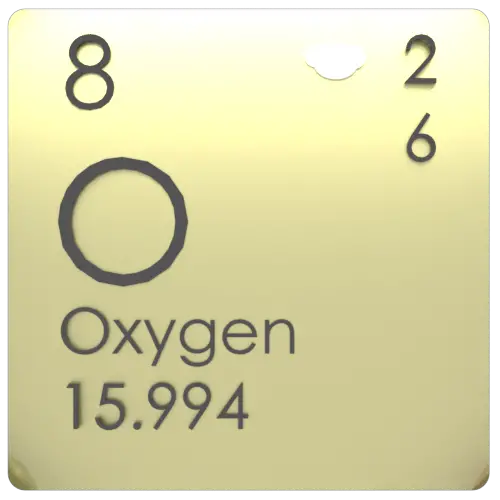
Oxygen is a colourless, odourless reactive gas, the chemical element of atomic number 8 and the life-supporting component of the air. It is a member of the chalcogen group on the periodic table, a highly reactive nonmetal, and an oxidizing agent that readily forms oxides with most elements as well as with other compounds. By mass, oxygen is the third-most abundant element in the universe, after hydrogen and helium.

Summary

Element Oxygen
Atomic number 8
Element category Non Metal
Phase at STP Gas
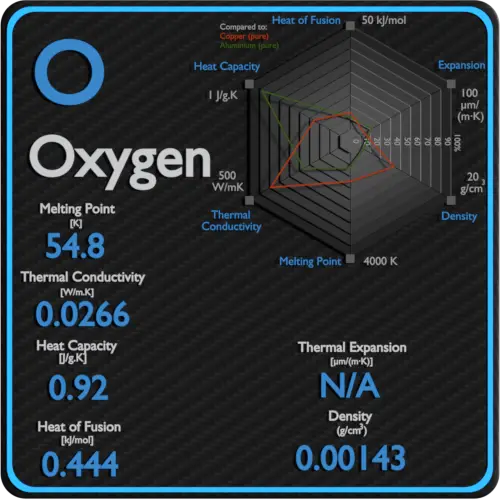
Density 0.00143 g/cm3
Ultimate Tensile Strength N/A
Yield Strength N/A
Young’s Modulus of Elasticity N/A
Mohs Scale N/A
Brinell Hardness N/A
Vickers Hardness N/A
Melting Point -218.4 °C
Boiling Point -183 °C
Thermal Conductivity 0.02674 W/mK
Thermal Expansion Coefficient — µm/mK
Specific Heat 0.92 J/g K
Heat of Fusion (O2) 0.444 kJ/mol
Heat of Vaporization (O2) 6.82 kJ/mol
Electrical resistivity [nanoOhm meter] —
Magnetic Susceptibility +3.4e-3 cm^3/mol

Applications of Oxygen

Common uses of oxygen include production of steel, plastics and textiles, brazing, welding and cutting of steels and other metals, rocket propellant, oxygen therapy, and life support systems in aircraft, submarines, spaceflight and diving. Smelting of iron ore into steel consumes 55% of commercially produced oxygen. In this process, oxygen is injected through a high-pressure lance into molten iron, which removes sulfur impurities and excess carbon as the respective oxides, sulfur dioxide and carbon dioxide. Uptake of oxygen from the air is the essential purpose of respiration, so oxygen supplementation is used in medicine. Treatment not only increases oxygen levels in the patient’s blood, but has the secondary effect of decreasing resistance to blood flow in many types of diseased lungs, easing work load on the heart.

Oxygen-applications

Production and Price of Oxygen

Raw materials prices change daily. They are primarily driven by supply, demand and energy prices. In 2019, prices of pure Oxygen were at around 3 $/kg.

One hundred million tonnes of oxygen are extracted from air for industrial uses annually by two primary methods. The most common method is fractional distillation of liquefied air, with nitrogen distilling as a vapor while oxygen is left as a liquid. The other primary method of producing oxygen is passing a stream of clean, dry air through one bed of a pair of identical zeolite molecular sieves, which absorbs the nitrogen and delivers a gas stream that is 90% to 93% oxygen.

Oxygen-periodic-table

Source: www.luciteria.com

Mechanical Properties of Oxygen

Oxygen-mechanical-properties-strength-hardness-crystal-structure

Strength of Oxygen

In mechanics of materials, the strength of a material is its ability to withstand an applied load without failure or plastic deformation. Strength of materials basically considers the relationship between the external loads applied to a material and the resulting deformation or change in material dimensions. In designing structures and machines, it is important to consider these factors, in order that the material selected will have adequate strength to resist applied loads or forces and retain its original shape. Strength of a material is its ability to withstand this applied load without failure or plastic deformation.

For tensile stress, the capacity of a material or structure to withstand loads tending to elongate is known as ultimate tensile strength (UTS). Yield strength or yield stress is the material property defined as the stress at which a material begins to deform plastically whereas yield point is the point where nonlinear (elastic + plastic) deformation begins.

See also: Strength of Materials

Ultimate Tensile Strength of Oxygen

Ultimate tensile strength of Oxygen is N/A.

Yield Strength of Oxygen

Yield strength of Oxygen is N/A.

Modulus of Elasticity of Oxygen

The Young’s modulus of elasticity of Oxygen is N/A.

Hardness of Oxygen

In materials science, hardness is the ability to withstand surface indentation (localized plastic deformation) and scratching. Brinell hardness test is one of indentation hardness tests, that has been developed for hardness testing. In Brinell tests, a hard, spherical indenter is forced under a specific load into the surface of the metal to be tested.

Brinell hardness of Oxygen is approximately N/A.

The Vickers hardness test method was developed by Robert L. Smith and George E. Sandland at Vickers Ltd as an alternative to the Brinell method to measure the hardness of materials. The Vickers hardness test method can be also used as a microhardness test method, which is mostly used for small parts, thin sections, or case depth work.

Vickers hardness of Oxygen is approximately N/A.

Scratch hardness is the measure of how resistant a sample is to permanent plastic deformation due to friction from a sharp object. The most common scale for this qualitative test is Mohs scale, which is used in mineralogy. The Mohs scale of mineral hardness is based on the ability of one natural sample of mineral to scratch another mineral visibly.

Oxygen is has a hardness of approximately N/A.

See also: Hardness of Materials

Oxygen – Crystal Structure

A possible crystal structure of Oxygen is cubic structure.

crystal structures - FCC, BCC, HCP

In metals, and in many other solids, the atoms are arranged in regular arrays called crystals. A crystal lattice is a repeating pattern of mathematical points that extends throughout space. The forces of chemical bonding causes this repetition. It is this repeated pattern which control properties like strength, ductility, density, conductivity (property of conducting or transmitting heat, electricity, etc.), and shape. There are 14 general types of such patterns known as Bravais lattices.

See also: Crystal Structure of Materials

Crystal Structure of Oxygen
Crystal Structure of Oxygen is: cubic

Strength of Elements

Elasticity of Elements

Hardness of Elements


Thermal Properties of Oxygen

Oxygen-melting-point-conductivity-thermal-properties

Oxygen – Melting Point and Boiling Point

Melting point of Oxygen is -218.4°C.

Boiling point of Oxygen is -183°C.

Note that, these points are associated with the standard atmospheric pressure.

Oxygen – Thermal Conductivity

Thermal conductivity of Oxygen is 0.02674 W/(m·K).

The heat transfer characteristics of a solid material are measured by a property called the thermal conductivity, k (or λ), measured in W/m.K. It is a measure of a substance’s ability to transfer heat through a material by conduction. Note that Fourier’s law applies for all matter, regardless of its state (solid, liquid, or gas), therefore, it is also defined for liquids and gases.

Coefficient of Thermal Expansion of Oxygen

Linear thermal expansion coefficient of Oxygen is — µm/(m·K)

Thermal expansion is generally the tendency of matter to change its dimensions in response to a change in temperature. It is usually expressed as a fractional change in length or volume per unit temperature change.

Oxygen – Specific Heat, Latent Heat of Fusion, Latent Heat of Vaporization

Specific heat of Oxygen is 0.92 J/g K.

Heat capacity is an extensive property of matter, meaning it is proportional to the size of the system. Heat capacity C has the unit of energy per degree or energy per kelvin. When expressing the same phenomenon as an intensive property, the heat capacity is divided by the amount of substance, mass, or volume, thus the quantity is independent of the size or extent of the sample.

Latent Heat of Fusion of Oxygen is (O2) 0.444 kJ/mol.

Latent Heat of Vaporization of Oxygen is (O2) 6.82 kJ/mol.

Latent heat is the amount of heat added to or removed from a substance to produce a change in phase. This energy breaks down the intermolecular attractive forces, and also must provide the energy necessary to expand the gas (the pΔV work). When latent heat is added, no temperature change occurs. The enthalpy of vaporization is a function of the pressure at which that transformation takes place.

Melting Point of Elements

Periodic Table of Elements - melting point

Thermal Conductivity of Elements

Periodic Table of Elements - thermal conductivity

Thermal Expansion of Elements

Periodic Table of Elements - thermal expansion

Heat Capacity of Elements

Periodic Table of Elements - heat capacity

Heat of Fusion of Elements

Periodic Table of Elements - latent heat fusion

Heat of Vaporization of Elements

Periodic Table of Elements - latent heat vaporization

Oxygen – Electrical Resistivity – Magnetic Susceptibility

Oxygen-electrical-resistivity-magnetic-susceptibility

Electrical property refers to the response of a material to an applied electric field. One of the principal characteristics of materials is their ability (or lack of ability) to conduct electrical current. Indeed, materials are classified by this property, that is, they are divided into conductors, semiconductors, and nonconductors.

See also: Electrical Properties

Magnetic property refers to the response of a material to an applied magnetic field. The macroscopic magnetic properties of a material are a consequence of interactions between an external magnetic field and the magnetic dipole moments of the constituent atoms. Different materials react to the application of magnetic field differently.

See also: Magnetic Properties

Electrical Resistivity of Oxygen

Electrical resistivity of Oxygen is — nΩ⋅m.

Electrical conductivity and its converse, electrical resistivity, is a fundamental property of a material that quantifies how Oxygen conducts the flow of electric current. Electrical conductivity or specific conductance is the reciprocal of electrical resistivity.

Magnetic Susceptibility of Oxygen

Magnetic susceptibility of Oxygen is +3.4e-3 cm^3/mol.

In electromagnetism, magnetic susceptibility is the measure of the magnetization of a substance. Magnetic susceptibility is a dimensionless proportionality factor that indicates the degree of magnetization of Oxygen in response to an applied magnetic field.

Electrical Resistivity of Elements

Periodic Table of Elements - electrical resistivity

Magnetic Susceptibility of Elements

Application and prices of other elements

Oxygen - Comparison of Properties and Prices

Periodic Table in 8K resolution

Other properties of Oxygen


Nitrogen – Properties – Price – Applications – Production

Nitrogen-properties-price-application-production

About Nitrogen

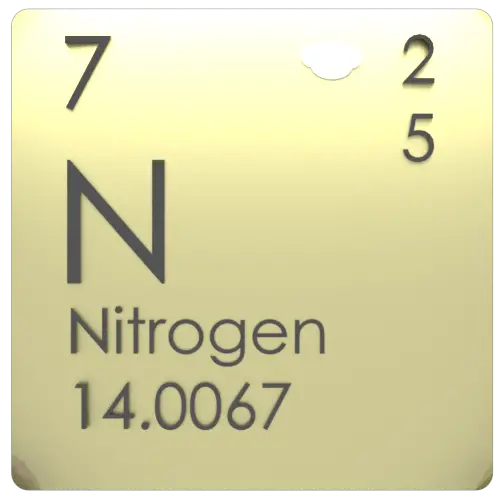
Nitrogen is a colourless, odourless unreactive gas that forms about 78% of the earth’s atmosphere. Liquid nitrogen (made by distilling liquid air) boils at 77.4 kelvins (−195.8°C) and is used as a coolant.

Summary

Element Nitrogen
Atomic number 7
Element category Non Metal
Phase at STP Gas
Density 0.00125 g/cm3
Ultimate Tensile Strength N/A
Yield Strength N/A
Young’s Modulus of Elasticity N/A
Mohs Scale N/A
Brinell Hardness N/A
Vickers Hardness N/A
Melting Point -209.9 °C
Boiling Point -195.8 °C
Thermal Conductivity 0.02598 W/mK
Thermal Expansion Coefficient — µm/mK
Specific Heat 1.04 J/g K
Heat of Fusion (N2) 0.7204 kJ/mol
Heat of Vaporization (N2) 5.56 kJ/mol
Electrical resistivity [nanoOhm meter] —
Magnetic Susceptibility −1.2e-5 cm^3/mol

Applications of Nitrogen

Nitrogen in various chemical forms plays a major role in large number of environmental issues. The applications of nitrogen compounds are naturally extremely widely varied due to the huge size of this class: hence, only applications of pure nitrogen itself will be considered here. Two-thirds of nitrogen produced by industry is sold as the gas and the remaining one-third as the liquid. In metallurgy, nitriding is a case hardening process in which the surface nitrogen concentration of a ferrous is increased by diffusion from the surrounding environment to create case-hardened surface. Nitriding produces hard, highly wear-resistant surface (shallow case depths) of product with fair capacity for contact load, good bending fatigue strength and excellent resistance to seizure. Synthetically produced ammonia and nitrates are key industrial fertilisers, and fertiliser nitrates are key pollutants in the eutrophication of water systems. Apart from its use in fertilisers and energy-stores, nitrogen is a constituent of organic compounds as diverse as Kevlar used in high-strength fabric and cyanoacrylate used in superglue.

Nitrogen-applications

Production and Price of Nitrogen

Raw materials prices change daily. They are primarily driven by supply, demand and energy prices. In 2019, prices of pure Nitrogen were at around 4 $/kg.

Dinitrogen forms about 78% of Earth’s atmosphere, making it the most abundant uncombined element. Nitrogen gas is an industrial gas produced by the fractional distillation of liquid air, or by mechanical means using gaseous air (pressurised reverse osmosis membrane or pressure swing adsorption). Nitrogen gas generators using membranes or pressure swing adsorption (PSA) are typically more cost and energy efficient than bulk delivered nitrogen. Commercial nitrogen is often a byproduct of air-processing for industrial concentration of oxygen for steelmaking and other purposes.

Nitrogen-periodic-table

Source: www.luciteria.com

Mechanical Properties of Nitrogen

Nitrogen-mechanical-properties-strength-hardness-crystal-structure

Strength of Nitrogen

In mechanics of materials, the strength of a material is its ability to withstand an applied load without failure or plastic deformation. Strength of materials basically considers the relationship between the external loads applied to a material and the resulting deformation or change in material dimensions. In designing structures and machines, it is important to consider these factors, in order that the material selected will have adequate strength to resist applied loads or forces and retain its original shape. Strength of a material is its ability to withstand this applied load without failure or plastic deformation.

For tensile stress, the capacity of a material or structure to withstand loads tending to elongate is known as ultimate tensile strength (UTS). Yield strength or yield stress is the material property defined as the stress at which a material begins to deform plastically whereas yield point is the point where nonlinear (elastic + plastic) deformation begins.

See also: Strength of Materials

Ultimate Tensile Strength of Nitrogen

Ultimate tensile strength of Nitrogen is N/A.

Yield Strength of Nitrogen

Yield strength of Nitrogen is N/A.

Modulus of Elasticity of Nitrogen

The Young’s modulus of elasticity of Nitrogen is N/A.

Hardness of Nitrogen

In materials science, hardness is the ability to withstand surface indentation (localized plastic deformation) and scratching. Brinell hardness test is one of indentation hardness tests, that has been developed for hardness testing. In Brinell tests, a hard, spherical indenter is forced under a specific load into the surface of the metal to be tested.

Brinell hardness of Nitrogen is approximately N/A.

The Vickers hardness test method was developed by Robert L. Smith and George E. Sandland at Vickers Ltd as an alternative to the Brinell method to measure the hardness of materials. The Vickers hardness test method can be also used as a microhardness test method, which is mostly used for small parts, thin sections, or case depth work.

Vickers hardness of Nitrogen is approximately N/A.

Scratch hardness is the measure of how resistant a sample is to permanent plastic deformation due to friction from a sharp object. The most common scale for this qualitative test is Mohs scale, which is used in mineralogy. The Mohs scale of mineral hardness is based on the ability of one natural sample of mineral to scratch another mineral visibly.

Nitrogen is has a hardness of approximately N/A.

See also: Hardness of Materials

Nitrogen – Crystal Structure

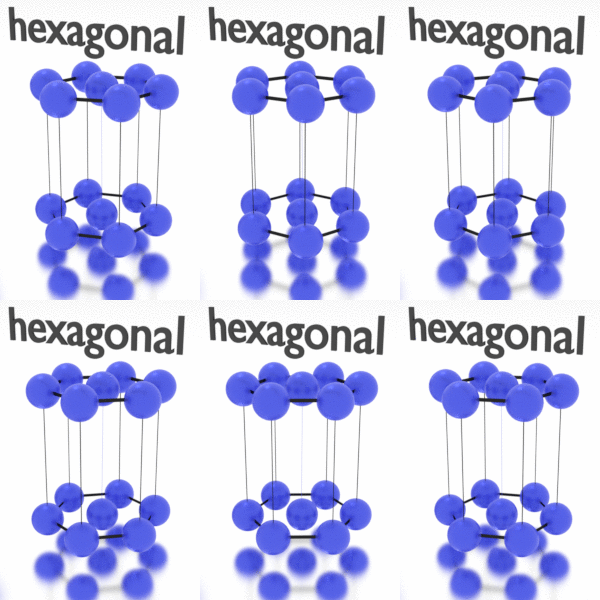
A possible crystal structure of Nitrogen is hexagonal structure.

crystal structures - FCC, BCC, HCP

In metals, and in many other solids, the atoms are arranged in regular arrays called crystals. A crystal lattice is a repeating pattern of mathematical points that extends throughout space. The forces of chemical bonding causes this repetition. It is this repeated pattern which control properties like strength, ductility, density, conductivity (property of conducting or transmitting heat, electricity, etc.), and shape. There are 14 general types of such patterns known as Bravais lattices.

See also: Crystal Structure of Materials

Crystal Structure of Nitrogen
Crystal Structure of Nitrogen is: hexagonal

Strength of Elements

Elasticity of Elements

Hardness of Elements


Thermal Properties of Nitrogen

Nitrogen-melting-point-conductivity-thermal-properties

Nitrogen – Melting Point and Boiling Point

Melting point of Nitrogen is -209.9°C.

Boiling point of Nitrogen is -195.8°C.

Note that, these points are associated with the standard atmospheric pressure.

Nitrogen – Thermal Conductivity

Thermal conductivity of Nitrogen is 0.02598 W/(m·K).

The heat transfer characteristics of a solid material are measured by a property called the thermal conductivity, k (or λ), measured in W/m.K. It is a measure of a substance’s ability to transfer heat through a material by conduction. Note that Fourier’s law applies for all matter, regardless of its state (solid, liquid, or gas), therefore, it is also defined for liquids and gases.

Coefficient of Thermal Expansion of Nitrogen

Linear thermal expansion coefficient of Nitrogen is — µm/(m·K)

Thermal expansion is generally the tendency of matter to change its dimensions in response to a change in temperature. It is usually expressed as a fractional change in length or volume per unit temperature change.

Nitrogen – Specific Heat, Latent Heat of Fusion, Latent Heat of Vaporization

Specific heat of Nitrogen is 1.04 J/g K.

Heat capacity is an extensive property of matter, meaning it is proportional to the size of the system. Heat capacity C has the unit of energy per degree or energy per kelvin. When expressing the same phenomenon as an intensive property, the heat capacity is divided by the amount of substance, mass, or volume, thus the quantity is independent of the size or extent of the sample.

Latent Heat of Fusion of Nitrogen is (N2) 0.7204 kJ/mol.

Latent Heat of Vaporization of Nitrogen is (N2) 5.56 kJ/mol.

Latent heat is the amount of heat added to or removed from a substance to produce a change in phase. This energy breaks down the intermolecular attractive forces, and also must provide the energy necessary to expand the gas (the pΔV work). When latent heat is added, no temperature change occurs. The enthalpy of vaporization is a function of the pressure at which that transformation takes place.

Melting Point of Elements

Periodic Table of Elements - melting point

Thermal Conductivity of Elements

Periodic Table of Elements - thermal conductivity

Thermal Expansion of Elements

Periodic Table of Elements - thermal expansion

Heat Capacity of Elements

Periodic Table of Elements - heat capacity

Heat of Fusion of Elements

Periodic Table of Elements - latent heat fusion

Heat of Vaporization of Elements

Periodic Table of Elements - latent heat vaporization

Nitrogen – Electrical Resistivity – Magnetic Susceptibility

Nitrogen-electrical-resistivity-magnetic-susceptibility

Electrical property refers to the response of a material to an applied electric field. One of the principal characteristics of materials is their ability (or lack of ability) to conduct electrical current. Indeed, materials are classified by this property, that is, they are divided into conductors, semiconductors, and nonconductors.

See also: Electrical Properties

Magnetic property refers to the response of a material to an applied magnetic field. The macroscopic magnetic properties of a material are a consequence of interactions between an external magnetic field and the magnetic dipole moments of the constituent atoms. Different materials react to the application of magnetic field differently.

See also: Magnetic Properties

Electrical Resistivity of Nitrogen

Electrical resistivity of Nitrogen is — nΩ⋅m.

Electrical conductivity and its converse, electrical resistivity, is a fundamental property of a material that quantifies how Nitrogen conducts the flow of electric current. Electrical conductivity or specific conductance is the reciprocal of electrical resistivity.

Magnetic Susceptibility of Nitrogen

Magnetic susceptibility of Nitrogen is −1.2e-5 cm^3/mol.

In electromagnetism, magnetic susceptibility is the measure of the magnetization of a substance. Magnetic susceptibility is a dimensionless proportionality factor that indicates the degree of magnetization of Nitrogen in response to an applied magnetic field.

Electrical Resistivity of Elements

Periodic Table of Elements - electrical resistivity

Magnetic Susceptibility of Elements

Application and prices of other elements

Nitrogen - Comparison of Properties and Prices

Periodic Table in 8K resolution

Other properties of Nitrogen


Carbon – Properties – Price – Applications – Production

Carbon-properties-price-application-production

About Carbon

It is nonmetallic and tetravalent—making four electrons available to form covalent chemical bonds. Carbon is one of the few elements known since antiquity. Carbon is the 15th most abundant element in the Earth’s crust, and the fourth most abundant element in the universe by mass after hydrogen, helium, and oxygen.

Summary

Element Carbon
Atomic number 6
Element category Non Metal
Phase at STP Solid
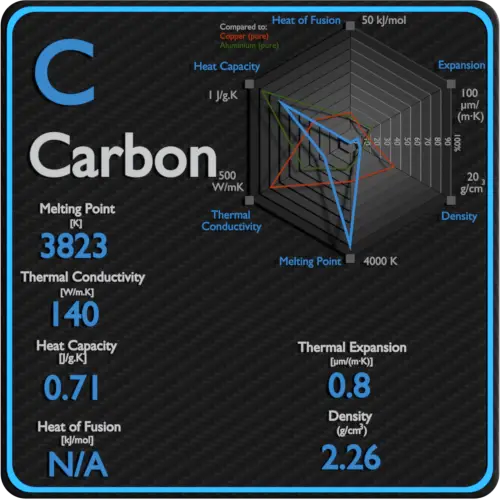
Density 2.26 g/cm3
Ultimate Tensile Strength 15 MPa (graphite); 3500 MPa (carbon fiber)
Yield Strength N/A
Young’s Modulus of Elasticity 4.1 GPa (graphite); 228 GPa (carbon fiber)
Mohs Scale 0.8 (graphite)
Brinell Hardness N/A
Vickers Hardness N/A
Melting Point 4099 °C
Boiling Point 4527 °C
Thermal Conductivity 129 W/mK
Thermal Expansion Coefficient 0.8 µm/mK
Specific Heat 0.71 J/g K
Heat of Fusion — kJ/mol
Heat of Vaporization 355.8 kJ/mol
Electrical resistivity [nanoOhm meter] 7837
Magnetic Susceptibility −5.9e-6 cm^3/mol

Applications of Carbon

The major economic use of carbon other than food and wood is in the form of hydrocarbons, most notably the fossil fuel methane gas and crude oil (petroleum). Graphite and diamonds are two important allotropes of carbon that have wide applications. The uses of carbon and its compounds are extremely varied. It can form alloys with iron, of which the most common is carbon steel. Carbon is a non-metallic element, which is an important alloying element in all ferrous metal based materials. Carbon is always present in metallic alloys, i.e. in all grades of stainless steel and heat resistant alloys. Carbon is a very strong austenitizer and increases the strength of steel. In fact, it is the principal hardening element and is essential to the formation of cementite, Fe3C, pearlite, spheroidite, and iron-carbon martensite. Adding a small amount of non-metallic carbon to iron trades its great ductility for the greater strength. Graphite is combined with clays to form the ‘lead’ used in pencils used for writing and drawing. It is also used as a lubricant and a pigment, as a molding material in glass manufacture, in electrodes for dry batteries and in electroplating and electroforming, in brushes for electric motors and as a neutron moderator in nuclear reactors. Charcoal has been used since earliest times for a large range of purposes including art and medicine, but by far its most important use has been as a metallurgical fuel. Carbon fibers are used where low weight, high stiffness, high conductivity, or where the look of the carbon fiber weave desired.

Carbon-applications

Production and Price of Carbon

Raw materials prices change daily. They are primarily driven by supply, demand and energy prices. In 2019, prices of pure Carbon were at around 24 $/kg.

Graphite, diamond and other carbon forms are directly obtained from mines. Synthetic diamonds can be produced when pure carbon is subjected to extremely high temperatures and pressures. Today, about 1/3rd of all diamonds are synthetically produced. Commercially viable natural deposits of graphite occur in many parts of the world, but the most important sources economically are in China, India, Brazil and North Korea. According to the USGS, world production of natural graphite was 1.1 million tonnes in 2010, to which China contributed 800,000 t, India 130,000 t, Brazil 76,000 t, North Korea 30,000 t and Canada 25,000 t.

Carbon-periodic-table

Source: www.luciteria.com

Mechanical Properties of Carbon

Carbon-mechanical-properties-strength-hardness-crystal-structure

Strength of Carbon

In mechanics of materials, the strength of a material is its ability to withstand an applied load without failure or plastic deformation. Strength of materials basically considers the relationship between the external loads applied to a material and the resulting deformation or change in material dimensions. In designing structures and machines, it is important to consider these factors, in order that the material selected will have adequate strength to resist applied loads or forces and retain its original shape. Strength of a material is its ability to withstand this applied load without failure or plastic deformation.

For tensile stress, the capacity of a material or structure to withstand loads tending to elongate is known as ultimate tensile strength (UTS). Yield strength or yield stress is the material property defined as the stress at which a material begins to deform plastically whereas yield point is the point where nonlinear (elastic + plastic) deformation begins.

See also: Strength of Materials

Ultimate Tensile Strength of Carbon

Ultimate tensile strength of Carbon is 15 MPa (graphite); 3500 MPa (carbon fiber).

Yield Strength of Carbon

Yield strength of Carbon is N/A.

Modulus of Elasticity of Carbon

The Young’s modulus of elasticity of Carbon is 4.1 GPa (graphite) – 228 GPa (carbon fiber).

Hardness of Carbon

In materials science, hardness is the ability to withstand surface indentation (localized plastic deformation) and scratching. Brinell hardness test is one of indentation hardness tests, that has been developed for hardness testing. In Brinell tests, a hard, spherical indenter is forced under a specific load into the surface of the metal to be tested.

Brinell hardness of Carbon is approximately N/A.

The Vickers hardness test method was developed by Robert L. Smith and George E. Sandland at Vickers Ltd as an alternative to the Brinell method to measure the hardness of materials. The Vickers hardness test method can be also used as a microhardness test method, which is mostly used for small parts, thin sections, or case depth work.

Vickers hardness of Carbon is approximately N/A.

Scratch hardness is the measure of how resistant a sample is to permanent plastic deformation due to friction from a sharp object. The most common scale for this qualitative test is Mohs scale, which is used in mineralogy. The Mohs scale of mineral hardness is based on the ability of one natural sample of mineral to scratch another mineral visibly.

Carbon is has a hardness of approximately 0.8 (graphite).

See also: Hardness of Materials

Carbon – Crystal Structure

A possible crystal structure of Carbon is hexagonal structure.

crystal structures - FCC, BCC, HCP

In metals, and in many other solids, the atoms are arranged in regular arrays called crystals. A crystal lattice is a repeating pattern of mathematical points that extends throughout space. The forces of chemical bonding causes this repetition. It is this repeated pattern which control properties like strength, ductility, density, conductivity (property of conducting or transmitting heat, electricity, etc.), and shape. There are 14 general types of such patterns known as Bravais lattices.

See also: Crystal Structure of Materials

Crystal Structure of Carbon
Crystal Structure of Carbon is: hexagonal

Strength of Elements

Elasticity of Elements

Hardness of Elements


Thermal Properties of Carbon

Carbon-melting-point-conductivity-thermal-properties

Carbon – Melting Point and Boiling Point

Melting point of Carbon is 4099°C.

Boiling point of Carbon is 4527°C.

Note that, these points are associated with the standard atmospheric pressure.

Carbon – Thermal Conductivity

Thermal conductivity of Carbon is 129 W/(m·K).

The heat transfer characteristics of a solid material are measured by a property called the thermal conductivity, k (or λ), measured in W/m.K. It is a measure of a substance’s ability to transfer heat through a material by conduction. Note that Fourier’s law applies for all matter, regardless of its state (solid, liquid, or gas), therefore, it is also defined for liquids and gases.

Coefficient of Thermal Expansion of Carbon

Linear thermal expansion coefficient of Carbon is 0.8 µm/(m·K)

Thermal expansion is generally the tendency of matter to change its dimensions in response to a change in temperature. It is usually expressed as a fractional change in length or volume per unit temperature change.

Carbon – Specific Heat, Latent Heat of Fusion, Latent Heat of Vaporization

Specific heat of Carbon is 0.71 J/g K.

Heat capacity is an extensive property of matter, meaning it is proportional to the size of the system. Heat capacity C has the unit of energy per degree or energy per kelvin. When expressing the same phenomenon as an intensive property, the heat capacity is divided by the amount of substance, mass, or volume, thus the quantity is independent of the size or extent of the sample.

Latent Heat of Fusion of Carbon is — kJ/mol.

Latent Heat of Vaporization of Carbon is 355.8 kJ/mol.

Latent heat is the amount of heat added to or removed from a substance to produce a change in phase. This energy breaks down the intermolecular attractive forces, and also must provide the energy necessary to expand the gas (the pΔV work). When latent heat is added, no temperature change occurs. The enthalpy of vaporization is a function of the pressure at which that transformation takes place.

Melting Point of Elements

Periodic Table of Elements - melting point

Thermal Conductivity of Elements

Periodic Table of Elements - thermal conductivity

Thermal Expansion of Elements

Periodic Table of Elements - thermal expansion

Heat Capacity of Elements

Periodic Table of Elements - heat capacity

Heat of Fusion of Elements

Periodic Table of Elements - latent heat fusion

Heat of Vaporization of Elements

Periodic Table of Elements - latent heat vaporization

Carbon – Electrical Resistivity – Magnetic Susceptibility

Carbon-electrical-resistivity-magnetic-susceptibility

Electrical property refers to the response of a material to an applied electric field. One of the principal characteristics of materials is their ability (or lack of ability) to conduct electrical current. Indeed, materials are classified by this property, that is, they are divided into conductors, semiconductors, and nonconductors.

See also: Electrical Properties

Magnetic property refers to the response of a material to an applied magnetic field. The macroscopic magnetic properties of a material are a consequence of interactions between an external magnetic field and the magnetic dipole moments of the constituent atoms. Different materials react to the application of magnetic field differently.

See also: Magnetic Properties

Electrical Resistivity of Carbon

Electrical resistivity of Carbon is 7837 nΩ⋅m.

Electrical conductivity and its converse, electrical resistivity, is a fundamental property of a material that quantifies how Carbon conducts the flow of electric current. Electrical conductivity or specific conductance is the reciprocal of electrical resistivity.

Magnetic Susceptibility of Carbon

Magnetic susceptibility of Carbon is −5.9e-6 cm^3/mol.

In electromagnetism, magnetic susceptibility is the measure of the magnetization of a substance. Magnetic susceptibility is a dimensionless proportionality factor that indicates the degree of magnetization of Carbon in response to an applied magnetic field.

Electrical Resistivity of Elements

Periodic Table of Elements - electrical resistivity

Magnetic Susceptibility of Elements

Application and prices of other elements

Carbon - Comparison of Properties and Prices

Periodic Table in 8K resolution

Other properties of Carbon


Boron – Properties – Price – Applications – Production

Boron-properties-price-application-production

About Boron

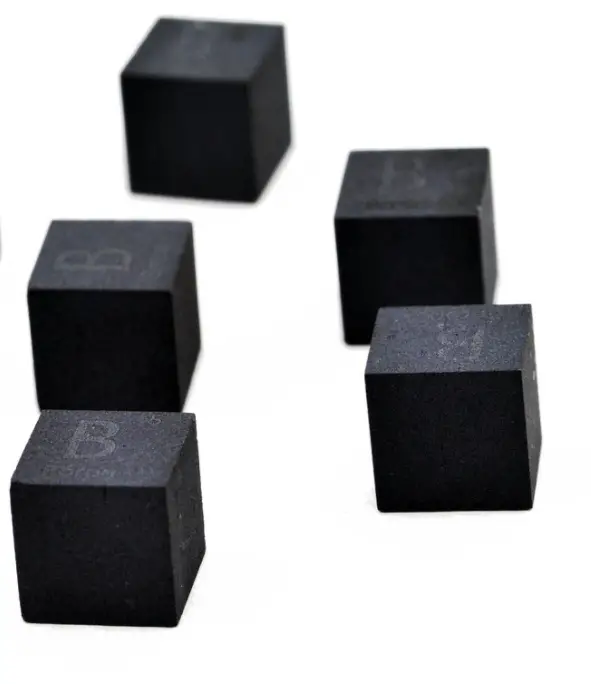
Significant concentrations of boron occur on the Earth in compounds known as the borate minerals. There are over 100 different borate minerals, but the most common are: borax, kernite, ulexite etc. Natural boron consists primarily of two stable isotopes, 11B (80.1%) and 10B (19.9%). In nuclear industry boron is commonly used as a neutron absorber due to the high neutron cross-section of isotope 10B. Its (n,alpha) reaction cross-section for thermal neutrons is about 3840 barns (for 0.025 eV neutron). Isotope 11B has absorption cross-section for thermal neutrons about 0.005 barns (for 0.025 eV neutron). Most of (n,alpha) reactions of thermal neutrons are 10B(n,alpha)7Li reactions accompanied by 0.48 MeV gamma emission.

Summary

Element Boron
Atomic number 5
Element category Metalloids
Phase at STP Solid
Density 2.46 g/cm3
Ultimate Tensile Strength N/A
Yield Strength N/A
Young’s Modulus of Elasticity N/A
Mohs Scale 9.5
Brinell Hardness N/A
Vickers Hardness 49000 MPa
Melting Point 2079 °C
Boiling Point 3927 °C
Thermal Conductivity 27 W/mK
Thermal Expansion Coefficient 5-7 µm/mK
Specific Heat 1.02 J/g K
Heat of Fusion 50.2 kJ/mol
Heat of Vaporization 508 kJ/mol
Electrical resistivity [nanoOhm meter] ~E15
Magnetic Susceptibility −6.7e-6 cm^3/mol

Applications of Boron

Nearly all boron ore extracted from the Earth is destined for refinement into boric acid and sodium tetraborate pentahydrate. In the United States, 70% of the boron is used for the production of glass and ceramics. The major global industrial-scale use of boron compounds (about 46% of end-use) is in production of glass fiber for boron-containing insulating and structural fiberglasses, especially in Asia. Boron is added to boron steels at the level of a few parts per million to increase hardenability. Higher percentages are added to steels used in the nuclear industry due to boron’s neutron absorption ability (e.g. pellets of Boron Carbide). Boron can also increase the surface hardness of steels and alloys through boriding. Boron carbide and cubic boron nitride powders are widely used as abrasives.

Boron-applications

Production and Price of Boron

Raw materials prices change daily. They are primarily driven by supply, demand and energy prices. In 2019, prices of pure Boron were at around 2500 $/kg.

Economically important sources of boron are the minerals colemanite, rasorite (kernite), ulexite and tincal. Together these constitute 90% of mined boron-containing ore. Turkey and the United States are the largest producers of boron products. Turkey produces about half of the global yearly demand.

Boron-periodic-table

Source: www.luciteria.com

Mechanical Properties of Boron

Boron-mechanical-properties-strength-hardness-crystal-structure

Strength of Boron

In mechanics of materials, the strength of a material is its ability to withstand an applied load without failure or plastic deformation. Strength of materials basically considers the relationship between the external loads applied to a material and the resulting deformation or change in material dimensions. In designing structures and machines, it is important to consider these factors, in order that the material selected will have adequate strength to resist applied loads or forces and retain its original shape. Strength of a material is its ability to withstand this applied load without failure or plastic deformation.

For tensile stress, the capacity of a material or structure to withstand loads tending to elongate is known as ultimate tensile strength (UTS). Yield strength or yield stress is the material property defined as the stress at which a material begins to deform plastically whereas yield point is the point where nonlinear (elastic + plastic) deformation begins.

See also: Strength of Materials

Ultimate Tensile Strength of Boron

Ultimate tensile strength of Boron is N/A.

Yield Strength of Boron

Yield strength of Boron is N/A.

Modulus of Elasticity of Boron

The Young’s modulus of elasticity of Boron is N/A.

Hardness of Boron

In materials science, hardness is the ability to withstand surface indentation (localized plastic deformation) and scratching. Brinell hardness test is one of indentation hardness tests, that has been developed for hardness testing. In Brinell tests, a hard, spherical indenter is forced under a specific load into the surface of the metal to be tested.

Brinell hardness of Boron is approximately N/A.

The Vickers hardness test method was developed by Robert L. Smith and George E. Sandland at Vickers Ltd as an alternative to the Brinell method to measure the hardness of materials. The Vickers hardness test method can be also used as a microhardness test method, which is mostly used for small parts, thin sections, or case depth work.

Vickers hardness of Boron is approximately 49000 MPa.

Scratch hardness is the measure of how resistant a sample is to permanent plastic deformation due to friction from a sharp object. The most common scale for this qualitative test is Mohs scale, which is used in mineralogy. The Mohs scale of mineral hardness is based on the ability of one natural sample of mineral to scratch another mineral visibly.

Boron is has a hardness of approximately 9.5.

See also: Hardness of Materials

Boron – Crystal Structure

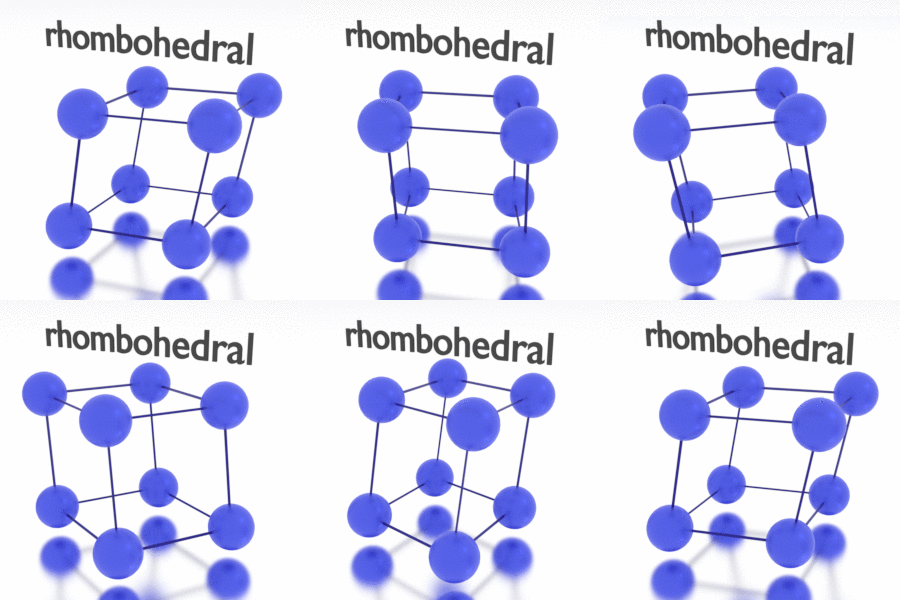
A possible crystal structure of Boron is rhombohedral structure.

crystal structures - FCC, BCC, HCP

In metals, and in many other solids, the atoms are arranged in regular arrays called crystals. A crystal lattice is a repeating pattern of mathematical points that extends throughout space. The forces of chemical bonding causes this repetition. It is this repeated pattern which control properties like strength, ductility, density, conductivity (property of conducting or transmitting heat, electricity, etc.), and shape. There are 14 general types of such patterns known as Bravais lattices.

See also: Crystal Structure of Materials

Crystal Structure of Boron
Crystal Structure of Boron is: rhombohedral

Strength of Elements

Elasticity of Elements

Hardness of Elements


Thermal Properties of Boron

Boron-melting-point-conductivity-thermal-properties

Boron – Melting Point and Boiling Point

Melting point of Boron is 2079°C.

Boiling point of Boron is 3927°C.

Note that, these points are associated with the standard atmospheric pressure.

Boron – Thermal Conductivity

Thermal conductivity of Boron is 27 W/(m·K).

The heat transfer characteristics of a solid material are measured by a property called the thermal conductivity, k (or λ), measured in W/m.K. It is a measure of a substance’s ability to transfer heat through a material by conduction. Note that Fourier’s law applies for all matter, regardless of its state (solid, liquid, or gas), therefore, it is also defined for liquids and gases.

Coefficient of Thermal Expansion of Boron

Linear thermal expansion coefficient of Boron is 5-7 µm/(m·K)

Thermal expansion is generally the tendency of matter to change its dimensions in response to a change in temperature. It is usually expressed as a fractional change in length or volume per unit temperature change.

Boron – Specific Heat, Latent Heat of Fusion, Latent Heat of Vaporization

Specific heat of Boron is 1.02 J/g K.

Heat capacity is an extensive property of matter, meaning it is proportional to the size of the system. Heat capacity C has the unit of energy per degree or energy per kelvin. When expressing the same phenomenon as an intensive property, the heat capacity is divided by the amount of substance, mass, or volume, thus the quantity is independent of the size or extent of the sample.

Latent Heat of Fusion of Boron is 50.2 kJ/mol.

Latent Heat of Vaporization of Boron is 508 kJ/mol.

Latent heat is the amount of heat added to or removed from a substance to produce a change in phase. This energy breaks down the intermolecular attractive forces, and also must provide the energy necessary to expand the gas (the pΔV work). When latent heat is added, no temperature change occurs. The enthalpy of vaporization is a function of the pressure at which that transformation takes place.

Melting Point of Elements

Periodic Table of Elements - melting point

Thermal Conductivity of Elements

Periodic Table of Elements - thermal conductivity

Thermal Expansion of Elements

Periodic Table of Elements - thermal expansion

Heat Capacity of Elements

Periodic Table of Elements - heat capacity

Heat of Fusion of Elements

Periodic Table of Elements - latent heat fusion

Heat of Vaporization of Elements

Periodic Table of Elements - latent heat vaporization

Boron – Electrical Resistivity – Magnetic Susceptibility

Boron-electrical-resistivity-magnetic-susceptibility

Electrical property refers to the response of a material to an applied electric field. One of the principal characteristics of materials is their ability (or lack of ability) to conduct electrical current. Indeed, materials are classified by this property, that is, they are divided into conductors, semiconductors, and nonconductors.

See also: Electrical Properties

Magnetic property refers to the response of a material to an applied magnetic field. The macroscopic magnetic properties of a material are a consequence of interactions between an external magnetic field and the magnetic dipole moments of the constituent atoms. Different materials react to the application of magnetic field differently.

See also: Magnetic Properties

Electrical Resistivity of Boron

Electrical resistivity of Boron is ~E15 nΩ⋅m.

Electrical conductivity and its converse, electrical resistivity, is a fundamental property of a material that quantifies how Boron conducts the flow of electric current. Electrical conductivity or specific conductance is the reciprocal of electrical resistivity.

Magnetic Susceptibility of Boron

Magnetic susceptibility of Boron is −6.7e-6 cm^3/mol.

In electromagnetism, magnetic susceptibility is the measure of the magnetization of a substance. Magnetic susceptibility is a dimensionless proportionality factor that indicates the degree of magnetization of Boron in response to an applied magnetic field.

Electrical Resistivity of Elements

Periodic Table of Elements - electrical resistivity

Magnetic Susceptibility of Elements

Application and prices of other elements

Boron - Comparison of Properties and Prices

Periodic Table in 8K resolution

Other properties of Boron


Beryllium – Properties – Price – Applications – Production

Beryllium-properties-price-application-production

About Beryllium

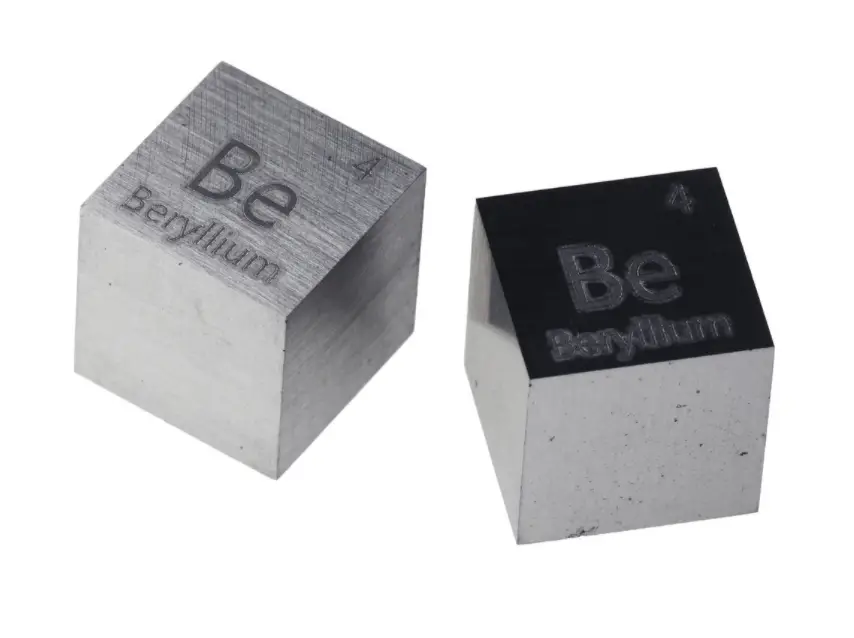
Beryllium is a hard, grayish metal naturally found in mineral rocks, coal, soil, and volcanic dust. The commercial use of beryllium requires the use of appropriate dust control equipment and industrial controls at all times because of the toxicity of inhaled beryllium-containing dusts that can cause a chronic life-threatening allergic disease in some people called berylliosis. Beryllium has a large scattering cross section for high-energy neutrons, about 6 barns for energies above approximately 10 keV. Therefore, it works as a neutron reflector and neutron moderator, effectively slowing the neutrons to the thermal energy. Since berylium has very low threshold energy for neutron emission, it can be used as a neutron source in nuclear reactors. The Sb-Be source is based on (γ,n) reaction (i.e. it emits photoneutrons).

Summary

Element Beryllium
Atomic number 4
Element category Alkaline Earth Metal
Phase at STP Solid
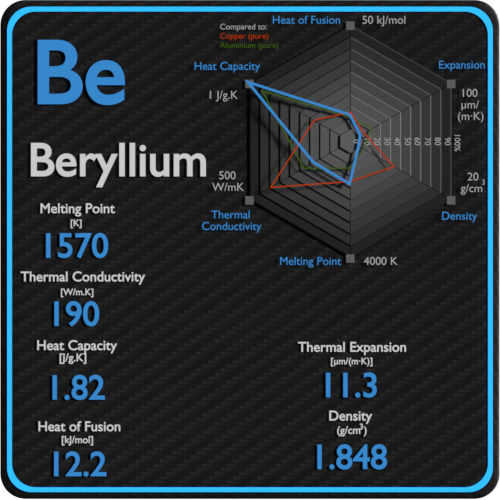
Density 1.848 g/cm3
Ultimate Tensile Strength 345 MPa
Yield Strength N/A
Young’s Modulus of Elasticity 287 GPa
Mohs Scale 5.5
Brinell Hardness 600 MPa
Vickers Hardness 1670 MPa
Melting Point 1278 °C
Boiling Point 2469 °C
Thermal Conductivity 200 W/mK
Thermal Expansion Coefficient 11.3 µm/mK
Specific Heat 1.82 J/g K
Heat of Fusion 12.2 kJ/mol
Heat of Vaporization 292.4 kJ/mol
Electrical resistivity [nanoOhm meter] 36
Magnetic Susceptibility −9.0e-6 cm^3/mol

Applications of Beryllium

Berylium can be utilized as alloying agent in production of beryllium-copper, X-ray detection diagnostics, manufacture of computer peripherals, in nuclear reactors as neutron moderators and reflectors. 80% of the beryllium used goes into copper beryllium alloys. The combination of light weight with high strength at extreme temperatures makes beryllium metal and aluminium beryllium alloys ideal for use in high performance aerospace applications such as components of rockets. Transparency to x-radiation makes pure beryllium metal essential in security equipment and high-resolution medical imaging technology, such as mammography to detect breast cancer. Copper beryllium is the hardest and strongest of any copper alloy (UTS up to 1,400 MPa), in the fully heat treated and cold worked condition. It combines high strength with non-magnetic and non-sparking qualities and it is similar in mechanical properties to many high strength alloy steels but, compared to steels, it has better corrosion resistance.

Beryllium-applications

Production and Price of Beryllium

Raw materials prices change daily. They are primarily driven by supply, demand and energy prices. In 2019, prices of pure Beryllium were at around 5300 $/kg.

Beryllium content on earth’s crust is 2.6 ppm. It is one of the most toxic elements, hence causes damage to human lungs and other organisms. It is found in as many as 30 different minerals. Beryllium is most commonly extracted from the mineral beryl, which is either sintered using an extraction agent or melted into a soluble mixture. The sintering process involves mixing beryl with sodium fluorosilicate and soda at 770 °C (1,420 °F) to form sodium fluoroberyllate, aluminium oxide and silicon dioxide. Beryllium can also be readily recycled from scrap alloys. However, the quantity of recycled materials is variable and limited due to its use in dispersive technologies, such as electronics.

Beryllium-periodic-table

Source: www.luciteria.com

Mechanical Properties of Beryllium

Beryllium-mechanical-properties-strength-hardness-crystal-structure

Strength of Beryllium

In mechanics of materials, the strength of a material is its ability to withstand an applied load without failure or plastic deformation. Strength of materials basically considers the relationship between the external loads applied to a material and the resulting deformation or change in material dimensions. In designing structures and machines, it is important to consider these factors, in order that the material selected will have adequate strength to resist applied loads or forces and retain its original shape. Strength of a material is its ability to withstand this applied load without failure or plastic deformation.

For tensile stress, the capacity of a material or structure to withstand loads tending to elongate is known as ultimate tensile strength (UTS). Yield strength or yield stress is the material property defined as the stress at which a material begins to deform plastically whereas yield point is the point where nonlinear (elastic + plastic) deformation begins.

See also: Strength of Materials

Ultimate Tensile Strength of Beryllium

Ultimate tensile strength of Beryllium is 345 MPa.

Yield Strength of Beryllium

Yield strength of Beryllium is N/A.

Modulus of Elasticity of Beryllium

The Young’s modulus of elasticity of Beryllium is 287 GPa.

Hardness of Beryllium

In materials science, hardness is the ability to withstand surface indentation (localized plastic deformation) and scratching. Brinell hardness test is one of indentation hardness tests, that has been developed for hardness testing. In Brinell tests, a hard, spherical indenter is forced under a specific load into the surface of the metal to be tested.

Brinell hardness of Beryllium is approximately 600 MPa.

The Vickers hardness test method was developed by Robert L. Smith and George E. Sandland at Vickers Ltd as an alternative to the Brinell method to measure the hardness of materials. The Vickers hardness test method can be also used as a microhardness test method, which is mostly used for small parts, thin sections, or case depth work.

Vickers hardness of Beryllium is approximately 1670 MPa.

Scratch hardness is the measure of how resistant a sample is to permanent plastic deformation due to friction from a sharp object. The most common scale for this qualitative test is Mohs scale, which is used in mineralogy. The Mohs scale of mineral hardness is based on the ability of one natural sample of mineral to scratch another mineral visibly.

Beryllium is has a hardness of approximately 5.5.

See also: Hardness of Materials

Beryllium – Crystal Structure

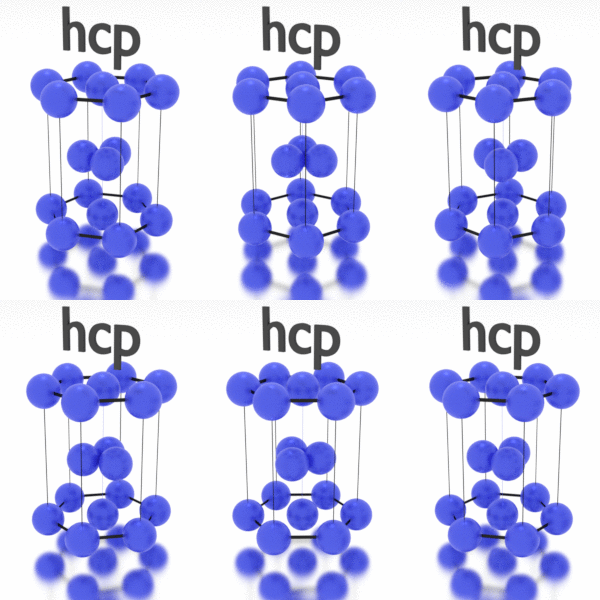
A possible crystal structure of Beryllium is hexagonal close-packed structure.

crystal structures - FCC, BCC, HCP

In metals, and in many other solids, the atoms are arranged in regular arrays called crystals. A crystal lattice is a repeating pattern of mathematical points that extends throughout space. The forces of chemical bonding causes this repetition. It is this repeated pattern which control properties like strength, ductility, density, conductivity (property of conducting or transmitting heat, electricity, etc.), and shape. There are 14 general types of such patterns known as Bravais lattices.

See also: Crystal Structure of Materials

Crystal Structure of Beryllium
Crystal Structure of Beryllium is: hexagonal close-packed

Strength of Elements

Elasticity of Elements

Hardness of Elements


Thermal Properties of Beryllium

Beryllium-melting-point-conductivity-thermal-properties

Beryllium – Melting Point and Boiling Point

Melting point of Beryllium is 1278°C.

Boiling point of Beryllium is 2469°C.

Note that, these points are associated with the standard atmospheric pressure.

Beryllium – Thermal Conductivity

Thermal conductivity of Beryllium is 200 W/(m·K).

The heat transfer characteristics of a solid material are measured by a property called the thermal conductivity, k (or λ), measured in W/m.K. It is a measure of a substance’s ability to transfer heat through a material by conduction. Note that Fourier’s law applies for all matter, regardless of its state (solid, liquid, or gas), therefore, it is also defined for liquids and gases.

Coefficient of Thermal Expansion of Beryllium

Linear thermal expansion coefficient of Beryllium is 11.3 µm/(m·K)

Thermal expansion is generally the tendency of matter to change its dimensions in response to a change in temperature. It is usually expressed as a fractional change in length or volume per unit temperature change.

Beryllium – Specific Heat, Latent Heat of Fusion, Latent Heat of Vaporization

Specific heat of Beryllium is 1.82 J/g K.

Heat capacity is an extensive property of matter, meaning it is proportional to the size of the system. Heat capacity C has the unit of energy per degree or energy per kelvin. When expressing the same phenomenon as an intensive property, the heat capacity is divided by the amount of substance, mass, or volume, thus the quantity is independent of the size or extent of the sample.

Latent Heat of Fusion of Beryllium is 12.2 kJ/mol.

Latent Heat of Vaporization of Beryllium is 292.4 kJ/mol.

Latent heat is the amount of heat added to or removed from a substance to produce a change in phase. This energy breaks down the intermolecular attractive forces, and also must provide the energy necessary to expand the gas (the pΔV work). When latent heat is added, no temperature change occurs. The enthalpy of vaporization is a function of the pressure at which that transformation takes place.

Melting Point of Elements

Periodic Table of Elements - melting point

Thermal Conductivity of Elements

Periodic Table of Elements - thermal conductivity

Thermal Expansion of Elements

Periodic Table of Elements - thermal expansion

Heat Capacity of Elements

Periodic Table of Elements - heat capacity

Heat of Fusion of Elements

Periodic Table of Elements - latent heat fusion

Heat of Vaporization of Elements

Periodic Table of Elements - latent heat vaporization

Beryllium – Electrical Resistivity – Magnetic Susceptibility

Beryllium-electrical-resistivity-magnetic-susceptibility

Electrical property refers to the response of a material to an applied electric field. One of the principal characteristics of materials is their ability (or lack of ability) to conduct electrical current. Indeed, materials are classified by this property, that is, they are divided into conductors, semiconductors, and nonconductors.

See also: Electrical Properties

Magnetic property refers to the response of a material to an applied magnetic field. The macroscopic magnetic properties of a material are a consequence of interactions between an external magnetic field and the magnetic dipole moments of the constituent atoms. Different materials react to the application of magnetic field differently.

See also: Magnetic Properties

Electrical Resistivity of Beryllium

Electrical resistivity of Beryllium is 36 nΩ⋅m.

Electrical conductivity and its converse, electrical resistivity, is a fundamental property of a material that quantifies how Beryllium conducts the flow of electric current. Electrical conductivity or specific conductance is the reciprocal of electrical resistivity.

Magnetic Susceptibility of Beryllium

Magnetic susceptibility of Beryllium is −9.0e-6 cm^3/mol.

In electromagnetism, magnetic susceptibility is the measure of the magnetization of a substance. Magnetic susceptibility is a dimensionless proportionality factor that indicates the degree of magnetization of Beryllium in response to an applied magnetic field.

Electrical Resistivity of Elements

Periodic Table of Elements - electrical resistivity

Magnetic Susceptibility of Elements

Application and prices of other elements

Beryllium - Comparison of Properties and Prices

Periodic Table in 8K resolution

Other properties of Beryllium


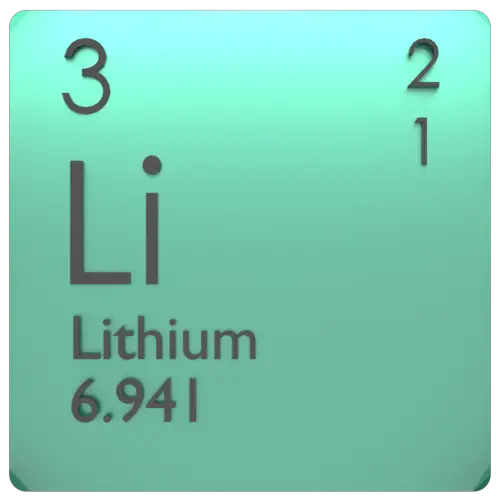
Lithium – Properties – Price – Applications – Production

Lithium-properties-price-application-production

About Lithium

It is a soft, silvery-white alkali metal. Under standard conditions, it is the lightest metal and the lightest solid element. Like all alkali metals, lithium is highly reactive and flammable, and is stored in mineral oil.

Summary

Element Lithium
Atomic number 3
Element category Alkali Metal
Phase at STP Solid
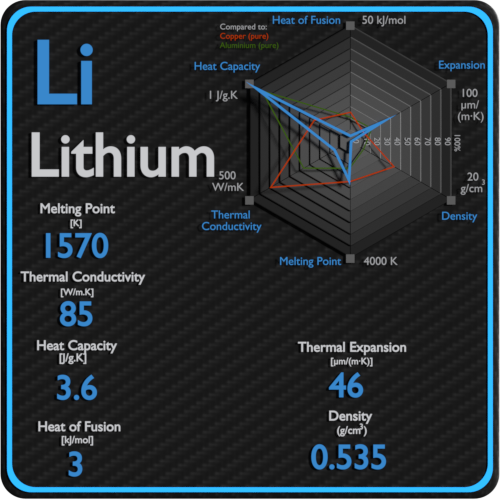
Density 0.535 g/cm3
Ultimate Tensile Strength 1.5 MPa
Yield Strength N/A
Young’s Modulus of Elasticity 4.9 GPa
Mohs Scale 0.6
Brinell Hardness 5 MPa
Vickers Hardness N/A
Melting Point 180.5 °C
Boiling Point 1342 °C
Thermal Conductivity 85 W/mK
Thermal Expansion Coefficient 46 µm/mK
Specific Heat 3.6 J/g K
Heat of Fusion 3 kJ/mol
Heat of Vaporization 145.92 kJ/mol
Electrical resistivity [nanoOhm meter] 92.8
Magnetic Susceptibility +14.2e-6 cm^3/mol

Applications of Lithium

Lithium has many applications, from lubricating grease, alloying additions in particular for aluminium and magnesium alloys, to glazes for ceramics, and finally, lithium batteries. In particular, lithium is and will continue to play an increasingly important role in the battery-powered clean air future. Lithium batteries are widely used in portable consumer electronic devices, and in electric vehicles ranging from full sized vehicles to radio controlled toys. The term “lithium battery” refers to a family of different lithium-metal chemistries, comprising many types of cathodes and electrolytes but all with metallic lithium as the anode.

Lithium-applications

Production and Price of Lithium

Raw materials prices change daily. They are primarily driven by supply, demand and energy prices. In 2019, prices of pure Lithium were at around 270 $/kg.

Lithium production has greatly increased since the end of World War II. Lithium is present in a number of different minerals, but for those who deal with its commercial extraction, there are really only a few that are of interest. The metal is separated from other elements in igneous minerals. The metal is produced through electrolysis from a mixture of fused 55% lithium chloride and 45% potassium chloride at about 450 °C. As of 2015, most of the world’s lithium production is in South America, where lithium-containing brine is extracted from underground pools and concentrated by solar evaporation. The standard extraction technique is to evaporate water from brine. Depending on the climate and weather in the region of the brine deposit, lithium concentration can take a few months to a year. Typically, lithium concentrations range between 1 and 2%.

Lithium-periodic-table

Source: www.luciteria.com

Mechanical Properties of Lithium

Lithium-mechanical-properties-strength-hardness-crystal-structure

Strength of Lithium

In mechanics of materials, the strength of a material is its ability to withstand an applied load without failure or plastic deformation. Strength of materials basically considers the relationship between the external loads applied to a material and the resulting deformation or change in material dimensions. In designing structures and machines, it is important to consider these factors, in order that the material selected will have adequate strength to resist applied loads or forces and retain its original shape. Strength of a material is its ability to withstand this applied load without failure or plastic deformation.

For tensile stress, the capacity of a material or structure to withstand loads tending to elongate is known as ultimate tensile strength (UTS). Yield strength or yield stress is the material property defined as the stress at which a material begins to deform plastically whereas yield point is the point where nonlinear (elastic + plastic) deformation begins.

See also: Strength of Materials

Ultimate Tensile Strength of Lithium

Ultimate tensile strength of Lithium is 1.5 MPa.

Yield Strength of Lithium

Yield strength of Lithium is N/A.

Modulus of Elasticity of Lithium

The Young’s modulus of elasticity of Lithium is 4.9 GPa.

Hardness of Lithium

In materials science, hardness is the ability to withstand surface indentation (localized plastic deformation) and scratching. Brinell hardness test is one of indentation hardness tests, that has been developed for hardness testing. In Brinell tests, a hard, spherical indenter is forced under a specific load into the surface of the metal to be tested.

Brinell hardness of Lithium is approximately 5 MPa.

The Vickers hardness test method was developed by Robert L. Smith and George E. Sandland at Vickers Ltd as an alternative to the Brinell method to measure the hardness of materials. The Vickers hardness test method can be also used as a microhardness test method, which is mostly used for small parts, thin sections, or case depth work.

Vickers hardness of Lithium is approximately N/A.

Scratch hardness is the measure of how resistant a sample is to permanent plastic deformation due to friction from a sharp object. The most common scale for this qualitative test is Mohs scale, which is used in mineralogy. The Mohs scale of mineral hardness is based on the ability of one natural sample of mineral to scratch another mineral visibly.

Lithium is has a hardness of approximately 0.6.

See also: Hardness of Materials

Lithium – Crystal Structure

A possible crystal structure of Lithium is body-centered cubic structure.

crystal structures - FCC, BCC, HCP

In metals, and in many other solids, the atoms are arranged in regular arrays called crystals. A crystal lattice is a repeating pattern of mathematical points that extends throughout space. The forces of chemical bonding causes this repetition. It is this repeated pattern which control properties like strength, ductility, density, conductivity (property of conducting or transmitting heat, electricity, etc.), and shape. There are 14 general types of such patterns known as Bravais lattices.

See also: Crystal Structure of Materials

Crystal Structure of Lithium
Crystal Structure of Lithium is: body-centered cubic

Strength of Elements

Elasticity of Elements

Hardness of Elements


Thermal Properties of Lithium

Lithium-melting-point-conductivity-thermal-properties

Lithium – Melting Point and Boiling Point

Melting point of Lithium is 180.5°C.

Boiling point of Lithium is 1342°C.

Note that, these points are associated with the standard atmospheric pressure.

Lithium – Thermal Conductivity

Thermal conductivity of Lithium is 85 W/(m·K).

The heat transfer characteristics of a solid material are measured by a property called the thermal conductivity, k (or λ), measured in W/m.K. It is a measure of a substance’s ability to transfer heat through a material by conduction. Note that Fourier’s law applies for all matter, regardless of its state (solid, liquid, or gas), therefore, it is also defined for liquids and gases.

Coefficient of Thermal Expansion of Lithium

Linear thermal expansion coefficient of Lithium is 46 µm/(m·K)

Thermal expansion is generally the tendency of matter to change its dimensions in response to a change in temperature. It is usually expressed as a fractional change in length or volume per unit temperature change.

Lithium – Specific Heat, Latent Heat of Fusion, Latent Heat of Vaporization

Specific heat of Lithium is 3.6 J/g K.

Heat capacity is an extensive property of matter, meaning it is proportional to the size of the system. Heat capacity C has the unit of energy per degree or energy per kelvin. When expressing the same phenomenon as an intensive property, the heat capacity is divided by the amount of substance, mass, or volume, thus the quantity is independent of the size or extent of the sample.

Latent Heat of Fusion of Lithium is 3 kJ/mol.

Latent Heat of Vaporization of Lithium is 145.92 kJ/mol.

Latent heat is the amount of heat added to or removed from a substance to produce a change in phase. This energy breaks down the intermolecular attractive forces, and also must provide the energy necessary to expand the gas (the pΔV work). When latent heat is added, no temperature change occurs. The enthalpy of vaporization is a function of the pressure at which that transformation takes place.

Melting Point of Elements

Periodic Table of Elements - melting point

Thermal Conductivity of Elements

Periodic Table of Elements - thermal conductivity

Thermal Expansion of Elements

Periodic Table of Elements - thermal expansion

Heat Capacity of Elements

Periodic Table of Elements - heat capacity

Heat of Fusion of Elements

Periodic Table of Elements - latent heat fusion

Heat of Vaporization of Elements

Periodic Table of Elements - latent heat vaporization

Lithium – Electrical Resistivity – Magnetic Susceptibility

Lithium-electrical-resistivity-magnetic-susceptibility

Electrical property refers to the response of a material to an applied electric field. One of the principal characteristics of materials is their ability (or lack of ability) to conduct electrical current. Indeed, materials are classified by this property, that is, they are divided into conductors, semiconductors, and nonconductors.

See also: Electrical Properties

Magnetic property refers to the response of a material to an applied magnetic field. The macroscopic magnetic properties of a material are a consequence of interactions between an external magnetic field and the magnetic dipole moments of the constituent atoms. Different materials react to the application of magnetic field differently.

See also: Magnetic Properties

Electrical Resistivity of Lithium

Electrical resistivity of Lithium is 92.8 nΩ⋅m.

Electrical conductivity and its converse, electrical resistivity, is a fundamental property of a material that quantifies how Lithium conducts the flow of electric current. Electrical conductivity or specific conductance is the reciprocal of electrical resistivity.

Magnetic Susceptibility of Lithium

Magnetic susceptibility of Lithium is +14.2e-6 cm^3/mol.

In electromagnetism, magnetic susceptibility is the measure of the magnetization of a substance. Magnetic susceptibility is a dimensionless proportionality factor that indicates the degree of magnetization of Lithium in response to an applied magnetic field.

Electrical Resistivity of Elements

Periodic Table of Elements - electrical resistivity

Magnetic Susceptibility of Elements

Application and prices of other elements

Lithium - Comparison of Properties and Prices

Periodic Table in 8K resolution

Other properties of Lithium


Helium – Properties – Price – Applications – Production

Helium-properties-price-application-production

About Helium

It is a colorless, odorless, tasteless, non-toxic, inert, monatomic gas, the first in the noble gas group in the periodic table. Its boiling point is the lowest among all the elements.

Summary

Element Helium
Atomic number 2
Element category Noble Gas
Phase at STP Gas
Density 0.00018 g/cm3
Ultimate Tensile Strength N/A
Yield Strength N/A
Young’s Modulus of Elasticity N/A
Mohs Scale N/A
Brinell Hardness N/A
Vickers Hardness N/A
Melting Point -272.2 °C
Boiling Point -268.9 °C
Thermal Conductivity 0.1513 W/mK
Thermal Expansion Coefficient — µm/mK
Specific Heat 5.193 J/g K
Heat of Fusion 0.0138 kJ/mol
Heat of Vaporization 0.0845 kJ/mol
Electrical resistivity [nanoOhm meter] —
Magnetic Susceptibility −1.88e-6 cm^3/mol

Applications of Helium

Helium is used for many purposes that require some of its unique properties, such as its low boiling point, low density, low solubility, high thermal conductivity, or inertness. Of the 2014 world helium total production of about 32 million kg (180 million standard cubic meters) helium per year, the largest use (about 32% of the total in 2014) is in cryogenic applications, most of which involves cooling the superconducting magnets in medical MRI scanners and NMR spectrometers. Most clinical magnets are superconducting magnets, which require liquid helium to keep them very cold.

Helium-applications

Production and Price of Helium

Raw materials prices change daily. They are primarily driven by supply, demand and energy prices. In 2019, prices of pure Helium were at around 52 $/kg.

For large-scale use, helium is extracted by fractional distillation from natural gas, which can contain as much as 7% helium. Natural gas contains methane and other hydrocarbons, which are the principal sources of heat energy when natural gas is burned. There are several methods used to upgrade natural gas. When the gas contains more than about 0.4% helium by volume, a cryogenic distillation method is often used in order to recover the helium content. Once the helium has been separated from the natural gas, it undergoes further refining to bring it to 99.99+% purity for commercial use.

Helium-periodic-table

Source: www.luciteria.com

Mechanical Properties of Helium

Helium-mechanical-properties-strength-hardness-crystal-structure

Strength of Helium

In mechanics of materials, the strength of a material is its ability to withstand an applied load without failure or plastic deformation. Strength of materials basically considers the relationship between the external loads applied to a material and the resulting deformation or change in material dimensions. In designing structures and machines, it is important to consider these factors, in order that the material selected will have adequate strength to resist applied loads or forces and retain its original shape. Strength of a material is its ability to withstand this applied load without failure or plastic deformation.

For tensile stress, the capacity of a material or structure to withstand loads tending to elongate is known as ultimate tensile strength (UTS). Yield strength or yield stress is the material property defined as the stress at which a material begins to deform plastically whereas yield point is the point where nonlinear (elastic + plastic) deformation begins.

See also: Strength of Materials

Ultimate Tensile Strength of Helium

Ultimate tensile strength of Helium is N/A.

Yield Strength of Helium

Yield strength of Helium is N/A.

Modulus of Elasticity of Helium

The Young’s modulus of elasticity of Helium is N/A.

Hardness of Helium

In materials science, hardness is the ability to withstand surface indentation (localized plastic deformation) and scratching. Brinell hardness test is one of indentation hardness tests, that has been developed for hardness testing. In Brinell tests, a hard, spherical indenter is forced under a specific load into the surface of the metal to be tested.

Brinell hardness of Helium is approximately N/A.

The Vickers hardness test method was developed by Robert L. Smith and George E. Sandland at Vickers Ltd as an alternative to the Brinell method to measure the hardness of materials. The Vickers hardness test method can be also used as a microhardness test method, which is mostly used for small parts, thin sections, or case depth work.

Vickers hardness of Helium is approximately N/A.

Scratch hardness is the measure of how resistant a sample is to permanent plastic deformation due to friction from a sharp object. The most common scale for this qualitative test is Mohs scale, which is used in mineralogy. The Mohs scale of mineral hardness is based on the ability of one natural sample of mineral to scratch another mineral visibly.

Helium is has a hardness of approximately N/A.

See also: Hardness of Materials

Helium – Crystal Structure

A possible crystal structure of Helium is hexagonal close-packed structure.

crystal structures - FCC, BCC, HCP

In metals, and in many other solids, the atoms are arranged in regular arrays called crystals. A crystal lattice is a repeating pattern of mathematical points that extends throughout space. The forces of chemical bonding causes this repetition. It is this repeated pattern which control properties like strength, ductility, density, conductivity (property of conducting or transmitting heat, electricity, etc.), and shape. There are 14 general types of such patterns known as Bravais lattices.

See also: Crystal Structure of Materials

Crystal Structure of Helium
Crystal Structure of Helium is: hexagonal close-packed

Strength of Elements

Elasticity of Elements

Hardness of Elements


Thermal Properties of Helium

Helium-melting-point-conductivity-thermal-properties

Helium – Melting Point and Boiling Point

Melting point of Helium is -272.2°C.

Boiling point of Helium is -268.9°C.

Note that, these points are associated with the standard atmospheric pressure.

Helium – Thermal Conductivity

Thermal conductivity of Helium is 0.1513 W/(m·K).

The heat transfer characteristics of a solid material are measured by a property called the thermal conductivity, k (or λ), measured in W/m.K. It is a measure of a substance’s ability to transfer heat through a material by conduction. Note that Fourier’s law applies for all matter, regardless of its state (solid, liquid, or gas), therefore, it is also defined for liquids and gases.

Coefficient of Thermal Expansion of Helium

Linear thermal expansion coefficient of Helium is — µm/(m·K)

Thermal expansion is generally the tendency of matter to change its dimensions in response to a change in temperature. It is usually expressed as a fractional change in length or volume per unit temperature change.

Helium – Specific Heat, Latent Heat of Fusion, Latent Heat of Vaporization

Specific heat of Helium is 5.193 J/g K.

Heat capacity is an extensive property of matter, meaning it is proportional to the size of the system. Heat capacity C has the unit of energy per degree or energy per kelvin. When expressing the same phenomenon as an intensive property, the heat capacity is divided by the amount of substance, mass, or volume, thus the quantity is independent of the size or extent of the sample.

Latent Heat of Fusion of Helium is 0.0138 kJ/mol.

Latent Heat of Vaporization of Helium is 0.0845 kJ/mol.

Latent heat is the amount of heat added to or removed from a substance to produce a change in phase. This energy breaks down the intermolecular attractive forces, and also must provide the energy necessary to expand the gas (the pΔV work). When latent heat is added, no temperature change occurs. The enthalpy of vaporization is a function of the pressure at which that transformation takes place.

Melting Point of Elements

Periodic Table of Elements - melting point

Thermal Conductivity of Elements

Periodic Table of Elements - thermal conductivity

Thermal Expansion of Elements

Periodic Table of Elements - thermal expansion

Heat Capacity of Elements

Periodic Table of Elements - heat capacity

Heat of Fusion of Elements

Periodic Table of Elements - latent heat fusion

Heat of Vaporization of Elements

Periodic Table of Elements - latent heat vaporization

Helium – Electrical Resistivity – Magnetic Susceptibility

Helium-electrical-resistivity-magnetic-susceptibility

Electrical property refers to the response of a material to an applied electric field. One of the principal characteristics of materials is their ability (or lack of ability) to conduct electrical current. Indeed, materials are classified by this property, that is, they are divided into conductors, semiconductors, and nonconductors.

See also: Electrical Properties

Magnetic property refers to the response of a material to an applied magnetic field. The macroscopic magnetic properties of a material are a consequence of interactions between an external magnetic field and the magnetic dipole moments of the constituent atoms. Different materials react to the application of magnetic field differently.

See also: Magnetic Properties

Electrical Resistivity of Helium

Electrical resistivity of Helium is — nΩ⋅m.

Electrical conductivity and its converse, electrical resistivity, is a fundamental property of a material that quantifies how Helium conducts the flow of electric current. Electrical conductivity or specific conductance is the reciprocal of electrical resistivity.

Magnetic Susceptibility of Helium

Magnetic susceptibility of Helium is −1.88e-6 cm^3/mol.

In electromagnetism, magnetic susceptibility is the measure of the magnetization of a substance. Magnetic susceptibility is a dimensionless proportionality factor that indicates the degree of magnetization of Helium in response to an applied magnetic field.

Electrical Resistivity of Elements

Periodic Table of Elements - electrical resistivity

Magnetic Susceptibility of Elements

Application and prices of other elements

Helium - Comparison of Properties and Prices

Periodic Table in 8K resolution

Other properties of Helium


Hydrogen – Properties – Price – Applications – Production

Hydrogen-properties-price-application-production

About Hydrogen

With a standard atomic weight of circa 1.008, hydrogen is the lightest element on the periodic table. Its monatomic form (H) is the most abundant chemical substance in the Universe, constituting roughly 75% of all baryonic mass.

Summary

Element Hydrogen
Atomic number 1
Element category Non Metal
Phase at STP Gas
Density 0.00009 g/cm3
Ultimate Tensile Strength N/A
Yield Strength N/A
Young’s Modulus of Elasticity N/A
Mohs Scale N/A
Brinell Hardness N/A
Vickers Hardness N/A
Melting Point -259.1 °C
Boiling Point -252.9 °C
Thermal Conductivity 0.1805 W/mK
Thermal Expansion Coefficient — µm/mK
Specific Heat 14.304 J/g K
Heat of Fusion 0.05868 kJ/mol
Heat of Vaporization 0.44936 kJ/mol
Electrical resistivity [nanoOhm meter] —
Magnetic Susceptibility −3.98e-6 cm^3/mol

Applications of Hydrogen

Hydrogen is versatile and can be utilized in various ways. These multiple uses can be grouped into two large categories. Hydrogen as a feedstock. A role whose importance is being recognized for decades and will continue to grow and evolve. The largest single use of hydrogen in the world is in ammonia manufacture, which consumes about two-thirds of the world’s hydrogen production. Hydrogen is versatile and can be utilized in various ways. These multiple uses can be grouped into two large categories. Hydrogen as a feedstock for further chemical processes. A role whose importance is being recognized for decades and will continue to grow and evolve. And hydrogen as an energy carrier. Hydrogen is also commonly used in power stations as a coolant in generators due to a number of favorable properties that are a direct result of its light diatomic molecules.

Hydrogen-applications

Production and Price of Hydrogen

Raw materials prices change daily. They are primarily driven by supply, demand and energy prices. In 2019, prices of pure Hydrogen were at around 120 $/kg. Hydrogen is produced in chemistry and biology laboratories, often as a by-product of other reactions. In industry, hydrogen is often produced using natural gas, which involves the removal of hydrogen from hydrocarbons at very high temperatures, with about 95% of hydrogen production coming from steam reforming around year 2000.

Hydrogen-periodic-table

Source: www.luciteria.com

Mechanical Properties of Hydrogen

Hydrogen-mechanical-properties-strength-hardness-crystal-structure

Strength of Hydrogen

In mechanics of materials, the strength of a material is its ability to withstand an applied load without failure or plastic deformation. Strength of materials basically considers the relationship between the external loads applied to a material and the resulting deformation or change in material dimensions. In designing structures and machines, it is important to consider these factors, in order that the material selected will have adequate strength to resist applied loads or forces and retain its original shape. Strength of a material is its ability to withstand this applied load without failure or plastic deformation. For tensile stress, the capacity of a material or structure to withstand loads tending to elongate is known as ultimate tensile strength (UTS). Yield strength or yield stress is the material property defined as the stress at which a material begins to deform plastically whereas yield point is the point where nonlinear (elastic + plastic) deformation begins. See also: Strength of Materials

Ultimate Tensile Strength of Hydrogen

Ultimate tensile strength of Hydrogen is N/A.

Yield Strength of Hydrogen

Yield strength of Hydrogen is N/A.

Modulus of Elasticity of Hydrogen

The Young’s modulus of elasticity of Hydrogen is N/A.

Hardness of Hydrogen

In materials science, hardness is the ability to withstand surface indentation (localized plastic deformation) and scratching. Brinell hardness test is one of indentation hardness tests, that has been developed for hardness testing. In Brinell tests, a hard, spherical indenter is forced under a specific load into the surface of the metal to be tested. Brinell hardness of Hydrogen is approximately N/A. The Vickers hardness test method was developed by Robert L. Smith and George E. Sandland at Vickers Ltd as an alternative to the Brinell method to measure the hardness of materials. The Vickers hardness test method can be also used as a microhardness test method, which is mostly used for small parts, thin sections, or case depth work. Vickers hardness of Hydrogen is approximately N/A. Scratch hardness is the measure of how resistant a sample is to permanent plastic deformation due to friction from a sharp object. The most common scale for this qualitative test is Mohs scale, which is used in mineralogy. The Mohs scale of mineral hardness is based on the ability of one natural sample of mineral to scratch another mineral visibly. Hydrogen is has a hardness of approximately N/A. See also: Hardness of Materials

Hydrogen – Crystal Structure

A possible crystal structure of Hydrogen is hexagonal structure. crystal structures - FCC, BCC, HCP In metals, and in many other solids, the atoms are arranged in regular arrays called crystals. A crystal lattice is a repeating pattern of mathematical points that extends throughout space. The forces of chemical bonding causes this repetition. It is this repeated pattern which control properties like strength, ductility, density, conductivity (property of conducting or transmitting heat, electricity, etc.), and shape. There are 14 general types of such patterns known as Bravais lattices. See also: Crystal Structure of Materials

Crystal Structure of Hydrogen Crystal Structure of Hydrogen is: hexagonal

Strength of Elements

Elasticity of Elements

Hardness of Elements


Thermal Properties of Hydrogen

Hydrogen-melting-point-conductivity-thermal-properties

Hydrogen – Melting Point and Boiling Point

Melting point of Hydrogen is -259.1°C.

Boiling point of Hydrogen is -252.9°C.

Note that, these points are associated with the standard atmospheric pressure.

Hydrogen – Thermal Conductivity

Thermal conductivity of Hydrogen is 0.1805 W/(m·K). The heat transfer characteristics of a solid material are measured by a property called the thermal conductivity, k (or λ), measured in W/m.K. It is a measure of a substance’s ability to transfer heat through a material by conduction. Note that Fourier’s law applies for all matter, regardless of its state (solid, liquid, or gas), therefore, it is also defined for liquids and gases.

Coefficient of Thermal Expansion of Hydrogen

Linear thermal expansion coefficient of Hydrogen is — µm/(m·K) Thermal expansion is generally the tendency of matter to change its dimensions in response to a change in temperature. It is usually expressed as a fractional change in length or volume per unit temperature change.

Hydrogen – Specific Heat, Latent Heat of Fusion, Latent Heat of Vaporization

Specific heat of Hydrogen is 14.304 J/g K. Heat capacity is an extensive property of matter, meaning it is proportional to the size of the system. Heat capacity C has the unit of energy per degree or energy per kelvin. When expressing the same phenomenon as an intensive property, the heat capacity is divided by the amount of substance, mass, or volume, thus the quantity is independent of the size or extent of the sample. Latent Heat of Fusion of Hydrogen is 0.05868 kJ/mol. Latent Heat of Vaporization of Hydrogen is 0.44936 kJ/mol. Latent heat is the amount of heat added to or removed from a substance to produce a change in phase. This energy breaks down the intermolecular attractive forces, and also must provide the energy necessary to expand the gas (the pΔV work). When latent heat is added, no temperature change occurs. The enthalpy of vaporization is a function of the pressure at which that transformation takes place.

Melting Point of Elements

Periodic Table of Elements - melting point

Thermal Conductivity of Elements

Periodic Table of Elements - thermal conductivity

Thermal Expansion of Elements

Periodic Table of Elements - thermal expansion

Heat Capacity of Elements

Periodic Table of Elements - heat capacity

Heat of Fusion of Elements

Periodic Table of Elements - latent heat fusion

Heat of Vaporization of Elements

Periodic Table of Elements - latent heat vaporization

Hydrogen – Electrical Resistivity – Magnetic Susceptibility

Hydrogen-electrical-resistivity-magnetic-susceptibility

Electrical property refers to the response of a material to an applied electric field. One of the principal characteristics of materials is their ability (or lack of ability) to conduct electrical current. Indeed, materials are classified by this property, that is, they are divided into conductors, semiconductors, and nonconductors. See also: Electrical Properties Magnetic property refers to the response of a material to an applied magnetic field. The macroscopic magnetic properties of a material are a consequence of interactions between an external magnetic field and the magnetic dipole moments of the constituent atoms. Different materials react to the application of magnetic field differently. See also: Magnetic Properties

Electrical Resistivity of Hydrogen

Electrical resistivity of Hydrogen is — nΩ⋅m. Electrical conductivity and its converse, electrical resistivity, is a fundamental property of a material that quantifies how Hydrogen conducts the flow of electric current. Electrical conductivity or specific conductance is the reciprocal of electrical resistivity.

Magnetic Susceptibility of Hydrogen

Magnetic susceptibility of Hydrogen is −3.98e-6 cm^3/mol. In electromagnetism, magnetic susceptibility is the measure of the magnetization of a substance. Magnetic susceptibility is a dimensionless proportionality factor that indicates the degree of magnetization of Hydrogen in response to an applied magnetic field.

Electrical Resistivity of Elements

Periodic Table of Elements - electrical resistivity

Magnetic Susceptibility of Elements

Application and prices of other elements

Hydrogen - Comparison of Properties and Prices

Periodic Table in 8K resolution

Other properties of Hydrogen