Facebook Instagram Youtube Twitter

Radium – Periodic Table – Atomic Properties

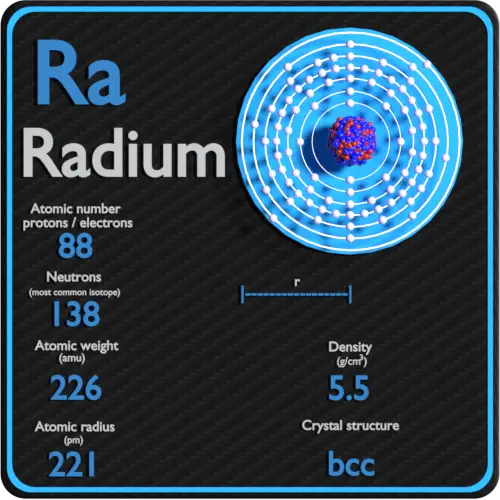
Radium-density-atomic-number-mass-radius

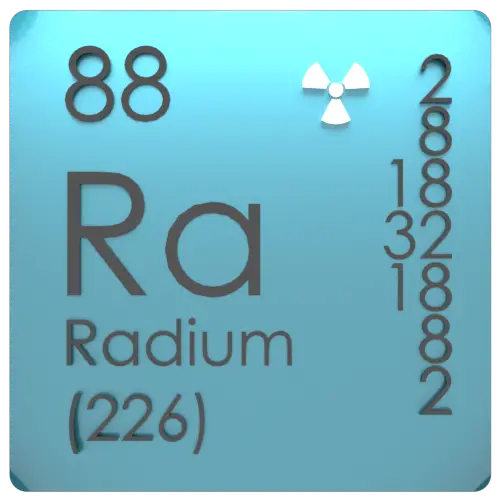
Pure radium is silvery-white alkaline earth metal. All isotopes of radium are highly radioactive, with the most stable isotope being radium-226.

Summary

Element Radium
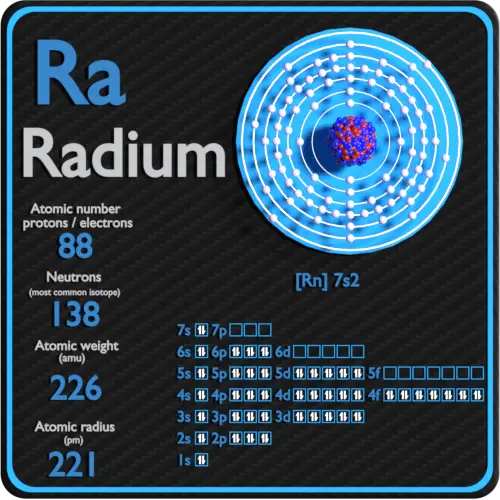
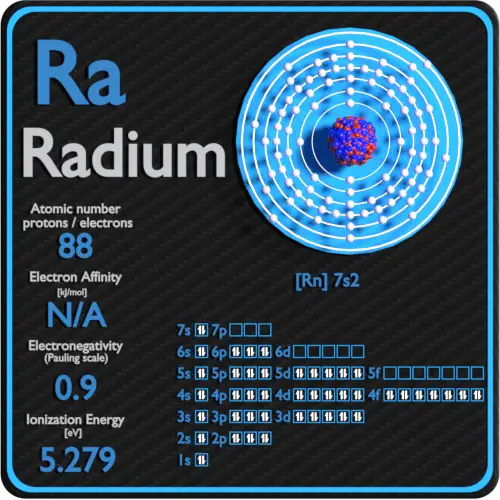
Atomic number 88
Atomic mass [amu] 226
Atomic mass [pm] 221
Density at STP [g/cm3] 5.5
Number of protons 88
Number of neutrons (typical isotopes) 226
Number of electrons 88
Electron configuration [Rn] 7s2
Oxidation states +2
Electron affinity [kJ/mol] —
Electronegativity [Pauling scale] 0.9
First ionization energy [eV] 5.2789

Atomic Number – Protons, Electrons and Neutrons in Radium

Proton Number - Atomic NumberRadium is a chemical element with atomic number 88 which means there are 88 protons in its nucleus. Total number of protons in the nucleus is called the atomic number of the atom and is given the symbol Z. The total electrical charge of the nucleus is therefore +Ze, where e (elementary charge) equals to 1,602 x 10-19 coulombs.

The total number of neutrons in the nucleus of an atom is called the neutron number of the atom and is given the symbol N. Neutron number plus atomic number equals atomic mass number: N+Z=A. The difference between the neutron number and the atomic number is known as the neutron excess: D = N – Z = A – 2Z.

For stable elements, there is usually a variety of stable isotopes. Isotopes are nuclides that have the same atomic number and are therefore the same element, but differ in the number of neutrons. Mass numbers of typical isotopes of Radium are 226.

Atomic Mass of Radium

Atomic mass of Radium is 226 u. 

The atomic mass is the mass of an atom. The atomic mass or relative isotopic mass refers to the mass of a single particle, and therefore is tied to a certain specific isotope of an element. The atomic mass is carried by the atomic nucleus, which occupies only about 10-12 of the total volume of the atom or less, but it contains all the positive charge and at least 99.95% of the total mass of the atom. Note that, each element may contain more isotopes, therefore this resulting atomic mass is calculated from naturally-occuring isotopes and their abundance.

Atomic Radius of Radium

The atomic radius of Radium atom is 221pm (covalent radius).

Atomic Radius of Chemical Elements

It must be noted, atoms lack a well-defined outer boundary. The atomic radius of a chemical element is a measure of the distance out to which the electron cloud extends from the nucleus. However, this assumes the atom to exhibit a spherical shape, which is only obeyed for atoms in vacuum or free space. Therefore, there are various non-equivalent definitions of atomic radius.

Electrons and Electron Configuration

The number of electrons in an electrically-neutral atom is the same as the number of protons in the nucleus. Therefore, the number of electrons in neutral atom of Radium is 88. Each electron is influenced by the electric fields produced by the positive nuclear charge and the other (Z – 1) negative electrons in the atom.

Since the number of electrons and their arrangement are responsible for the chemical behavior of atoms, the atomic number identifies the various chemical elements. The configuration of these electrons follows from the principles of quantum mechanics. The number of electrons in each element’s electron shells, particularly the outermost valence shell, is the primary factor in determining its chemical bonding behavior. In the periodic table, the elements are listed in order of increasing atomic number Z.

Electron configuration of Radium is [Rn] 7s2.

Possible oxidation states are +2.

Density of Radium

Density of Radium is 5.5g/cm3.

Typical densities of various substances are at atmospheric pressure.

Density is defined as the mass per unit volume. It is an intensive property, which is mathematically defined as mass divided by volume:

ρ = m/V

Atomic Masses of Elements

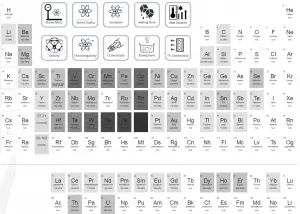
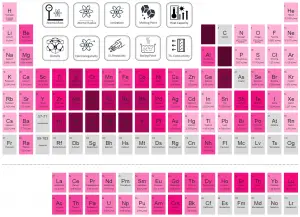
Periodic Table of Elements - atomic mass

Atomic Radii of Elements

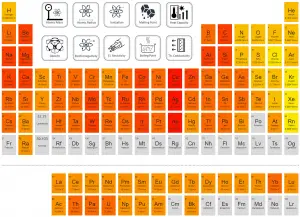
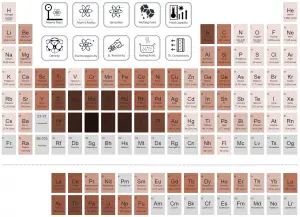
Periodic Table of Elements - atomic radius

Densities of Elements

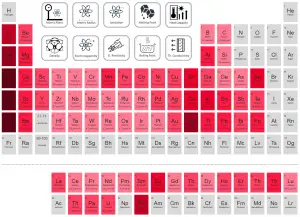
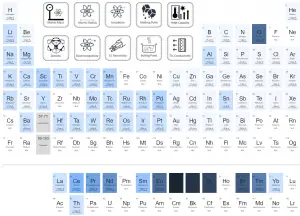
Periodic Table of Elements - density

Radium-protons-neutrons-electrons-configuration

Radium-affinity-electronegativity-ionization

Electron Affinity – Radium

Electron affinity of Radium is — kJ/mol.

In chemistry and atomic physics, the electron affinity of an atom or molecule is defined as:

the change in energy (in kJ/mole) of a neutral atom or molecule (in the gaseous phase) when an electron is added to the atom to form a negative ion.

X + e– → X– + energy        Affinity = – ∆H

In other words, it can be expressed as the neutral atom’s likelihood of gaining an electron. Note that, ionization energies measure the tendency of a neutral atom to resist the loss of electrons. Electron affinities are more difficult to measure than ionization energies.

Electronegativity of Radium

Electronegativity of Radium is 0.9.

Electronegativity, symbol χ, is a chemical property that describes the tendency of an atom to attract electrons towards this atom. For this purposes, a dimensionless quantity the Pauling scale, symbol χ, is the most commonly used.

The electronegativity of Radium is: χ = 0.9

First Ionization Energy of Radium

First Ionization Energy of Radium is 5.2789 eV.

Ionization energy, also called ionization potential, is the energy necessary to remove an electron from the neutral atom.

X + energy → X+ + e−

where X is any atom or molecule capable of being ionized, X+ is that atom or molecule with an electron removed (positive ion), and e− is the removed electron.

A Radium atom, for example, requires the following ionization energy to remove the outermost electron.

Ra + IE → Ra+ + e−        IE = 5.2789 eV

Electronegativity of Elements

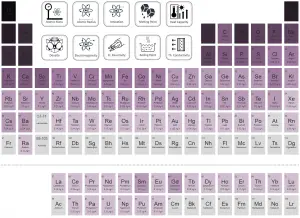
Periodic Table of Elements - electronegativity

Ionization Energy of Elements

Periodic Table of Elements - ionization energy

Radium-periodic-table

Source: www.luciteria.com


Properties of other elements

Radium - Comparison of Atomic Properties

Periodic Table in 8K resolution

Other properties of Radium


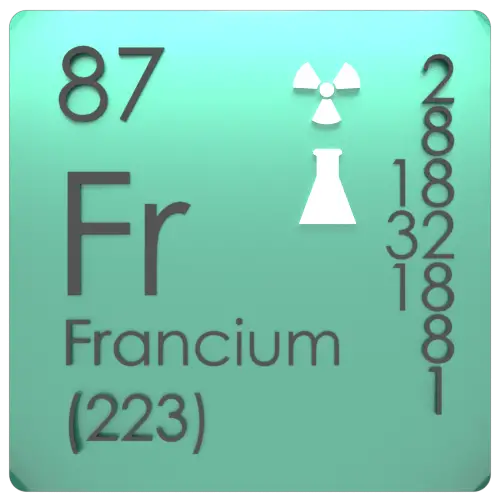
Francium – Periodic Table – Atomic Properties

Francium-density-atomic-number-mass-radius

Francium is an alkali metal, that has one valence electron. Francium is the second-least electronegative element, behind only caesium, and is the second rarest naturally occurring element (after astatine). Francium is a highly radioactive metal that decays into astatine, radium, and radon.

Summary

Element Francium
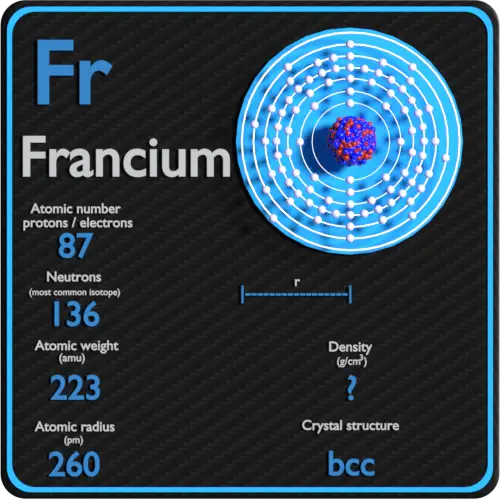
Atomic number 87
Atomic mass [amu] 223
Atomic mass [pm] 260
Density at STP [g/cm3] —
Number of protons 87
Number of neutrons (typical isotopes) 223
Number of electrons 87
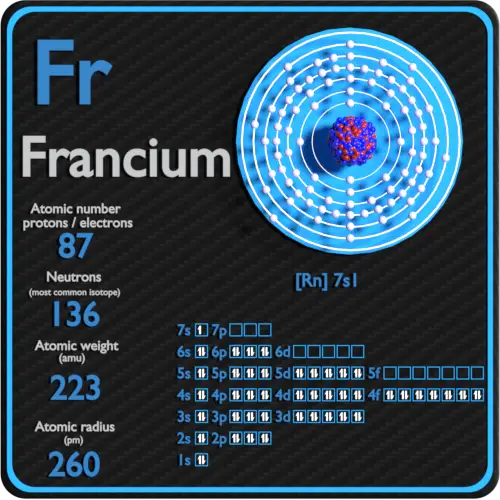
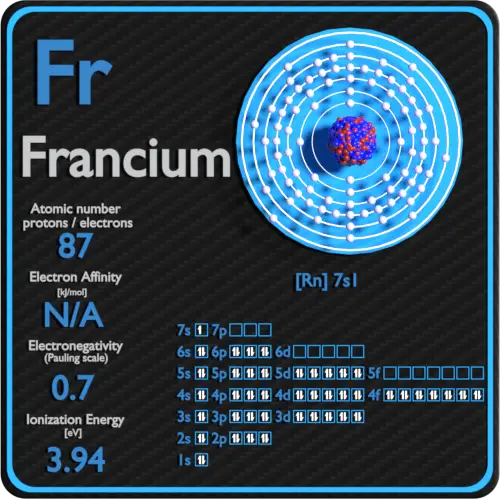
Electron configuration [Rn] 7s1
Oxidation states +1
Electron affinity [kJ/mol] —
Electronegativity [Pauling scale] 0.7
First ionization energy [eV] 3.94

Atomic Number – Protons, Electrons and Neutrons in Francium

Proton Number - Atomic NumberFrancium is a chemical element with atomic number 87 which means there are 87 protons in its nucleus. Total number of protons in the nucleus is called the atomic number of the atom and is given the symbol Z. The total electrical charge of the nucleus is therefore +Ze, where e (elementary charge) equals to 1,602 x 10-19 coulombs.

The total number of neutrons in the nucleus of an atom is called the neutron number of the atom and is given the symbol N. Neutron number plus atomic number equals atomic mass number: N+Z=A. The difference between the neutron number and the atomic number is known as the neutron excess: D = N – Z = A – 2Z.

For stable elements, there is usually a variety of stable isotopes. Isotopes are nuclides that have the same atomic number and are therefore the same element, but differ in the number of neutrons. Mass numbers of typical isotopes of Francium are 223.

Atomic Mass of Francium

Atomic mass of Francium is 223 u. 

The atomic mass is the mass of an atom. The atomic mass or relative isotopic mass refers to the mass of a single particle, and therefore is tied to a certain specific isotope of an element. The atomic mass is carried by the atomic nucleus, which occupies only about 10-12 of the total volume of the atom or less, but it contains all the positive charge and at least 99.95% of the total mass of the atom. Note that, each element may contain more isotopes, therefore this resulting atomic mass is calculated from naturally-occuring isotopes and their abundance.

Atomic Radius of Francium

The atomic radius of Francium atom is 260pm (covalent radius).

Atomic Radius of Chemical Elements

It must be noted, atoms lack a well-defined outer boundary. The atomic radius of a chemical element is a measure of the distance out to which the electron cloud extends from the nucleus. However, this assumes the atom to exhibit a spherical shape, which is only obeyed for atoms in vacuum or free space. Therefore, there are various non-equivalent definitions of atomic radius.

Electrons and Electron Configuration

The number of electrons in an electrically-neutral atom is the same as the number of protons in the nucleus. Therefore, the number of electrons in neutral atom of Francium is 87. Each electron is influenced by the electric fields produced by the positive nuclear charge and the other (Z – 1) negative electrons in the atom.

Since the number of electrons and their arrangement are responsible for the chemical behavior of atoms, the atomic number identifies the various chemical elements. The configuration of these electrons follows from the principles of quantum mechanics. The number of electrons in each element’s electron shells, particularly the outermost valence shell, is the primary factor in determining its chemical bonding behavior. In the periodic table, the elements are listed in order of increasing atomic number Z.

Electron configuration of Francium is [Rn] 7s1.

Possible oxidation states are +1.

Density of Francium

Density of Francium is –g/cm3.

Typical densities of various substances are at atmospheric pressure.

Density is defined as the mass per unit volume. It is an intensive property, which is mathematically defined as mass divided by volume:

ρ = m/V

Atomic Masses of Elements

Periodic Table of Elements - atomic mass

Atomic Radii of Elements

Periodic Table of Elements - atomic radius

Densities of Elements

Periodic Table of Elements - density

Francium-protons-neutrons-electrons-configuration

Francium-affinity-electronegativity-ionization

Electron Affinity – Francium

Electron affinity of Francium is — kJ/mol.

In chemistry and atomic physics, the electron affinity of an atom or molecule is defined as:

the change in energy (in kJ/mole) of a neutral atom or molecule (in the gaseous phase) when an electron is added to the atom to form a negative ion.

X + e– → X– + energy        Affinity = – ∆H

In other words, it can be expressed as the neutral atom’s likelihood of gaining an electron. Note that, ionization energies measure the tendency of a neutral atom to resist the loss of electrons. Electron affinities are more difficult to measure than ionization energies.

Electronegativity of Francium

Electronegativity of Francium is 0.7.

Electronegativity, symbol χ, is a chemical property that describes the tendency of an atom to attract electrons towards this atom. For this purposes, a dimensionless quantity the Pauling scale, symbol χ, is the most commonly used.

The electronegativity of Francium is: χ = 0.7

First Ionization Energy of Francium

First Ionization Energy of Francium is 3.94 eV.

Ionization energy, also called ionization potential, is the energy necessary to remove an electron from the neutral atom.

X + energy → X+ + e−

where X is any atom or molecule capable of being ionized, X+ is that atom or molecule with an electron removed (positive ion), and e− is the removed electron.

A Francium atom, for example, requires the following ionization energy to remove the outermost electron.

Fr + IE → Fr+ + e−        IE = 3.94 eV

Electronegativity of Elements

Periodic Table of Elements - electronegativity

Ionization Energy of Elements

Periodic Table of Elements - ionization energy

Francium-periodic-table

Source: www.luciteria.com


Properties of other elements

Francium - Comparison of Atomic Properties

Periodic Table in 8K resolution

Other properties of Francium


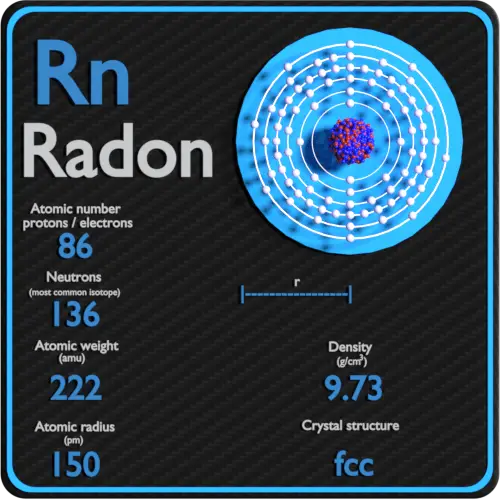
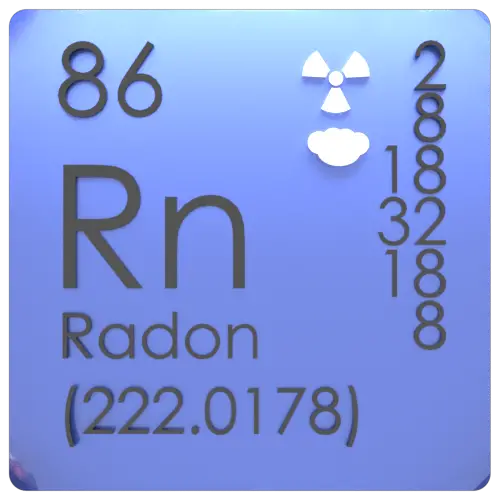
Radon – Periodic Table – Atomic Properties

Radon-density-atomic-number-mass-radius

Radon is a radioactive, colorless, odorless, tasteless noble gas. Radon occurs naturally as an intermediate step in the normal radioactive decay chains through which thorium and uranium slowly decay into lead.

Summary

Element Radon
Atomic number 86
Atomic mass [amu] 222
Atomic mass [pm] 150
Density at STP [g/cm3] 0.00973
Number of protons 86
Number of neutrons (typical isotopes) 222
Number of electrons 86
Electron configuration [Hg] 6p6
Oxidation states 0
Electron affinity [kJ/mol] —
Electronegativity [Pauling scale] —
First ionization energy [eV] 10.7485

Atomic Number – Protons, Electrons and Neutrons in Radon

Proton Number - Atomic NumberRadon is a chemical element with atomic number 86 which means there are 86 protons in its nucleus. Total number of protons in the nucleus is called the atomic number of the atom and is given the symbol Z. The total electrical charge of the nucleus is therefore +Ze, where e (elementary charge) equals to 1,602 x 10-19 coulombs.

The total number of neutrons in the nucleus of an atom is called the neutron number of the atom and is given the symbol N. Neutron number plus atomic number equals atomic mass number: N+Z=A. The difference between the neutron number and the atomic number is known as the neutron excess: D = N – Z = A – 2Z.

For stable elements, there is usually a variety of stable isotopes. Isotopes are nuclides that have the same atomic number and are therefore the same element, but differ in the number of neutrons. Mass numbers of typical isotopes of Radon are 222.

Atomic Mass of Radon

Atomic mass of Radon is 222 u. 

The atomic mass is the mass of an atom. The atomic mass or relative isotopic mass refers to the mass of a single particle, and therefore is tied to a certain specific isotope of an element. The atomic mass is carried by the atomic nucleus, which occupies only about 10-12 of the total volume of the atom or less, but it contains all the positive charge and at least 99.95% of the total mass of the atom. Note that, each element may contain more isotopes, therefore this resulting atomic mass is calculated from naturally-occuring isotopes and their abundance.

Atomic Radius of Radon

The atomic radius of Radon atom is 150pm (covalent radius).

Atomic Radius of Chemical Elements

It must be noted, atoms lack a well-defined outer boundary. The atomic radius of a chemical element is a measure of the distance out to which the electron cloud extends from the nucleus. However, this assumes the atom to exhibit a spherical shape, which is only obeyed for atoms in vacuum or free space. Therefore, there are various non-equivalent definitions of atomic radius.

Electrons and Electron Configuration

The number of electrons in an electrically-neutral atom is the same as the number of protons in the nucleus. Therefore, the number of electrons in neutral atom of Radon is 86. Each electron is influenced by the electric fields produced by the positive nuclear charge and the other (Z – 1) negative electrons in the atom.

Since the number of electrons and their arrangement are responsible for the chemical behavior of atoms, the atomic number identifies the various chemical elements. The configuration of these electrons follows from the principles of quantum mechanics. The number of electrons in each element’s electron shells, particularly the outermost valence shell, is the primary factor in determining its chemical bonding behavior. In the periodic table, the elements are listed in order of increasing atomic number Z.

Electron configuration of Radon is [Hg] 6p6.

Possible oxidation states are 0.

Density of Radon

Density of Radon is 0.00973g/cm3.

Typical densities of various substances are at atmospheric pressure.

Density is defined as the mass per unit volume. It is an intensive property, which is mathematically defined as mass divided by volume:

ρ = m/V

Atomic Masses of Elements

Periodic Table of Elements - atomic mass

Atomic Radii of Elements

Periodic Table of Elements - atomic radius

Densities of Elements

Periodic Table of Elements - density

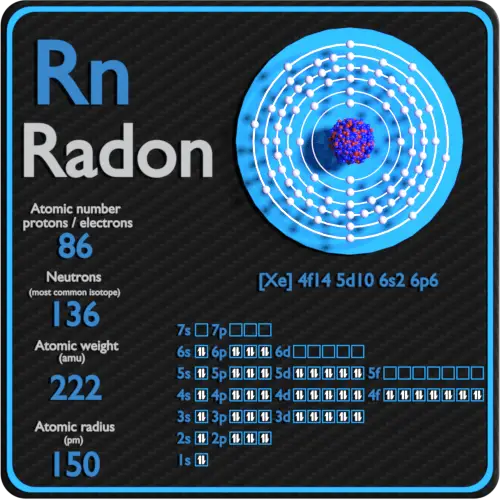
Radon-protons-neutrons-electrons-configuration

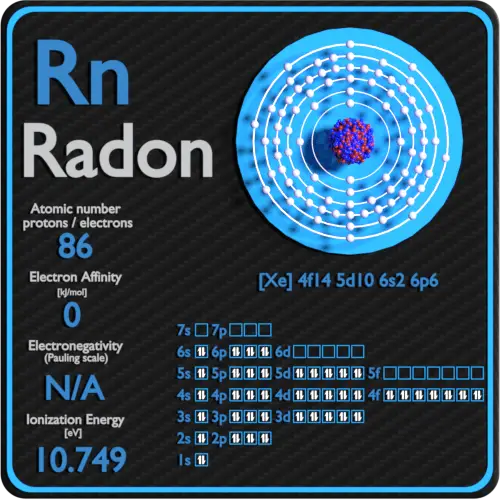
Radon-affinity-electronegativity-ionization

Electron Affinity – Radon

Electron affinity of Radon is — kJ/mol.

In chemistry and atomic physics, the electron affinity of an atom or molecule is defined as:

the change in energy (in kJ/mole) of a neutral atom or molecule (in the gaseous phase) when an electron is added to the atom to form a negative ion.

X + e– → X– + energy        Affinity = – ∆H

In other words, it can be expressed as the neutral atom’s likelihood of gaining an electron. Note that, ionization energies measure the tendency of a neutral atom to resist the loss of electrons. Electron affinities are more difficult to measure than ionization energies.

Electronegativity of Radon

Electronegativity of Radon is —.

Electronegativity, symbol χ, is a chemical property that describes the tendency of an atom to attract electrons towards this atom. For this purposes, a dimensionless quantity the Pauling scale, symbol χ, is the most commonly used.

The electronegativity of Radon is: χ = —

First Ionization Energy of Radon

First Ionization Energy of Radon is 10.7485 eV.

Ionization energy, also called ionization potential, is the energy necessary to remove an electron from the neutral atom.

X + energy → X+ + e−

where X is any atom or molecule capable of being ionized, X+ is that atom or molecule with an electron removed (positive ion), and e− is the removed electron.

A Radon atom, for example, requires the following ionization energy to remove the outermost electron.

Rn + IE → Rn+ + e−        IE = 10.7485 eV

Electronegativity of Elements

Periodic Table of Elements - electronegativity

Ionization Energy of Elements

Periodic Table of Elements - ionization energy

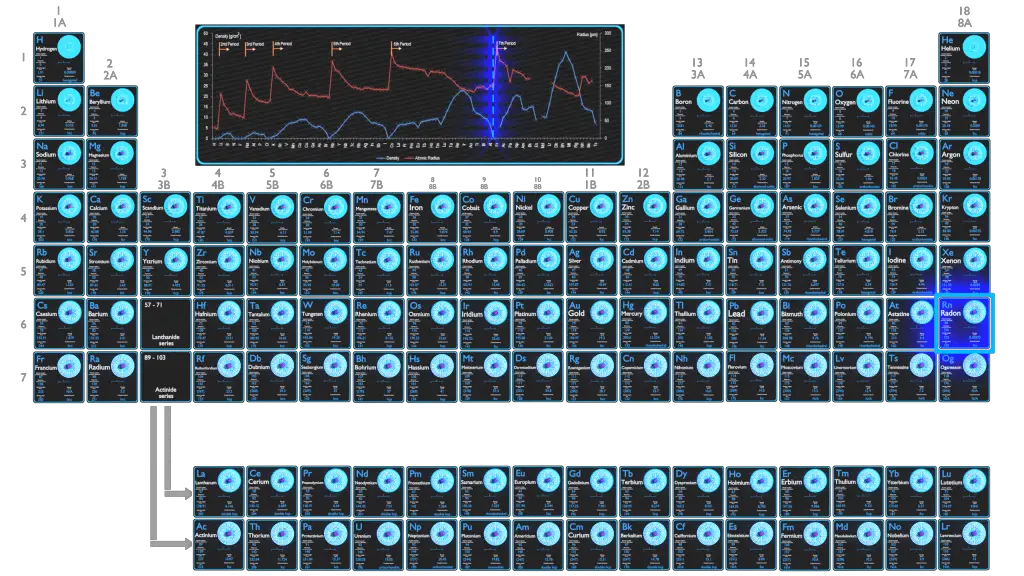
Radon-periodic-table

Source: www.luciteria.com


Properties of other elements

Radon - Comparison of Atomic Properties

Periodic Table in 8K resolution

Other properties of Radon


Astatine – Periodic Table – Atomic Properties

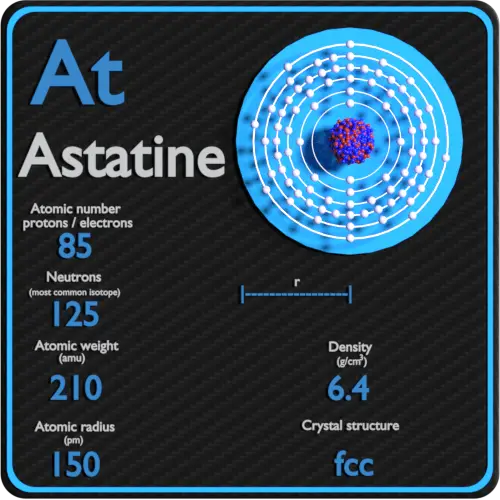
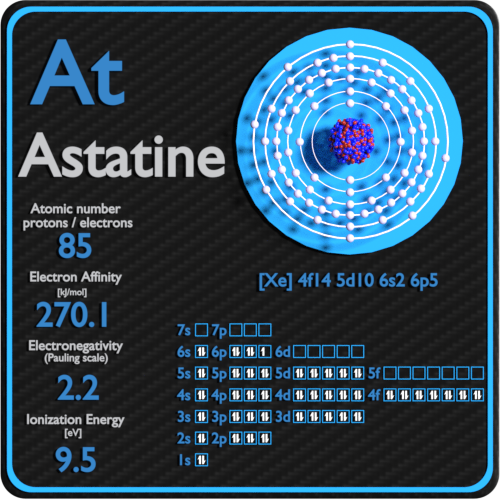
Astatine-density-atomic-number-mass-radius

Astatine is the rarest naturally occurring element on the Earth’s crust. It occurs on Earth as the decay product of various heavier elements. The bulk properties of astatine are not known with any certainty.

Summary

Element Astatine
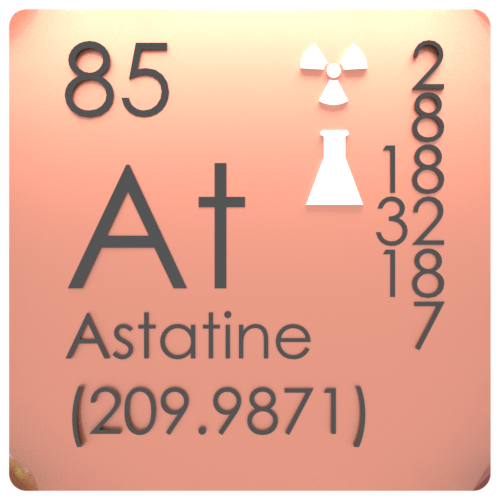
Atomic number 85
Atomic mass [amu] 210
Atomic mass [pm] 150
Density at STP [g/cm3] 6.4
Number of protons 85
Number of neutrons (typical isotopes) 210
Number of electrons 85
Electron configuration [Hg] 6p5
Oxidation states
Electron affinity [kJ/mol] 270.1
Electronegativity [Pauling scale] 2.2
First ionization energy [eV] 9.5

Atomic Number – Protons, Electrons and Neutrons in Astatine

Proton Number - Atomic NumberAstatine is a chemical element with atomic number 85 which means there are 85 protons in its nucleus. Total number of protons in the nucleus is called the atomic number of the atom and is given the symbol Z. The total electrical charge of the nucleus is therefore +Ze, where e (elementary charge) equals to 1,602 x 10-19 coulombs.

The total number of neutrons in the nucleus of an atom is called the neutron number of the atom and is given the symbol N. Neutron number plus atomic number equals atomic mass number: N+Z=A. The difference between the neutron number and the atomic number is known as the neutron excess: D = N – Z = A – 2Z.

For stable elements, there is usually a variety of stable isotopes. Isotopes are nuclides that have the same atomic number and are therefore the same element, but differ in the number of neutrons. Mass numbers of typical isotopes of Astatine are 210.

Atomic Mass of Astatine

Atomic mass of Astatine is 210 u. 

The atomic mass is the mass of an atom. The atomic mass or relative isotopic mass refers to the mass of a single particle, and therefore is tied to a certain specific isotope of an element. The atomic mass is carried by the atomic nucleus, which occupies only about 10-12 of the total volume of the atom or less, but it contains all the positive charge and at least 99.95% of the total mass of the atom. Note that, each element may contain more isotopes, therefore this resulting atomic mass is calculated from naturally-occuring isotopes and their abundance.

Atomic Radius of Astatine

The atomic radius of Astatine atom is 150pm (covalent radius).

Atomic Radius of Chemical Elements

It must be noted, atoms lack a well-defined outer boundary. The atomic radius of a chemical element is a measure of the distance out to which the electron cloud extends from the nucleus. However, this assumes the atom to exhibit a spherical shape, which is only obeyed for atoms in vacuum or free space. Therefore, there are various non-equivalent definitions of atomic radius.

Electrons and Electron Configuration

The number of electrons in an electrically-neutral atom is the same as the number of protons in the nucleus. Therefore, the number of electrons in neutral atom of Astatine is 85. Each electron is influenced by the electric fields produced by the positive nuclear charge and the other (Z – 1) negative electrons in the atom.

Since the number of electrons and their arrangement are responsible for the chemical behavior of atoms, the atomic number identifies the various chemical elements. The configuration of these electrons follows from the principles of quantum mechanics. The number of electrons in each element’s electron shells, particularly the outermost valence shell, is the primary factor in determining its chemical bonding behavior. In the periodic table, the elements are listed in order of increasing atomic number Z.

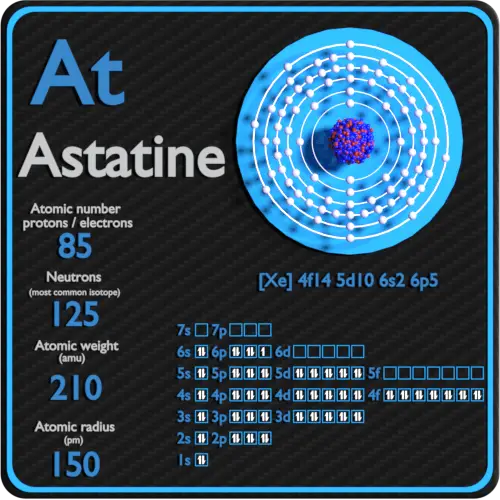
Electron configuration of Astatine is [Hg] 6p5.

Possible oxidation states are .

Density of Astatine

Density of Astatine is 6.4g/cm3.

Typical densities of various substances are at atmospheric pressure.

Density is defined as the mass per unit volume. It is an intensive property, which is mathematically defined as mass divided by volume:

ρ = m/V

Atomic Masses of Elements

Periodic Table of Elements - atomic mass

Atomic Radii of Elements

Periodic Table of Elements - atomic radius

Densities of Elements

Periodic Table of Elements - density

Astatine-protons-neutrons-electrons-configuration

Astatine-affinity-electronegativity-ionization

Electron Affinity – Astatine

Electron affinity of Astatine is 270.1 kJ/mol.

In chemistry and atomic physics, the electron affinity of an atom or molecule is defined as:

the change in energy (in kJ/mole) of a neutral atom or molecule (in the gaseous phase) when an electron is added to the atom to form a negative ion.

X + e– → X– + energy        Affinity = – ∆H

In other words, it can be expressed as the neutral atom’s likelihood of gaining an electron. Note that, ionization energies measure the tendency of a neutral atom to resist the loss of electrons. Electron affinities are more difficult to measure than ionization energies.

Electronegativity of Astatine

Electronegativity of Astatine is 2.2.

Electronegativity, symbol χ, is a chemical property that describes the tendency of an atom to attract electrons towards this atom. For this purposes, a dimensionless quantity the Pauling scale, symbol χ, is the most commonly used.

The electronegativity of Astatine is: χ = 2.2

First Ionization Energy of Astatine

First Ionization Energy of Astatine is 9.5 eV.

Ionization energy, also called ionization potential, is the energy necessary to remove an electron from the neutral atom.

X + energy → X+ + e−

where X is any atom or molecule capable of being ionized, X+ is that atom or molecule with an electron removed (positive ion), and e− is the removed electron.

A Astatine atom, for example, requires the following ionization energy to remove the outermost electron.

At + IE → At+ + e−        IE = 9.5 eV

Electronegativity of Elements

Periodic Table of Elements - electronegativity

Ionization Energy of Elements

Periodic Table of Elements - ionization energy

Astatine-periodic-table

Source: www.luciteria.com


Properties of other elements

Astatine - Comparison of Atomic Properties

Periodic Table in 8K resolution

Other properties of Astatine


Polonium – Periodic Table – Atomic Properties

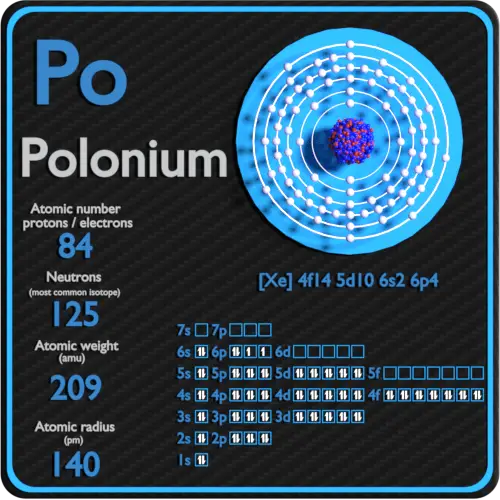
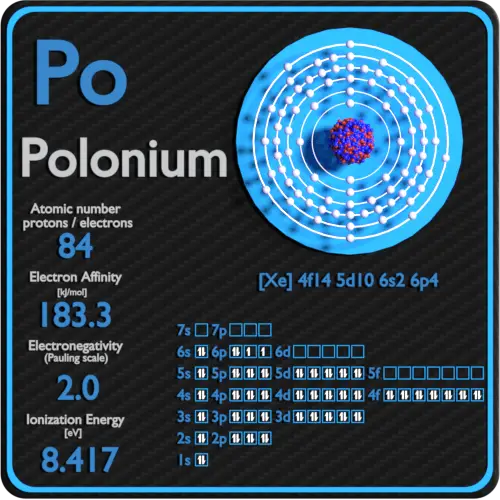
Polonium-density-atomic-number-mass-radius

Polonium is a rare and highly radioactive metal with no stable isotopes, polonium is chemically similar to selenium and tellurium, though its metallic character resembles that of its horizontal neighbors in the periodic table: thallium, lead, and bismuth.

Summary

Element Polonium
Atomic number 84
Atomic mass [amu] 209
Atomic mass [pm] 140
Density at STP [g/cm3] 9.196
Number of protons 84
Number of neutrons (typical isotopes) 208-210
Number of electrons 84
Electron configuration [Hg] 6p4
Oxidation states +2,4
Electron affinity [kJ/mol] 183.3
Electronegativity [Pauling scale] 2
First ionization energy [eV] 8.4167

Atomic Number – Protons, Electrons and Neutrons in Polonium

Proton Number - Atomic NumberPolonium is a chemical element with atomic number 84 which means there are 84 protons in its nucleus. Total number of protons in the nucleus is called the atomic number of the atom and is given the symbol Z. The total electrical charge of the nucleus is therefore +Ze, where e (elementary charge) equals to 1,602 x 10-19 coulombs.

The total number of neutrons in the nucleus of an atom is called the neutron number of the atom and is given the symbol N. Neutron number plus atomic number equals atomic mass number: N+Z=A. The difference between the neutron number and the atomic number is known as the neutron excess: D = N – Z = A – 2Z.

For stable elements, there is usually a variety of stable isotopes. Isotopes are nuclides that have the same atomic number and are therefore the same element, but differ in the number of neutrons. Mass numbers of typical isotopes of Polonium are 208-210.

Atomic Mass of Polonium

Atomic mass of Polonium is 209 u. 

The atomic mass is the mass of an atom. The atomic mass or relative isotopic mass refers to the mass of a single particle, and therefore is tied to a certain specific isotope of an element. The atomic mass is carried by the atomic nucleus, which occupies only about 10-12 of the total volume of the atom or less, but it contains all the positive charge and at least 99.95% of the total mass of the atom. Note that, each element may contain more isotopes, therefore this resulting atomic mass is calculated from naturally-occuring isotopes and their abundance.

Atomic Radius of Polonium

The atomic radius of Polonium atom is 140pm (covalent radius).

Atomic Radius of Chemical Elements

It must be noted, atoms lack a well-defined outer boundary. The atomic radius of a chemical element is a measure of the distance out to which the electron cloud extends from the nucleus. However, this assumes the atom to exhibit a spherical shape, which is only obeyed for atoms in vacuum or free space. Therefore, there are various non-equivalent definitions of atomic radius.

Electrons and Electron Configuration

The number of electrons in an electrically-neutral atom is the same as the number of protons in the nucleus. Therefore, the number of electrons in neutral atom of Polonium is 84. Each electron is influenced by the electric fields produced by the positive nuclear charge and the other (Z – 1) negative electrons in the atom.

Since the number of electrons and their arrangement are responsible for the chemical behavior of atoms, the atomic number identifies the various chemical elements. The configuration of these electrons follows from the principles of quantum mechanics. The number of electrons in each element’s electron shells, particularly the outermost valence shell, is the primary factor in determining its chemical bonding behavior. In the periodic table, the elements are listed in order of increasing atomic number Z.

Electron configuration of Polonium is [Hg] 6p4.

Possible oxidation states are +2,4.

Density of Polonium

Density of Polonium is 9.196g/cm3.

Typical densities of various substances are at atmospheric pressure.

Density is defined as the mass per unit volume. It is an intensive property, which is mathematically defined as mass divided by volume:

ρ = m/V

Atomic Masses of Elements

Periodic Table of Elements - atomic mass

Atomic Radii of Elements

Periodic Table of Elements - atomic radius

Densities of Elements

Periodic Table of Elements - density

Polonium-protons-neutrons-electrons-configuration

Polonium-affinity-electronegativity-ionization

Electron Affinity – Polonium

Electron affinity of Polonium is 183.3 kJ/mol.

In chemistry and atomic physics, the electron affinity of an atom or molecule is defined as:

the change in energy (in kJ/mole) of a neutral atom or molecule (in the gaseous phase) when an electron is added to the atom to form a negative ion.

X + e– → X– + energy        Affinity = – ∆H

In other words, it can be expressed as the neutral atom’s likelihood of gaining an electron. Note that, ionization energies measure the tendency of a neutral atom to resist the loss of electrons. Electron affinities are more difficult to measure than ionization energies.

Electronegativity of Polonium

Electronegativity of Polonium is 2.

Electronegativity, symbol χ, is a chemical property that describes the tendency of an atom to attract electrons towards this atom. For this purposes, a dimensionless quantity the Pauling scale, symbol χ, is the most commonly used.

The electronegativity of Polonium is: χ = 2

First Ionization Energy of Polonium

First Ionization Energy of Polonium is 8.4167 eV.

Ionization energy, also called ionization potential, is the energy necessary to remove an electron from the neutral atom.

X + energy → X+ + e−

where X is any atom or molecule capable of being ionized, X+ is that atom or molecule with an electron removed (positive ion), and e− is the removed electron.

A Polonium atom, for example, requires the following ionization energy to remove the outermost electron.

Po + IE → Po+ + e−        IE = 8.4167 eV

Electronegativity of Elements

Periodic Table of Elements - electronegativity

Ionization Energy of Elements

Periodic Table of Elements - ionization energy

Polonium-periodic-table

Source: www.luciteria.com


Properties of other elements

Polonium - Comparison of Atomic Properties

Periodic Table in 8K resolution

Other properties of Polonium


Uranium – Properties – Price – Applications – Production

Uranium-properties-price-application-production

About Uranium

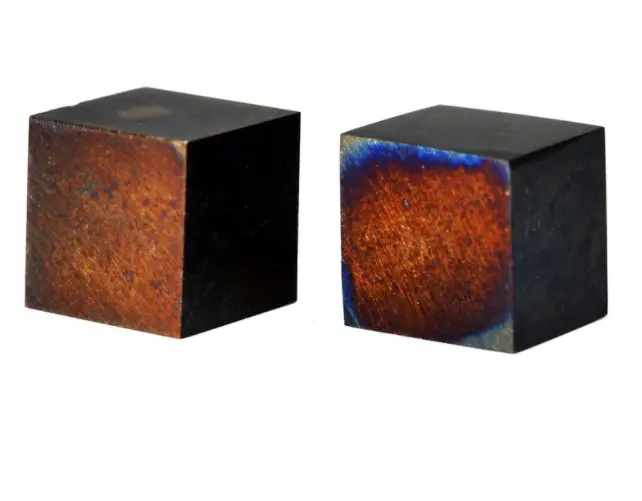
Uranium is a silvery-white metal in the actinide series of the periodic table. Uranium is weakly radioactive because all isotopes of uranium are unstable, with half-lives varying between 159,200 years and 4.5 billion years. Uranium has the highest atomic weight of the primordially occurring elements. Its density is about 70% higher than that of lead, and slightly lower than that of gold or tungsten. Uranium is commonly found at low levels (a few ppm – parts per million) in all rocks, soil, water, plants, and animals (including humans). Uranium occurs also in seawater, and can be recovered from the ocean water. Significant concentrations of uranium occur in some substances such as uraninite (the most common uranium ore), phosphate rock deposits, and other minerals.
Summary

Element Uranium
Atomic number 92
Element category Rare Earth Metal
Phase at STP Solid
Density 19.05 g/cm3
Ultimate Tensile Strength 390 MPa
Yield Strength 190 MPa
Young’s Modulus of Elasticity 208 GPa
Mohs Scale 6
Brinell Hardness 2400 MPa
Vickers Hardness 1960 MPa
Melting Point 1132 °C
Boiling Point 4131 °C
Thermal Conductivity 27 W/mK
Thermal Expansion Coefficient 13.9 µm/mK
Specific Heat 0.12 J/g K
Heat of Fusion 8.52 kJ/mol
Heat of Vaporization 417 kJ/mol
Electrical resistivity [nanoOhm meter] 280
Magnetic Susceptibility N/A

Applications of Uranium

The main use of uranium in the civilian sector is to fuel nuclear power plants. One kilogram of uranium-235 can theoretically produce about 20 terajoules of energy, assuming complete fission; as much energy as 1.5 million kilograms (1,500 tonnes) of coal. Typical reactor may contain about 100 tonnes of enriched uranium (i.e. about 113 tonnes of uranium dioxide). This fuel is loaded within, for example, 157 fuel assemblies composed of over 45,000 fuel rods. A common fuel assembly contain energy for approximately 4 years of operation at full power. The removed fuel (spent nuclear fuel) still contains about 96% of reusable material (it must be removed due to decreasing kinf of an assembly). Before (and, occasionally, after) the discovery of radioactivity, uranium was primarily used in small amounts for yellow glass and pottery glazes, such as uranium glass. Uranium is also used by the military to power nuclear submarines and in nuclear weapons. Due to its high density, this material is found in inertial guidance systems and in gyroscopic compasses.[10] Depleted uranium is preferred over similarly dense metals due to its ability to be easily machined and cast as well as its relatively low cost. The main risk of exposure to depleted uranium is chemical poisoning by uranium oxide rather than radioactivity (uranium being only a weak alpha emitter). Depleted uranium is uranium that has much less uranium-235 than natural uranium. It is considerably less radioactive than natural uranium. It is a dense metal that can be used as ballast for ships and counterweights for aircraft. It is also used in ammunition and armour. Depleted uranium can be also used to shield radiation. Depleted uranium is much more effective due to its higher Z. Depleted uranium is used for shielding in portable gamma ray sources. Uranium is used in high-speed steels as an alloying agent to improve strength and toughness. Uranium trioxide (also called uranic oxide) with formula UO3, is an orange-yellow powder and is used as a pigment for ceramics. In glasses it produces a beautiful greenish-yellow “uranium glass”.

Uranium-applications

Production and Price of Uranium

Raw materials prices change daily. They are primarily driven by supply, demand and energy prices. In 2019, prices of pure Uranium were at around N/A $/kg.

Uranium is commonly found at low levels (a few ppm – parts per million) in all rocks, soil, water, plants, and animals (including humans). Uranium occurs also in seawater, and can be recovered from the ocean water. Significant concentrations of uranium occur in some substances such as uraninite (the most common uranium ore), phosphate rock deposits, and other minerals. Uranium is often found with copper, phosphates, and other minerals; thus, it is often a co-product of other mining operations. The worldwide production of uranium in 2015 amounted to 60496 tonnes. Kazakhstan, Canada, and Australia are the top three producers and together account for 70% of world uranium production. Uranium is commonly found at low levels (a few ppm – parts per million) in all rocks, soil, water, plants, and animals (including humans). Uranium occurs also in seawater, and can be recovered from the ocean water. But only a few of the uranium ores known contain sufficient uranium (greater than 0.1%) to extract commercially. Significant concentrations of uranium occur in some substances such as uraninite (the most common uranium ore), phosphate rock deposits, and other minerals.

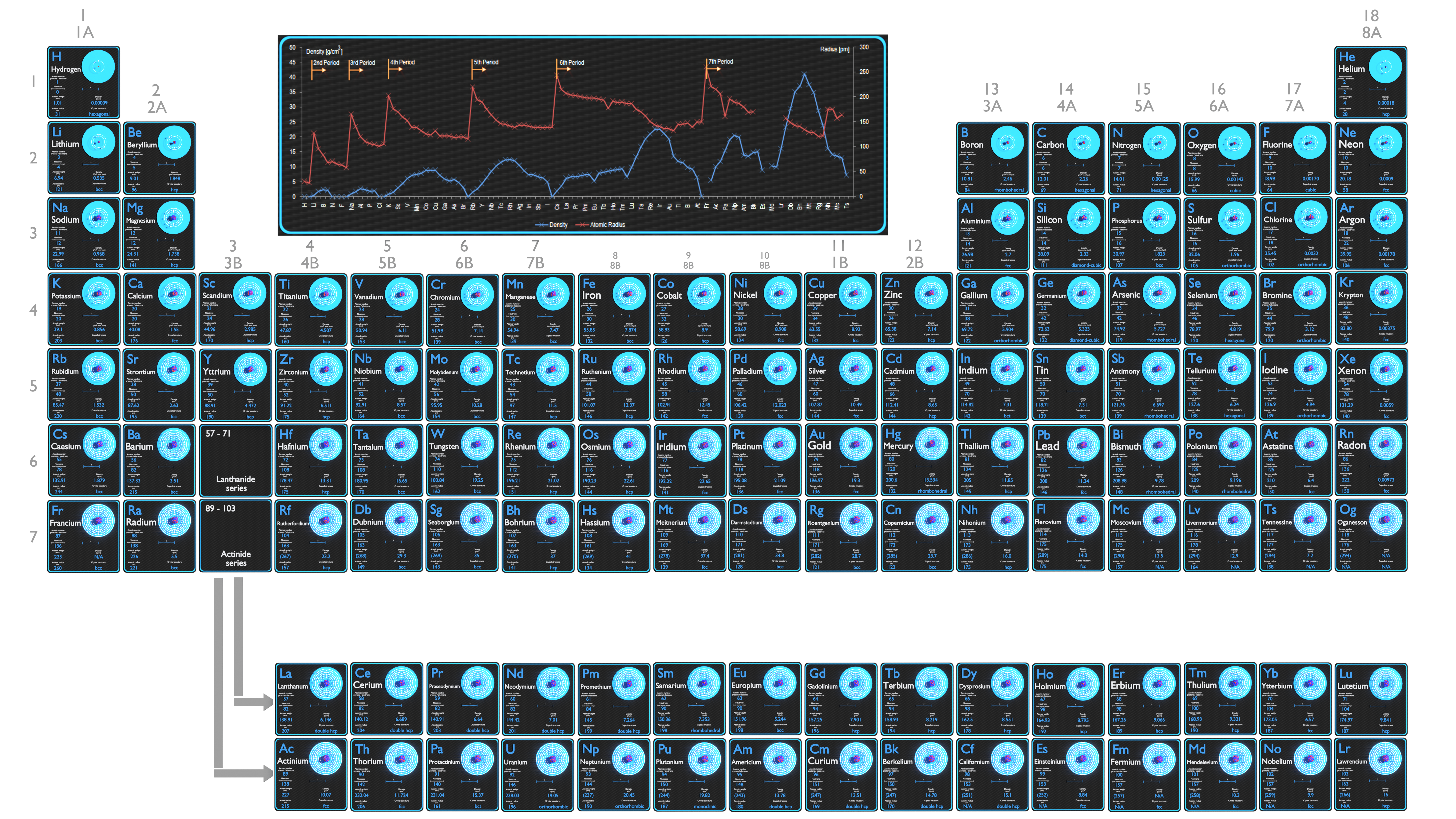
Uranium-periodic-table

Source: www.luciteria.com

Mechanical Properties of Uranium
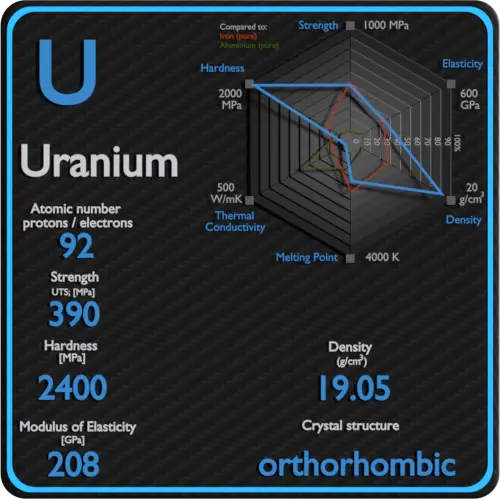
Uranium-mechanical-properties-strength-hardness-crystal-structure

Strength of Uranium

In mechanics of materials, the strength of a material is its ability to withstand an applied load without failure or plastic deformation. Strength of materials basically considers the relationship between the external loads applied to a material and the resulting deformation or change in material dimensions. In designing structures and machines, it is important to consider these factors, in order that the material selected will have adequate strength to resist applied loads or forces and retain its original shape. Strength of a material is its ability to withstand this applied load without failure or plastic deformation.

For tensile stress, the capacity of a material or structure to withstand loads tending to elongate is known as ultimate tensile strength (UTS). Yield strength or yield stress is the material property defined as the stress at which a material begins to deform plastically whereas yield point is the point where nonlinear (elastic + plastic) deformation begins.

See also: Strength of Materials

Ultimate Tensile Strength of Uranium

Ultimate tensile strength of Uranium is 390 MPa.

Yield Strength of Uranium

Yield strength of Uranium is 190 MPa.

Modulus of Elasticity of Uranium

The Young’s modulus of elasticity of Uranium is 190 MPa.

Hardness of Uranium

In materials science, hardness is the ability to withstand surface indentation (localized plastic deformation) and scratching. Brinell hardness test is one of indentation hardness tests, that has been developed for hardness testing. In Brinell tests, a hard, spherical indenter is forced under a specific load into the surface of the metal to be tested.

Brinell hardness of Uranium is approximately 2400 MPa.

The Vickers hardness test method was developed by Robert L. Smith and George E. Sandland at Vickers Ltd as an alternative to the Brinell method to measure the hardness of materials. The Vickers hardness test method can be also used as a microhardness test method, which is mostly used for small parts, thin sections, or case depth work.

Vickers hardness of Uranium is approximately 1960 MPa.

Scratch hardness is the measure of how resistant a sample is to permanent plastic deformation due to friction from a sharp object. The most common scale for this qualitative test is Mohs scale, which is used in mineralogy. The Mohs scale of mineral hardness is based on the ability of one natural sample of mineral to scratch another mineral visibly.

Uranium is has a hardness of approximately 6.

See also: Hardness of Materials

Uranium – Crystal Structure

A possible crystal structure of Uranium is orthorhombic structure.

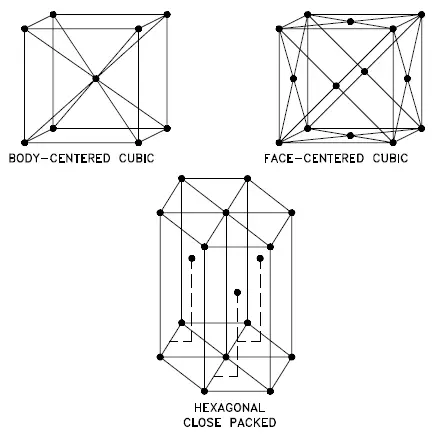
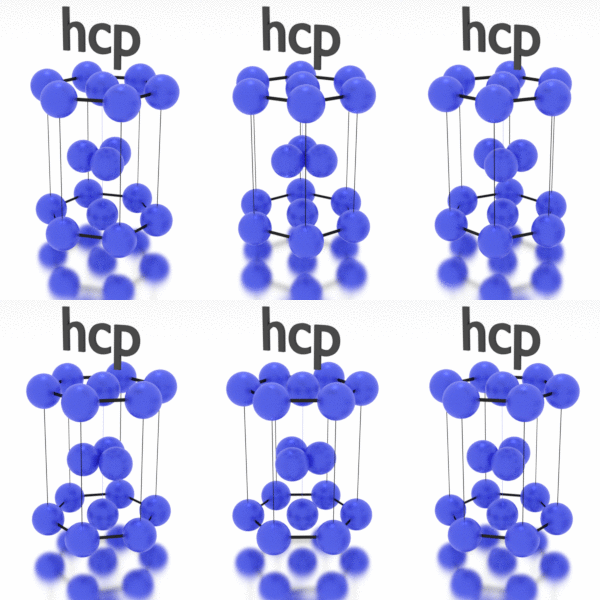
crystal structures - FCC, BCC, HCP

In metals, and in many other solids, the atoms are arranged in regular arrays called crystals. A crystal lattice is a repeating pattern of mathematical points that extends throughout space. The forces of chemical bonding causes this repetition. It is this repeated pattern which control properties like strength, ductility, density, conductivity (property of conducting or transmitting heat, electricity, etc.), and shape. There are 14 general types of such patterns known as Bravais lattices.

See also: Crystal Structure of Materials

Crystal Structure of Uranium
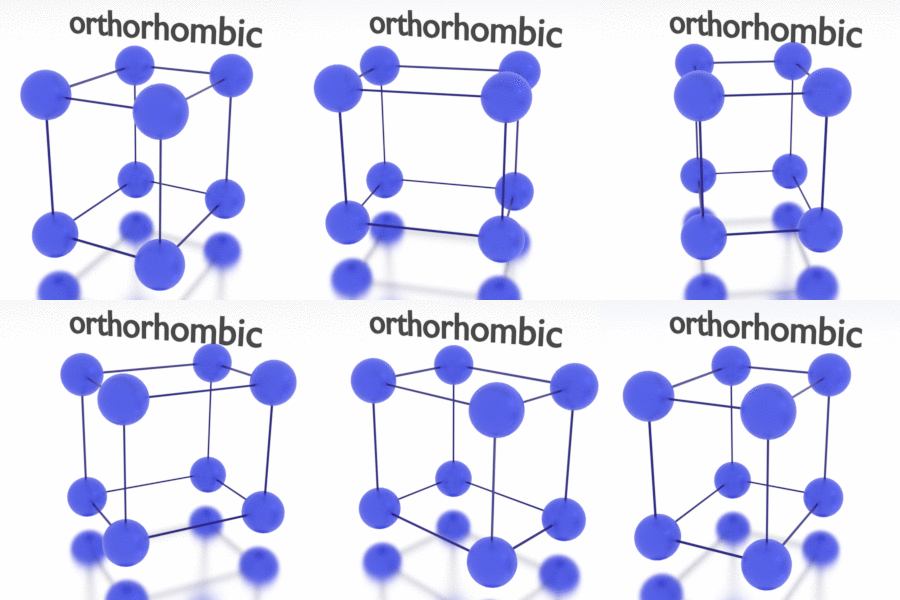
Crystal Structure of Uranium is: orthorhombic

Strength of Elements

Elasticity of Elements
Hardness of Elements
 

Thermal Properties of Uranium

Uranium-melting-point-conductivity-thermal-properties

Uranium – Melting Point and Boiling Point

Melting point of Uranium is 1132°C.

Boiling point of Uranium is 4131°C.

Note that, these points are associated with the standard atmospheric pressure.

Uranium – Thermal Conductivity

Thermal conductivity of Uranium is 27 W/(m·K).

The heat transfer characteristics of a solid material are measured by a property called the thermal conductivity, k (or λ), measured in W/m.K. It is a measure of a substance’s ability to transfer heat through a material by conduction. Note that Fourier’s law applies for all matter, regardless of its state (solid, liquid, or gas), therefore, it is also defined for liquids and gases.

Coefficient of Thermal Expansion of Uranium

Linear thermal expansion coefficient of Uranium is 13.9 µm/(m·K)

Thermal expansion is generally the tendency of matter to change its dimensions in response to a change in temperature. It is usually expressed as a fractional change in length or volume per unit temperature change.

Uranium – Specific Heat, Latent Heat of Fusion, Latent Heat of Vaporization

Specific heat of Uranium is 0.12 J/g K.

Heat capacity is an extensive property of matter, meaning it is proportional to the size of the system. Heat capacity C has the unit of energy per degree or energy per kelvin. When expressing the same phenomenon as an intensive property, the heat capacity is divided by the amount of substance, mass, or volume, thus the quantity is independent of the size or extent of the sample.

Latent Heat of Fusion of Uranium is 8.52 kJ/mol.

Latent Heat of Vaporization of Uranium is 417 kJ/mol.

Latent heat is the amount of heat added to or removed from a substance to produce a change in phase. This energy breaks down the intermolecular attractive forces, and also must provide the energy necessary to expand the gas (the pΔV work). When latent heat is added, no temperature change occurs. The enthalpy of vaporization is a function of the pressure at which that transformation takes place.

Melting Point of Elements
Periodic Table of Elements - melting point

Thermal Conductivity of Elements

Periodic Table of Elements - thermal conductivity

Thermal Expansion of Elements

Periodic Table of Elements - thermal expansion

Heat Capacity of Elements

Periodic Table of Elements - heat capacity

Heat of Fusion of Elements

Periodic Table of Elements - latent heat fusion

Heat of Vaporization of Elements

Periodic Table of Elements - latent heat vaporization

Uranium – Electrical Resistivity – Magnetic Susceptibility

Uranium-electrical-resistivity-magnetic-susceptibility

Electrical property refers to the response of a material to an applied electric field. One of the principal characteristics of materials is their ability (or lack of ability) to conduct electrical current. Indeed, materials are classified by this property, that is, they are divided into conductors, semiconductors, and nonconductors.

See also: Electrical Properties

Magnetic property refers to the response of a material to an applied magnetic field. The macroscopic magnetic properties of a material are a consequence of interactions between an external magnetic field and the magnetic dipole moments of the constituent atoms. Different materials react to the application of magnetic field differently.

See also: Magnetic Properties

Electrical Resistivity of Uranium

Electrical resistivity of Uranium is 280 nΩ⋅m.

Electrical conductivity and its converse, electrical resistivity, is a fundamental property of a material that quantifies how Uranium conducts the flow of electric current. Electrical conductivity or specific conductance is the reciprocal of electrical resistivity.

Magnetic Susceptibility of Uranium

Magnetic susceptibility of Uranium is N/A.

In electromagnetism, magnetic susceptibility is the measure of the magnetization of a substance. Magnetic susceptibility is a dimensionless proportionality factor that indicates the degree of magnetization of Uranium in response to an applied magnetic field.

Electrical Resistivity of Elements
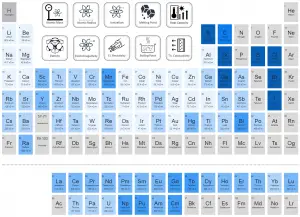
Periodic Table of Elements - electrical resistivity

Magnetic Susceptibility of Elements

Application and prices of other elements

Uranium - Comparison of Properties and Prices

Periodic Table in 8K resolution

Other properties of Uranium


Thorium – Properties – Price – Applications – Production

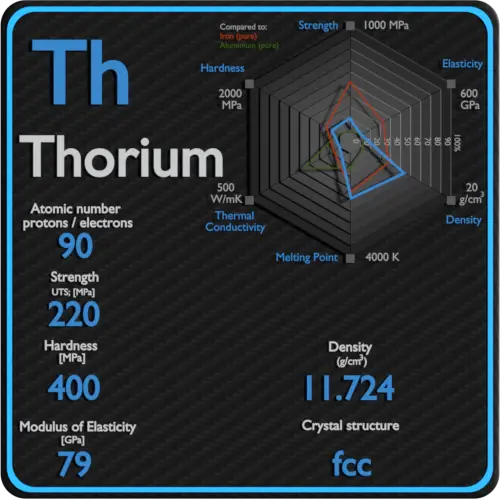
Thorium-properties-price-application-production

About Thorium

Thorium metal is silvery and tarnishes black when exposed to air, forming the dioxide. Thorium is moderately hard, malleable, and has a high melting point. Thorium is a naturally-occurring element and it is estimated to be about three times more abundant than uranium. Thorium is commonly found in monazite sands (rare earth metals containing phosphate mineral).

Summary

Element Thorium
Atomic number 90
Element category Rare Earth Metal
Phase at STP Solid
Density 11.724 g/cm3
Ultimate Tensile Strength 220 MPa
Yield Strength 144 MPa
Young’s Modulus of Elasticity 79 GPa
Mohs Scale 3
Brinell Hardness 400 MPa
Vickers Hardness 350 MPa
Melting Point 1750 °C
Boiling Point 4790 °C
Thermal Conductivity 54 W/mK
Thermal Expansion Coefficient 11 µm/mK
Specific Heat 0.12 J/g K
Heat of Fusion 13.8 kJ/mol
Heat of Vaporization 514.4 kJ/mol
Electrical resistivity [nanoOhm meter] 157
Magnetic Susceptibility +132e-6 cm^3/mol

Applications of Thorium

Most thorium applications use its dioxide (sometimes called “thoria” in the industry), rather than the metal. This compound has a melting point of 3300 °C (6000 °F), the highest of all known oxides; only a few substances have higher melting points.[46] This helps the compound remain solid in a flame, and it considerably increases the brightness of the flame; this is the main reason thorium is used in gas lamp mantles. All substances emit energy (glow) at high temperatures, but the light emitted by thorium is nearly all in the visible spectrum, hence the brightness of thorium mantles. Thorium is an important alloying agent in magnesium, as it imparts greater strength and creep resistance at high temperatures. Thorium oxide is used as an industrial catalyst. Other uses for thorium include heat-resistant ceramics, aircraft engines, and in light bulbs. Thorium can be used as a source of nuclear power. It is about three times as abundant as uranium and about as abundant as lead, and there is probably more energy available from thorium than from both uranium and fossil fuels. 232Th is a fertile isotope. 232Th is not capable of undergoing fission reaction after absorbing thermal neutron, on the other hand 232Th can be fissioned by fast neutron with energy higher than >1MeV. India and China are in the process of developing nuclear power plants with thorium reactors, but this is still a very new technology. Thorium dioxide was formerly added to glass during manufacture to increase the refractive index, producing thoriated glass for use in high-quality camera lenses.
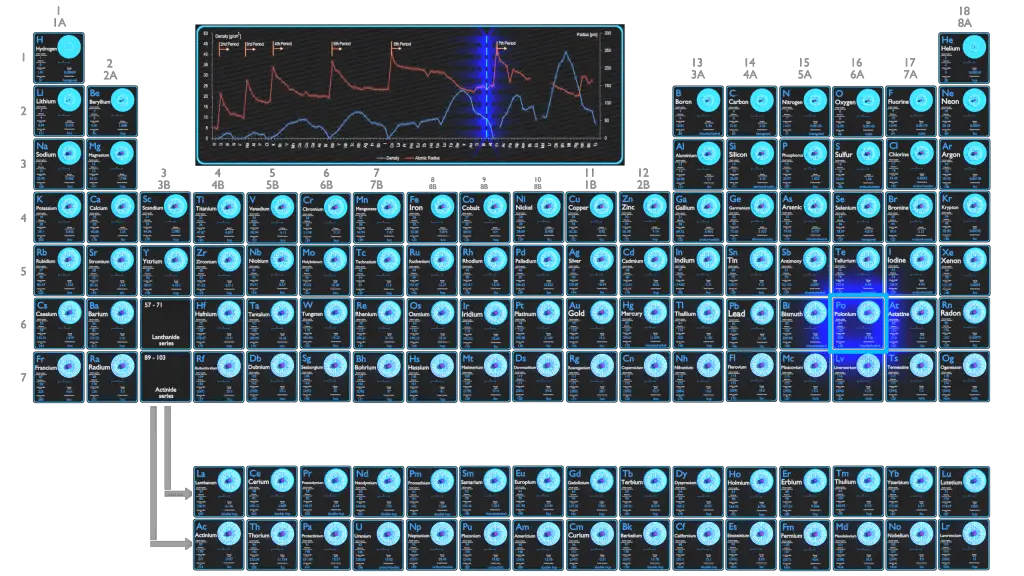
Thorium-applications

Production and Price of Thorium

Raw materials prices change daily. They are primarily driven by supply, demand and energy prices. In 2019, prices of pure Thorium were at around 30 $/kg.

Thorium is a naturally-occurring element and it is estimated to be about three times more abundant than uranium. Thorium is commonly found in monazite sands (rare earth metals containing phosphate mineral). The current reliance on monazite for production is due to thorium being largely produced as a by-product; other sources such as thorite contain more thorium and could easily be used for production if demand rose.

Thorium-periodic-table

Source: www.luciteria.com

Mechanical Properties of Thorium

Thorium-mechanical-properties-strength-hardness-crystal-structure

Strength of Thorium

In mechanics of materials, the strength of a material is its ability to withstand an applied load without failure or plastic deformation. Strength of materials basically considers the relationship between the external loads applied to a material and the resulting deformation or change in material dimensions. In designing structures and machines, it is important to consider these factors, in order that the material selected will have adequate strength to resist applied loads or forces and retain its original shape. Strength of a material is its ability to withstand this applied load without failure or plastic deformation.

For tensile stress, the capacity of a material or structure to withstand loads tending to elongate is known as ultimate tensile strength (UTS). Yield strength or yield stress is the material property defined as the stress at which a material begins to deform plastically whereas yield point is the point where nonlinear (elastic + plastic) deformation begins.

See also: Strength of Materials

Ultimate Tensile Strength of Thorium

Ultimate tensile strength of Thorium is 220 MPa.

Yield Strength of Thorium

Yield strength of Thorium is 144 MPa.

Modulus of Elasticity of Thorium

The Young’s modulus of elasticity of Thorium is 144 MPa.

Hardness of Thorium

In materials science, hardness is the ability to withstand surface indentation (localized plastic deformation) and scratching. Brinell hardness test is one of indentation hardness tests, that has been developed for hardness testing. In Brinell tests, a hard, spherical indenter is forced under a specific load into the surface of the metal to be tested.

Brinell hardness of Thorium is approximately 400 MPa.

The Vickers hardness test method was developed by Robert L. Smith and George E. Sandland at Vickers Ltd as an alternative to the Brinell method to measure the hardness of materials. The Vickers hardness test method can be also used as a microhardness test method, which is mostly used for small parts, thin sections, or case depth work.

Vickers hardness of Thorium is approximately 350 MPa.

Scratch hardness is the measure of how resistant a sample is to permanent plastic deformation due to friction from a sharp object. The most common scale for this qualitative test is Mohs scale, which is used in mineralogy. The Mohs scale of mineral hardness is based on the ability of one natural sample of mineral to scratch another mineral visibly.

Thorium is has a hardness of approximately 3.

See also: Hardness of Materials

Thorium – Crystal Structure

A possible crystal structure of Thorium is face-centered cubic structure.

crystal structures - FCC, BCC, HCP

In metals, and in many other solids, the atoms are arranged in regular arrays called crystals. A crystal lattice is a repeating pattern of mathematical points that extends throughout space. The forces of chemical bonding causes this repetition. It is this repeated pattern which control properties like strength, ductility, density, conductivity (property of conducting or transmitting heat, electricity, etc.), and shape. There are 14 general types of such patterns known as Bravais lattices.

See also: Crystal Structure of Materials

Crystal Structure of Thorium
Crystal Structure of Thorium is: face-centered cubic

Strength of Elements

Elasticity of Elements

Hardness of Elements


Thermal Properties of Thorium

Thorium-melting-point-conductivity-thermal-properties

Thorium – Melting Point and Boiling Point

Melting point of Thorium is 1750°C.

Boiling point of Thorium is 4790°C.

Note that, these points are associated with the standard atmospheric pressure.

Thorium – Thermal Conductivity

Thermal conductivity of Thorium is 54 W/(m·K).

The heat transfer characteristics of a solid material are measured by a property called the thermal conductivity, k (or λ), measured in W/m.K. It is a measure of a substance’s ability to transfer heat through a material by conduction. Note that Fourier’s law applies for all matter, regardless of its state (solid, liquid, or gas), therefore, it is also defined for liquids and gases.

Coefficient of Thermal Expansion of Thorium

Linear thermal expansion coefficient of Thorium is 11 µm/(m·K)

Thermal expansion is generally the tendency of matter to change its dimensions in response to a change in temperature. It is usually expressed as a fractional change in length or volume per unit temperature change.

Thorium – Specific Heat, Latent Heat of Fusion, Latent Heat of Vaporization

Specific heat of Thorium is 0.12 J/g K.

Heat capacity is an extensive property of matter, meaning it is proportional to the size of the system. Heat capacity C has the unit of energy per degree or energy per kelvin. When expressing the same phenomenon as an intensive property, the heat capacity is divided by the amount of substance, mass, or volume, thus the quantity is independent of the size or extent of the sample.

Latent Heat of Fusion of Thorium is 13.8 kJ/mol.

Latent Heat of Vaporization of Thorium is 514.4 kJ/mol.

Latent heat is the amount of heat added to or removed from a substance to produce a change in phase. This energy breaks down the intermolecular attractive forces, and also must provide the energy necessary to expand the gas (the pΔV work). When latent heat is added, no temperature change occurs. The enthalpy of vaporization is a function of the pressure at which that transformation takes place.

Melting Point of Elements

Periodic Table of Elements - melting point

Thermal Conductivity of Elements

Periodic Table of Elements - thermal conductivity

Thermal Expansion of Elements

Periodic Table of Elements - thermal expansion

Heat Capacity of Elements

Periodic Table of Elements - heat capacity

Heat of Fusion of Elements

Periodic Table of Elements - latent heat fusion

Heat of Vaporization of Elements

Periodic Table of Elements - latent heat vaporization

Thorium – Electrical Resistivity – Magnetic Susceptibility

Thorium-electrical-resistivity-magnetic-susceptibility

Electrical property refers to the response of a material to an applied electric field. One of the principal characteristics of materials is their ability (or lack of ability) to conduct electrical current. Indeed, materials are classified by this property, that is, they are divided into conductors, semiconductors, and nonconductors.

See also: Electrical Properties

Magnetic property refers to the response of a material to an applied magnetic field. The macroscopic magnetic properties of a material are a consequence of interactions between an external magnetic field and the magnetic dipole moments of the constituent atoms. Different materials react to the application of magnetic field differently.

See also: Magnetic Properties

Electrical Resistivity of Thorium

Electrical resistivity of Thorium is 157 nΩ⋅m.

Electrical conductivity and its converse, electrical resistivity, is a fundamental property of a material that quantifies how Thorium conducts the flow of electric current. Electrical conductivity or specific conductance is the reciprocal of electrical resistivity.

Magnetic Susceptibility of Thorium

Magnetic susceptibility of Thorium is +132e-6 cm^3/mol.

In electromagnetism, magnetic susceptibility is the measure of the magnetization of a substance. Magnetic susceptibility is a dimensionless proportionality factor that indicates the degree of magnetization of Thorium in response to an applied magnetic field.

Electrical Resistivity of Elements

Periodic Table of Elements - electrical resistivity

Magnetic Susceptibility of Elements

Application and prices of other elements

Thorium - Comparison of Properties and Prices

Periodic Table in 8K resolution

Other properties of Thorium


Bismuth – Properties – Price – Applications – Production

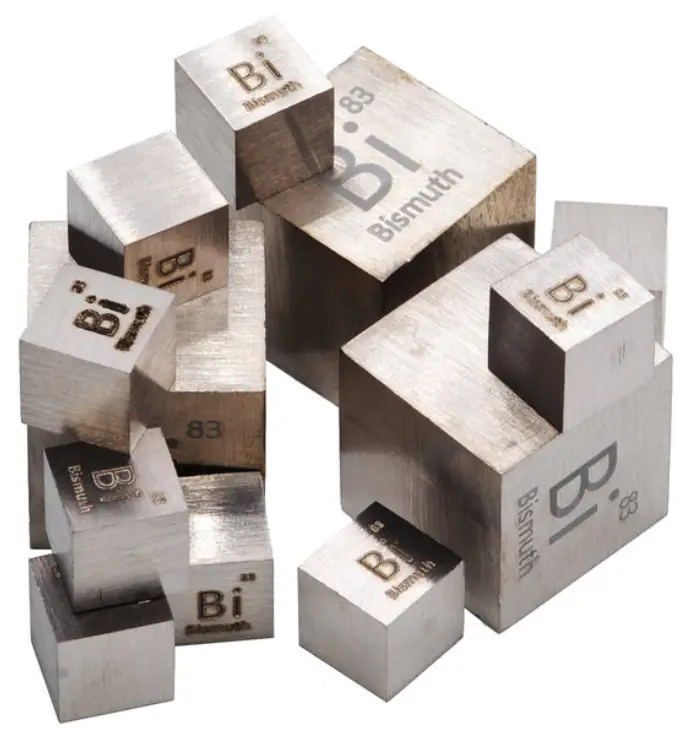
Bismuth-properties-price-application-production

About Bismuth

Bismuth is a brittle metal with a silvery white color when freshly produced, but surface oxidation can give it a pink tinge. Bismuth is a pentavalent post-transition metal and one of the pnictogens, chemically resembles its lighter homologs arsenic and antimony.

Summary

Element Bismuth
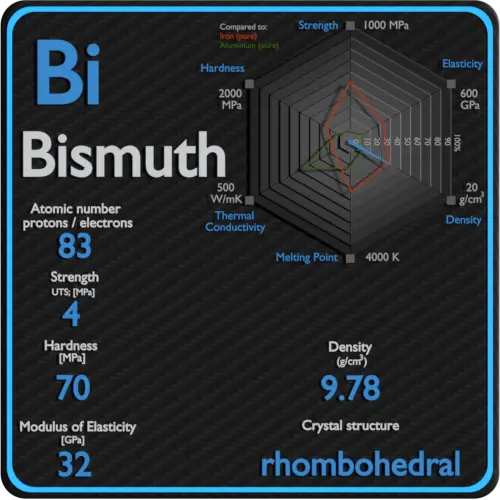
Atomic number 83
Element category Poor Metal
Phase at STP Solid
Density 9.78 g/cm3
Ultimate Tensile Strength 4 MPa
Yield Strength 2 MPa
Young’s Modulus of Elasticity 32 GPa
Mohs Scale 2.5
Brinell Hardness 70 MPa
Vickers Hardness N/A
Melting Point 271 °C
Boiling Point 1560 °C
Thermal Conductivity 8 W/mK
Thermal Expansion Coefficient 13.4 µm/mK
Specific Heat 0.12 J/g K
Heat of Fusion 11.3 kJ/mol
Heat of Vaporization 104.8 kJ/mol
Electrical resistivity [nanoOhm meter] 1290
Magnetic Susceptibility −280e-6 cm^3/mol

Applications of Bismuth

Bismuth metal is brittle and so it is usually mixed with other metals to make it useful. Its alloys with tin or cadmium have low melting points and are used in fire detectors and extinguishers, electric fuses and solders. Bismuth oxide is used as a yellow pigment for cosmetics and paints. Bismuth alloys are used in soldering, thermocouple materials and magnetic memory devices. Compounds of bismuth are used in lubricating greases, thermoelectric materials, infrared spectrometers. Bismuth oxychloride (BiOCl) is sometimes used in cosmetics, as a pigment in paint for eye shadows, hair sprays and nail polishes.

Bismuth-applications

Production and Price of Bismuth

Raw materials prices change daily. They are primarily driven by supply, demand and energy prices. In 2019, prices of pure Bismuth were at around 110 $/kg.

n the United States, for example, 733 tonnes of bismuth were consumed in 2016, of which 70% went into chemicals (including pharmaceuticals, pigments, and cosmetics) and 11% into bismuth alloys. The price for pure bismuth metal has been relatively stable through most of the 20th century, except for a spike in the 1970s. Bismuth has always been produced mainly as a byproduct of lead refining, and thus the price usually reflected the cost of recovery and the balance between production and demand.

Bismuth-periodic-table

Source: www.luciteria.com

Mechanical Properties of Bismuth

Bismuth-mechanical-properties-strength-hardness-crystal-structure

Strength of Bismuth

In mechanics of materials, the strength of a material is its ability to withstand an applied load without failure or plastic deformation. Strength of materials basically considers the relationship between the external loads applied to a material and the resulting deformation or change in material dimensions. In designing structures and machines, it is important to consider these factors, in order that the material selected will have adequate strength to resist applied loads or forces and retain its original shape. Strength of a material is its ability to withstand this applied load without failure or plastic deformation.

For tensile stress, the capacity of a material or structure to withstand loads tending to elongate is known as ultimate tensile strength (UTS). Yield strength or yield stress is the material property defined as the stress at which a material begins to deform plastically whereas yield point is the point where nonlinear (elastic + plastic) deformation begins.

See also: Strength of Materials

Ultimate Tensile Strength of Bismuth

Ultimate tensile strength of Bismuth is 4 MPa.

Yield Strength of Bismuth

Yield strength of Bismuth is 2 MPa.

Modulus of Elasticity of Bismuth

The Young’s modulus of elasticity of Bismuth is 2 MPa.

Hardness of Bismuth

In materials science, hardness is the ability to withstand surface indentation (localized plastic deformation) and scratching. Brinell hardness test is one of indentation hardness tests, that has been developed for hardness testing. In Brinell tests, a hard, spherical indenter is forced under a specific load into the surface of the metal to be tested.

Brinell hardness of Bismuth is approximately 70 MPa.

The Vickers hardness test method was developed by Robert L. Smith and George E. Sandland at Vickers Ltd as an alternative to the Brinell method to measure the hardness of materials. The Vickers hardness test method can be also used as a microhardness test method, which is mostly used for small parts, thin sections, or case depth work.

Vickers hardness of Bismuth is approximately N/A.

Scratch hardness is the measure of how resistant a sample is to permanent plastic deformation due to friction from a sharp object. The most common scale for this qualitative test is Mohs scale, which is used in mineralogy. The Mohs scale of mineral hardness is based on the ability of one natural sample of mineral to scratch another mineral visibly.

Bismuth is has a hardness of approximately 2.5.

See also: Hardness of Materials

Bismuth – Crystal Structure

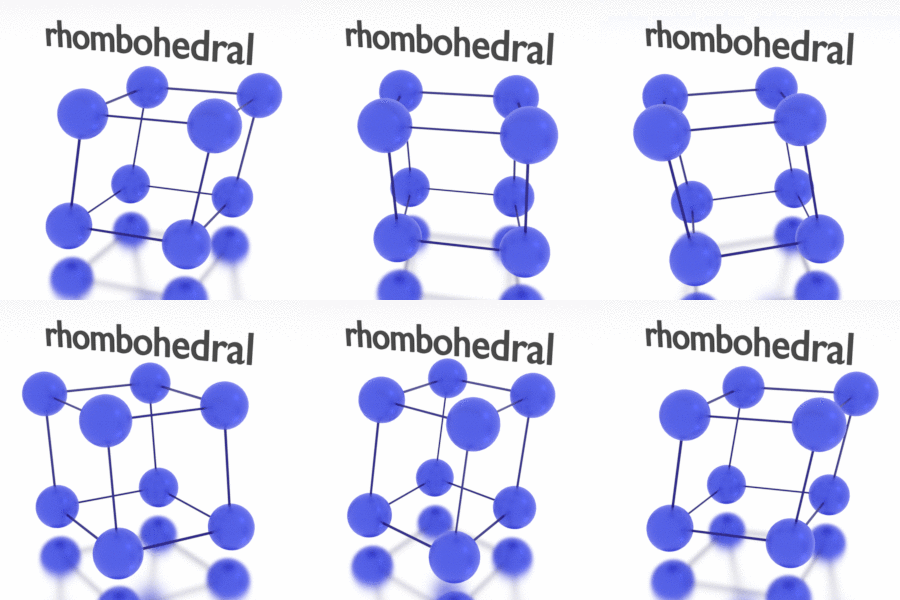
A possible crystal structure of Bismuth is rhombohedral structure.

crystal structures - FCC, BCC, HCP

In metals, and in many other solids, the atoms are arranged in regular arrays called crystals. A crystal lattice is a repeating pattern of mathematical points that extends throughout space. The forces of chemical bonding causes this repetition. It is this repeated pattern which control properties like strength, ductility, density, conductivity (property of conducting or transmitting heat, electricity, etc.), and shape. There are 14 general types of such patterns known as Bravais lattices.

See also: Crystal Structure of Materials

Crystal Structure of Bismuth
Crystal Structure of Bismuth is: rhombohedral

Strength of Elements

Elasticity of Elements

Hardness of Elements


Thermal Properties of Bismuth

Bismuth-melting-point-conductivity-thermal-properties

Bismuth – Melting Point and Boiling Point

Melting point of Bismuth is 271°C.

Boiling point of Bismuth is 1560°C.

Note that, these points are associated with the standard atmospheric pressure.

Bismuth – Thermal Conductivity

Thermal conductivity of Bismuth is 8 W/(m·K).

The heat transfer characteristics of a solid material are measured by a property called the thermal conductivity, k (or λ), measured in W/m.K. It is a measure of a substance’s ability to transfer heat through a material by conduction. Note that Fourier’s law applies for all matter, regardless of its state (solid, liquid, or gas), therefore, it is also defined for liquids and gases.

Coefficient of Thermal Expansion of Bismuth

Linear thermal expansion coefficient of Bismuth is 13.4 µm/(m·K)

Thermal expansion is generally the tendency of matter to change its dimensions in response to a change in temperature. It is usually expressed as a fractional change in length or volume per unit temperature change.

Bismuth – Specific Heat, Latent Heat of Fusion, Latent Heat of Vaporization

Specific heat of Bismuth is 0.12 J/g K.

Heat capacity is an extensive property of matter, meaning it is proportional to the size of the system. Heat capacity C has the unit of energy per degree or energy per kelvin. When expressing the same phenomenon as an intensive property, the heat capacity is divided by the amount of substance, mass, or volume, thus the quantity is independent of the size or extent of the sample.

Latent Heat of Fusion of Bismuth is 11.3 kJ/mol.

Latent Heat of Vaporization of Bismuth is 104.8 kJ/mol.

Latent heat is the amount of heat added to or removed from a substance to produce a change in phase. This energy breaks down the intermolecular attractive forces, and also must provide the energy necessary to expand the gas (the pΔV work). When latent heat is added, no temperature change occurs. The enthalpy of vaporization is a function of the pressure at which that transformation takes place.

Melting Point of Elements

Periodic Table of Elements - melting point

Thermal Conductivity of Elements

Periodic Table of Elements - thermal conductivity

Thermal Expansion of Elements

Periodic Table of Elements - thermal expansion

Heat Capacity of Elements

Periodic Table of Elements - heat capacity

Heat of Fusion of Elements

Periodic Table of Elements - latent heat fusion

Heat of Vaporization of Elements

Periodic Table of Elements - latent heat vaporization

Bismuth – Electrical Resistivity – Magnetic Susceptibility

Bismuth-electrical-resistivity-magnetic-susceptibility

Electrical property refers to the response of a material to an applied electric field. One of the principal characteristics of materials is their ability (or lack of ability) to conduct electrical current. Indeed, materials are classified by this property, that is, they are divided into conductors, semiconductors, and nonconductors.

See also: Electrical Properties

Magnetic property refers to the response of a material to an applied magnetic field. The macroscopic magnetic properties of a material are a consequence of interactions between an external magnetic field and the magnetic dipole moments of the constituent atoms. Different materials react to the application of magnetic field differently.

See also: Magnetic Properties

Electrical Resistivity of Bismuth

Electrical resistivity of Bismuth is 1290 nΩ⋅m.

Electrical conductivity and its converse, electrical resistivity, is a fundamental property of a material that quantifies how Bismuth conducts the flow of electric current. Electrical conductivity or specific conductance is the reciprocal of electrical resistivity.

Magnetic Susceptibility of Bismuth

Magnetic susceptibility of Bismuth is −280e-6 cm^3/mol.

In electromagnetism, magnetic susceptibility is the measure of the magnetization of a substance. Magnetic susceptibility is a dimensionless proportionality factor that indicates the degree of magnetization of Bismuth in response to an applied magnetic field.

Electrical Resistivity of Elements

Periodic Table of Elements - electrical resistivity

Magnetic Susceptibility of Elements

Application and prices of other elements

Other properties of Bismuth


Lead – Properties – Price – Applications – Production

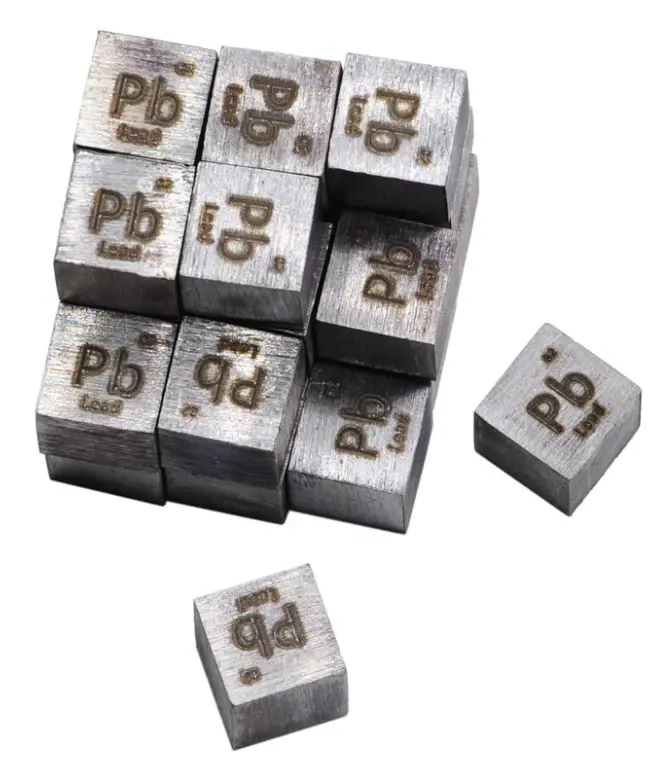
Lead-properties-price-application-production

About Lead

Lead is a heavy metal that is denser than most common materials. Lead is soft and malleable, and has a relatively low melting point. Lead is widely used as a gamma shield. Major advantage of lead shield is in its compactness due to its higher density. Lead has the highest atomic number of any stable element and concludes three major decay chains of heavier elements.

Summary

Element Lead
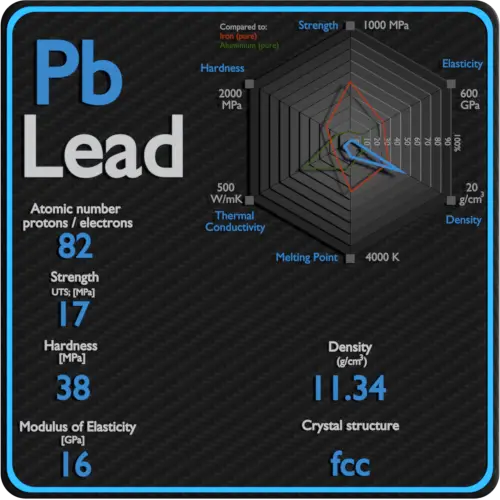
Atomic number 82
Element category Poor Metal
Phase at STP Solid
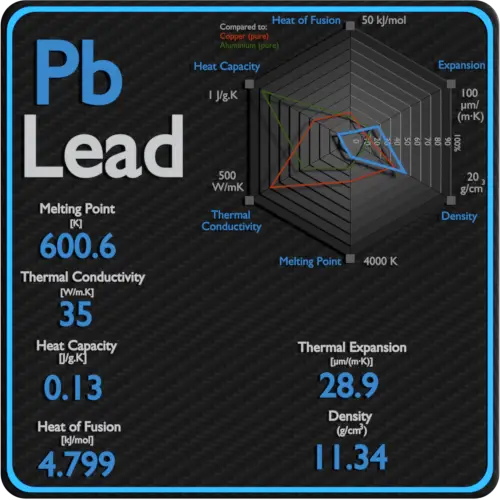
Density 11.34 g/cm3
Ultimate Tensile Strength 17 MPa
Yield Strength 5.5 MPa
Young’s Modulus of Elasticity 16 GPa
Mohs Scale 1.5
Brinell Hardness 38 MPa
Vickers Hardness N/A
Melting Point 327.5 °C
Boiling Point 1740 °C
Thermal Conductivity 35 W/mK
Thermal Expansion Coefficient 28.9 µm/mK
Specific Heat 0.13 J/g K
Heat of Fusion 4.799 kJ/mol
Heat of Vaporization 177.7 kJ/mol
Electrical resistivity [nanoOhm meter] 208
Magnetic Susceptibility −23e-6 cm^3/mol

Applications of Lead

Lead metal has several useful mechanical properties, including high density, low melting point, ductility, and relative inertness. Lead is widely used for car batteries, pigments, ammunition, cable sheathing, weights for lifting, weight belts for diving, lead crystal glass, radiation protection and in some solders. The largest use of lead in the early 21st century is in lead–acid batteries. The lead in batteries undergoes no direct contact with humans, so there are fewer toxicity concerns. Lead is used in high voltage power cables as sheathing material to prevent water diffusion into insulation; this use is decreasing as lead is being phased out. A lead is widely used as a gamma shield. Major advantage of lead shield is in its compactness due to its higher density. On the other hand depleted uranium is much more effective due to its higher Z. Depleted uranium is used for shielding in portable gamma ray sources.

Lead-applications

Production and Price of Lead

Raw materials prices change daily. They are primarily driven by supply, demand and energy prices. In 2019, prices of pure Lead were at around 15 $/kg.

As of 2014, production of lead is increasing worldwide due to its use in lead–acid batteries. There are two major categories of production: primary from mined ores, and secondary from scrap. In 2014, 4.58 million metric tons came from primary production and 5.64 million from secondary production. The top three producers of mined lead concentrate in that year were China, Australia, and the United States.

Lead-periodic-table

Source: www.luciteria.com

Mechanical Properties of Lead

Lead-mechanical-properties-strength-hardness-crystal-structure

Strength of Lead

In mechanics of materials, the strength of a material is its ability to withstand an applied load without failure or plastic deformation. Strength of materials basically considers the relationship between the external loads applied to a material and the resulting deformation or change in material dimensions. In designing structures and machines, it is important to consider these factors, in order that the material selected will have adequate strength to resist applied loads or forces and retain its original shape. Strength of a material is its ability to withstand this applied load without failure or plastic deformation.

For tensile stress, the capacity of a material or structure to withstand loads tending to elongate is known as ultimate tensile strength (UTS). Yield strength or yield stress is the material property defined as the stress at which a material begins to deform plastically whereas yield point is the point where nonlinear (elastic + plastic) deformation begins.

See also: Strength of Materials

Ultimate Tensile Strength of Lead

Ultimate tensile strength of Lead is 17 MPa.

Yield Strength of Lead

Yield strength of Lead is 5.5 MPa.

Modulus of Elasticity of Lead

The Young’s modulus of elasticity of Lead is 5.5 MPa.

Hardness of Lead

In materials science, hardness is the ability to withstand surface indentation (localized plastic deformation) and scratching. Brinell hardness test is one of indentation hardness tests, that has been developed for hardness testing. In Brinell tests, a hard, spherical indenter is forced under a specific load into the surface of the metal to be tested.

Brinell hardness of Lead is approximately 38 MPa.

The Vickers hardness test method was developed by Robert L. Smith and George E. Sandland at Vickers Ltd as an alternative to the Brinell method to measure the hardness of materials. The Vickers hardness test method can be also used as a microhardness test method, which is mostly used for small parts, thin sections, or case depth work.

Vickers hardness of Lead is approximately N/A.

Scratch hardness is the measure of how resistant a sample is to permanent plastic deformation due to friction from a sharp object. The most common scale for this qualitative test is Mohs scale, which is used in mineralogy. The Mohs scale of mineral hardness is based on the ability of one natural sample of mineral to scratch another mineral visibly.

Lead is has a hardness of approximately 1.5.

See also: Hardness of Materials

Lead – Crystal Structure

A possible crystal structure of Lead is face-centered cubic structure.

crystal structures - FCC, BCC, HCP

In metals, and in many other solids, the atoms are arranged in regular arrays called crystals. A crystal lattice is a repeating pattern of mathematical points that extends throughout space. The forces of chemical bonding causes this repetition. It is this repeated pattern which control properties like strength, ductility, density, conductivity (property of conducting or transmitting heat, electricity, etc.), and shape. There are 14 general types of such patterns known as Bravais lattices.

See also: Crystal Structure of Materials

Crystal Structure of Lead
Crystal Structure of Lead is: face-centered cubic

Strength of Elements

Elasticity of Elements

Hardness of Elements


Thermal Properties of Lead

Lead-melting-point-conductivity-thermal-properties

Lead – Melting Point and Boiling Point

Melting point of Lead is 327.5°C.

Boiling point of Lead is 1740°C.

Note that, these points are associated with the standard atmospheric pressure.

Lead – Thermal Conductivity

Thermal conductivity of Lead is 35 W/(m·K).

The heat transfer characteristics of a solid material are measured by a property called the thermal conductivity, k (or λ), measured in W/m.K. It is a measure of a substance’s ability to transfer heat through a material by conduction. Note that Fourier’s law applies for all matter, regardless of its state (solid, liquid, or gas), therefore, it is also defined for liquids and gases.

Coefficient of Thermal Expansion of Lead

Linear thermal expansion coefficient of Lead is 28.9 µm/(m·K)

Thermal expansion is generally the tendency of matter to change its dimensions in response to a change in temperature. It is usually expressed as a fractional change in length or volume per unit temperature change.

Lead – Specific Heat, Latent Heat of Fusion, Latent Heat of Vaporization

Specific heat of Lead is 0.13 J/g K.

Heat capacity is an extensive property of matter, meaning it is proportional to the size of the system. Heat capacity C has the unit of energy per degree or energy per kelvin. When expressing the same phenomenon as an intensive property, the heat capacity is divided by the amount of substance, mass, or volume, thus the quantity is independent of the size or extent of the sample.

Latent Heat of Fusion of Lead is 4.799 kJ/mol.

Latent Heat of Vaporization of Lead is 177.7 kJ/mol.

Latent heat is the amount of heat added to or removed from a substance to produce a change in phase. This energy breaks down the intermolecular attractive forces, and also must provide the energy necessary to expand the gas (the pΔV work). When latent heat is added, no temperature change occurs. The enthalpy of vaporization is a function of the pressure at which that transformation takes place.

Melting Point of Elements

Periodic Table of Elements - melting point

Thermal Conductivity of Elements

Periodic Table of Elements - thermal conductivity

Thermal Expansion of Elements

Periodic Table of Elements - thermal expansion

Heat Capacity of Elements

Periodic Table of Elements - heat capacity

Heat of Fusion of Elements

Periodic Table of Elements - latent heat fusion

Heat of Vaporization of Elements

Periodic Table of Elements - latent heat vaporization

Lead – Electrical Resistivity – Magnetic Susceptibility

Lead-electrical-resistivity-magnetic-susceptibility

Electrical property refers to the response of a material to an applied electric field. One of the principal characteristics of materials is their ability (or lack of ability) to conduct electrical current. Indeed, materials are classified by this property, that is, they are divided into conductors, semiconductors, and nonconductors.

See also: Electrical Properties

Magnetic property refers to the response of a material to an applied magnetic field. The macroscopic magnetic properties of a material are a consequence of interactions between an external magnetic field and the magnetic dipole moments of the constituent atoms. Different materials react to the application of magnetic field differently.

See also: Magnetic Properties

Electrical Resistivity of Lead

Electrical resistivity of Lead is 208 nΩ⋅m.

Electrical conductivity and its converse, electrical resistivity, is a fundamental property of a material that quantifies how Lead conducts the flow of electric current. Electrical conductivity or specific conductance is the reciprocal of electrical resistivity.

Magnetic Susceptibility of Lead

Magnetic susceptibility of Lead is −23e-6 cm^3/mol.

In electromagnetism, magnetic susceptibility is the measure of the magnetization of a substance. Magnetic susceptibility is a dimensionless proportionality factor that indicates the degree of magnetization of Lead in response to an applied magnetic field.

Electrical Resistivity of Elements

Periodic Table of Elements - electrical resistivity

Magnetic Susceptibility of Elements

Application and prices of other elements

Other properties of Lead


Thallium – Properties – Price – Applications – Production

Thallium-properties-price-application-production

About Thallium

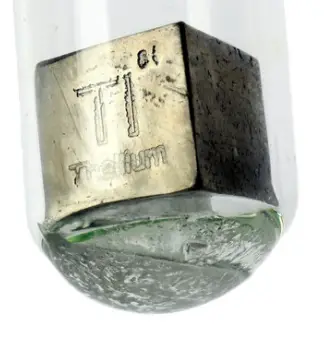
Thallium is a soft gray post-transition metal is not found free in nature. Commercially, thallium is produced as a byproduct from refining of heavy metal sulfide ores. Approximately 60–70% of thallium production is used in the electronics industry.

Summary

Element Thallium
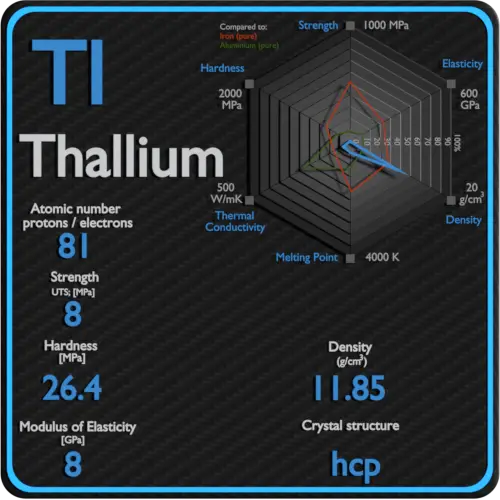
Atomic number 81
Element category Poor Metal
Phase at STP Solid
Density 11.85 g/cm3
Ultimate Tensile Strength 8 MPa
Yield Strength 4 MPa
Young’s Modulus of Elasticity 8 GPa
Mohs Scale 1.2
Brinell Hardness 26.4 MPa
Vickers Hardness N/A
Melting Point 303 °C
Boiling Point 1457 °C
Thermal Conductivity 46 W/mK
Thermal Expansion Coefficient 29.9 µm/mK
Specific Heat 0.13 J/g K
Heat of Fusion 4.142 kJ/mol
Heat of Vaporization 164.1 kJ/mol
Electrical resistivity [nanoOhm meter] 180
Magnetic Susceptibility −50.9e-6 cm^3/mol

Applications of Thallium

The use of thallium is limited as it is a toxic element. Thallium is rarely used, with the exception of the manufacture of special grades of glass. In the past, Thallium compounds found applications as diverse as rat poisons and hair restorers! Most thallium is used by the electronics industry in photoelectric cells. Thallium oxide is used to produce special glass with a high index of refraction, and also low melting glass that becomes fluid at about 125K.

Thallium-applications

Production and Price of Thallium

Raw materials prices change daily. They are primarily driven by supply, demand and energy prices. In 2019, prices of pure Thallium were at around 480 $/kg.

Thallium is found in the minerals crookesite TlCu7Se4, hutchinsonite TlPbAs5S9, and lorándite TlAsS2. Thallium also occurs as a trace element in iron pyrite, and thallium is extracted as a by-product of roasting this mineral for the production of sulfuric acid. Thallium can also be obtained from the smelting of lead and zinc ores.

Thallium-periodic-table

Source: www.luciteria.com

Mechanical Properties of Thallium

Thallium-mechanical-properties-strength-hardness-crystal-structure

Strength of Thallium

In mechanics of materials, the strength of a material is its ability to withstand an applied load without failure or plastic deformation. Strength of materials basically considers the relationship between the external loads applied to a material and the resulting deformation or change in material dimensions. In designing structures and machines, it is important to consider these factors, in order that the material selected will have adequate strength to resist applied loads or forces and retain its original shape. Strength of a material is its ability to withstand this applied load without failure or plastic deformation.

For tensile stress, the capacity of a material or structure to withstand loads tending to elongate is known as ultimate tensile strength (UTS). Yield strength or yield stress is the material property defined as the stress at which a material begins to deform plastically whereas yield point is the point where nonlinear (elastic + plastic) deformation begins.

See also: Strength of Materials

Ultimate Tensile Strength of Thallium

Ultimate tensile strength of Thallium is 8 MPa.

Yield Strength of Thallium

Yield strength of Thallium is 4 MPa.

Modulus of Elasticity of Thallium

The Young’s modulus of elasticity of Thallium is 4 MPa.

Hardness of Thallium

In materials science, hardness is the ability to withstand surface indentation (localized plastic deformation) and scratching. Brinell hardness test is one of indentation hardness tests, that has been developed for hardness testing. In Brinell tests, a hard, spherical indenter is forced under a specific load into the surface of the metal to be tested.

Brinell hardness of Thallium is approximately 26.4 MPa.

The Vickers hardness test method was developed by Robert L. Smith and George E. Sandland at Vickers Ltd as an alternative to the Brinell method to measure the hardness of materials. The Vickers hardness test method can be also used as a microhardness test method, which is mostly used for small parts, thin sections, or case depth work.

Vickers hardness of Thallium is approximately N/A.

Scratch hardness is the measure of how resistant a sample is to permanent plastic deformation due to friction from a sharp object. The most common scale for this qualitative test is Mohs scale, which is used in mineralogy. The Mohs scale of mineral hardness is based on the ability of one natural sample of mineral to scratch another mineral visibly.

Thallium is has a hardness of approximately 1.2.

See also: Hardness of Materials

Thallium – Crystal Structure

A possible crystal structure of Thallium is hexagonal close-packed structure.

crystal structures - FCC, BCC, HCP

In metals, and in many other solids, the atoms are arranged in regular arrays called crystals. A crystal lattice is a repeating pattern of mathematical points that extends throughout space. The forces of chemical bonding causes this repetition. It is this repeated pattern which control properties like strength, ductility, density, conductivity (property of conducting or transmitting heat, electricity, etc.), and shape. There are 14 general types of such patterns known as Bravais lattices.

See also: Crystal Structure of Materials

Crystal Structure of Thallium
Crystal Structure of Thallium is: hexagonal close-packed

Strength of Elements

Elasticity of Elements

Hardness of Elements


Thermal Properties of Thallium

Thallium-melting-point-conductivity-thermal-properties

Thallium – Melting Point and Boiling Point

Melting point of Thallium is 303°C.

Boiling point of Thallium is 1457°C.

Note that, these points are associated with the standard atmospheric pressure.

Thallium – Thermal Conductivity

Thermal conductivity of Thallium is 46 W/(m·K).

The heat transfer characteristics of a solid material are measured by a property called the thermal conductivity, k (or λ), measured in W/m.K. It is a measure of a substance’s ability to transfer heat through a material by conduction. Note that Fourier’s law applies for all matter, regardless of its state (solid, liquid, or gas), therefore, it is also defined for liquids and gases.

Coefficient of Thermal Expansion of Thallium

Linear thermal expansion coefficient of Thallium is 29.9 µm/(m·K)

Thermal expansion is generally the tendency of matter to change its dimensions in response to a change in temperature. It is usually expressed as a fractional change in length or volume per unit temperature change.

Thallium – Specific Heat, Latent Heat of Fusion, Latent Heat of Vaporization

Specific heat of Thallium is 0.13 J/g K.

Heat capacity is an extensive property of matter, meaning it is proportional to the size of the system. Heat capacity C has the unit of energy per degree or energy per kelvin. When expressing the same phenomenon as an intensive property, the heat capacity is divided by the amount of substance, mass, or volume, thus the quantity is independent of the size or extent of the sample.

Latent Heat of Fusion of Thallium is 4.142 kJ/mol.

Latent Heat of Vaporization of Thallium is 164.1 kJ/mol.

Latent heat is the amount of heat added to or removed from a substance to produce a change in phase. This energy breaks down the intermolecular attractive forces, and also must provide the energy necessary to expand the gas (the pΔV work). When latent heat is added, no temperature change occurs. The enthalpy of vaporization is a function of the pressure at which that transformation takes place.

Melting Point of Elements

Periodic Table of Elements - melting point

Thermal Conductivity of Elements

Periodic Table of Elements - thermal conductivity

Thermal Expansion of Elements

Periodic Table of Elements - thermal expansion

Heat Capacity of Elements

Periodic Table of Elements - heat capacity

Heat of Fusion of Elements

Periodic Table of Elements - latent heat fusion

Heat of Vaporization of Elements

Periodic Table of Elements - latent heat vaporization

Thallium – Electrical Resistivity – Magnetic Susceptibility

Thallium-electrical-resistivity-magnetic-susceptibility

Electrical property refers to the response of a material to an applied electric field. One of the principal characteristics of materials is their ability (or lack of ability) to conduct electrical current. Indeed, materials are classified by this property, that is, they are divided into conductors, semiconductors, and nonconductors.

See also: Electrical Properties

Magnetic property refers to the response of a material to an applied magnetic field. The macroscopic magnetic properties of a material are a consequence of interactions between an external magnetic field and the magnetic dipole moments of the constituent atoms. Different materials react to the application of magnetic field differently.

See also: Magnetic Properties

Electrical Resistivity of Thallium

Electrical resistivity of Thallium is 180 nΩ⋅m.

Electrical conductivity and its converse, electrical resistivity, is a fundamental property of a material that quantifies how Thallium conducts the flow of electric current. Electrical conductivity or specific conductance is the reciprocal of electrical resistivity.

Magnetic Susceptibility of Thallium

Magnetic susceptibility of Thallium is −50.9e-6 cm^3/mol.

In electromagnetism, magnetic susceptibility is the measure of the magnetization of a substance. Magnetic susceptibility is a dimensionless proportionality factor that indicates the degree of magnetization of Thallium in response to an applied magnetic field.

Electrical Resistivity of Elements

Periodic Table of Elements - electrical resistivity

Magnetic Susceptibility of Elements

Application and prices of other elements

Thallium - Comparison of Properties and Prices

Periodic Table in 8K resolution

Other properties of Thallium